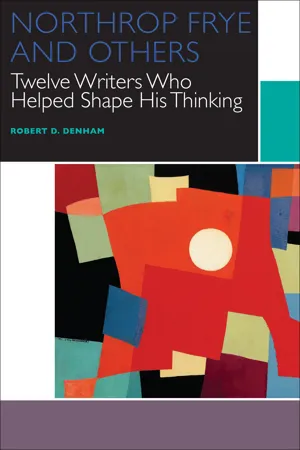
Eminent Northrop Frye scholar Robert D. Denham explores the connection between Frye and twelve writers who influenced his thinking but about whom he didn't write anything expansive. Denham draws especially on Frye's notebooks and other previously unpublished texts, now available in the Collected Works of Frye. Such varied thinkers as Aristotle, Lewis Carroll, Søren Kierkegaard, and Paul Tillich emerge as important figures in defining Frye's cross-disciplinary interests. Eventually, the twelve "Others" of the title come to represent a space occupied by writers whose interests paralleled Frye's and helped to establish his own critical universe.
- 304 pages
- English
- ePUB (mobile friendly)
- Available on iOS & Android
eBook - ePub
Northrop Frye and Others
About this book
Information
Topic
LiteraturaSubtopic
Crítica literaria norteamericana1
Frye and Aristotle
Aristotle’s Poetics is the most influential critical work in the Western tradition. Northrop Frye’s Anatomy of Criticism is the most influential critical work of the last century. How are the two connected? Two of Frye’s early theoretical essays — “A Conspectus of Dramatic Genres” (1951) and “Towards a Theory of Cultural History” (1953) — begin with Aristotle: the first quotes the opening paragraph of the Poetics (CW 21: 104), and the second refers us to what Aristotle says about character in chapter 2 (CW 21: 150). When Frye writes in “The Archetypes of Literature” that we need a “new poetics” (CW 21: 124), he clearly has Aristotle in mind: he wants to do for his own time what Aristotle had done for posterity. And at the very beginning of the Anatomy, Frye announces that by following in Aristotle’s footsteps he is undertaking a twentieth-century Poetics:
A theory of criticism whose principles apply to the whole of literature and account for every valid type of critical procedure is what I think Aristotle meant by poetics. Aristotle seems to me to approach poetry as a biologist would approach a system of organisms, picking out its genera and species, formulating the broad laws of literary experience, and in short writing as though he believed that there is a totally intelligible structure of knowledge attainable about poetry which is not poetry itself, or the experience of it, but poetics. One would imagine that, after two thousand years of post-Aristotelian literary activity, his views on poetics, like his views on the generation of animals, could be re-examined in the light of fresh evidence. Meanwhile, the opening words of the Poetics, in the Bywater translation, remain as good an introduction to the subject as ever, and describe the kind of approach that I have tried to keep in mind for myself. (CW 22: 16)
The Poetics comes to us circuitously — through an eleventh-century manuscript, now at the Bibliothèque Nationale, a thirteenth- or fourteenth-century manuscript, a Syriac translation from the Greek, and an Arabic translation from the Syriac, both from the tenth century. The earliest extant manuscript of the Poetics, then, is separated from its origin by more than a millennium. It is a fragmentary and corrupted text, and what has come down to us was composed perhaps by one of Aristotle’s students, who, some have speculated, appears to have dozed off at certain key points. So the question of what Aristotle actually said or wrote cannot be answered with any certainty. But from the text we have (and we are naturally dependent on the agendas of the various translators), it is by no means clear that “poetics” for Aristotle, according to Frye, meant a “theory of criticism whose principles apply to the whole of literature and account for every valid type of critical procedure.” The extant portions of the original text reveal a much more focused objective. The first paragraph sets the parameters. Aristotle proposes to discuss the art of poetry itself, as opposed to poetry in relation to other things. In other words, he brackets out a host of critical questions, such as those having to do with the poet’s creative process or with the reader’s response or with the social and political function of poetry. He believes there are various poetic species, each with its own particular power or quality (dynamis). He is interested in how poems are constructed, and in the making of poems, plot is singled out as especially important. He wants to enumerate the kinds of poetic parts, which, we discover, turn out to be both quantitative (prologue, exode, etc.) and qualitative (plot, character, thought, etc.). And he wants to begin with “the principles which come first,” meaning apparently the antecedent conditions of making. Where Frye derives the idea that Aristotle’s principles are intended to “apply to the whole of literature” is uncertain. In his second paragraph, Aristotle restricts his treatise to most forms of epic and dithyrambic poetry and of tragic and comic drama, and his subject is restricted even more to those that “happen to be imitations,” the implication being that some poetic works happen not to be imitations.8
Frye is not unaware of most of these matters, having devoted a great deal of concentrated attention to the Poetics for more than sixty years. It seems unlikely that he knew much about Aristotle before arriving at Victoria College as a seventeen-year-old in 1929, but once he was accepted into the Honours curriculum in philosophy (English or history option) during his second year he would have read Aristotle in several courses. For his last three years he enrolled in courses in ethics (two courses), philosophical texts, history of philosophy, types of aesthetic theory, and modern philosophy. His transcript identifies his first course in Honours Philosophy only as “Phil.,” so it is impossible to know from this record which of the first- or second-year courses (ethics, logic, history of philosophy) he elected. The University of Toronto Calendar does not provide reading lists for all of Frye’s courses, but the lists that are supplied do naturally include Aristotle. And Frye would have encountered Aristotle in the secondary readings for these courses, listed as “references” in the Calendar. We know, for example, that Frye read Wilhelm Windelband’s History of Philosophy the summer before his fourth year at Victoria, or at least began reading it (CW 1: 66), and he used Windelband in his fourth-year paper on Romanticism (CW 3: 477). His student papers also cite histories of philosophy by Ueberweg and Erdmann (CW3: 250). While we do not have a very complete record of which Aristotelian texts Frye read as a student, in the dozen-and-a-half references to Aristotle in the student essays that have survived, it is clear that he was familiar with the Poetics and the Politics. We also know that during his first year of teaching at Victoria (1937–38), Frye, who was twenty-five at the time, lectured on Aristotle to first-year students.9 Five years later Aristotle crops up in one of Frye’s many resolutions for intellectual self-improvement: “What I do now is learn some German and set up the seven pillars of wisdom — Homer, Aeschylus, Sophocles, Euripides, Aristophanes, Plato & Aristotle — in my own backyard” (CW 15: 15). In the early explorations for the shape of the book that would follow Fearful Symmetry, Frye planned to devote the seventh chapter of the book to Renaissance Platonism. This chapter, Frye writes in the late 1940s, would include material on “Plato as a dramatist & as a ‘rhetorical’ stick to beat the ‘logical’ Aristotle.… Aristotle himself transformed into a literary critic by the revival of the Poetics” (CW 15: 50). Frye’s interest in the Poetics was no doubt spurred by his encounter with the Chicago Neo-Aristotelians. He had heard R. S. Crane lecture at Toronto in 1952, had reviewed the Chicagoans’ Critics and Criticism and Crane’s The Languages of Criticism and the Structure of Poetry in 1954, and in 1955 had lectured at Chicago, where he encountered Elder Olson and other members of the so-called Neo-Aristotelian school.10
In 1954 we find Frye teaching Aristotle’s Poetics in a course in literary criticism. Margaret (née Kell) Virany’s forty-two pages of class notes give a fairly detailed record of Frye’s lectures in this course.11 His reading of Aristotle over the years was fairly wide. Throughout his writing he either quotes from or refers to the Poetics, Metaphysics, Nicomachean Ethics, Physics, Rhetoric, Politics, Analytics, and On the Soul. He also refers to Aristotle’s treatise on biology, apparently the Parts of Animals. One of the features of Frye’s writing is the appearance of aperçus that he had picked up in his reading of poets or philosophers or critics. These insights, often signalled by a single word, then get repeated over and over in his writing. Examples include Kierkegaard’s “repetition,” Joachim of Floris’s “three ages,” Hegel’s “Aufhebung,” Plato’s commonwealth as an allegory of the wise man’s mind, and Samuel Butler’s “practice-memory.” There are scores of these catchwords and several are from Aristotle, such as “rhetoric is the antistrophos of dialectic” — a line that gets repeated a dozen times from 1954 to 1990. Similarly, such Aristotelian ideas as proairesis (moral character), hexis (state, disposition, habit), and telos (end, purpose) recur time and again.
“Literary criticism,” Frye tells his students at the beginning of the 1954 course, “is one of the hardest types of all literary writing. The world has seen only a few good literary critics.” The course was listed as Greek and Latin Literature, but apparently instructors could tailor the course to meet their own interests. In any event, Frye devoted the course to the major critical figures — Plato, Aristotle, Horace, Longinus, and Quintilian, with glances at Aristophanes, Theophrastus, Isocrates, Terence, Laertius, Lucilius, Neoptolemus of Parium, Philodemus of Gadara, Aristarchus of Samothrace, and Dionysius of Halicarnassus.12 The course met one hour per week for twelve weeks. Frye allocated three full lectures and portions of two other lectures to Aristotle, which was close to a third of the course — about 30 percent of Virany’s notes. Her notes on Aristotle are reproduced in the Appendix to the present chapter.
LUMPERS AND SPLITTERS
My intent now is to examine Frye’s debt to Aristotle as it manifests itself throughout his writing, using Virany’s class notes when they can help to elaborate his views or define his own critical position.13 Not long after he taught the literary criticism course, Frye wrote in one of his notebooks,
Aristotle seems to me unique among philosophers, not only in dealing specifically with poetics, but in assuming that such poetics would be an organon of a specific discipline. Other philosophers, when they touch on the arts, deal in questions of general aesthetics which they make a set of analogies to their logical & metaphysical views; hence it is difficult to use the aesthetics of, say, Kant or Hegel without getting involved in a Kantian or Hegelian “position,” which of course is the opposite of what I am here attempting to do. (CW 23: 267)
Frye’s “here” refers to the notes he is making for Anatomy of Criticism. The distinction is between what George Simpson calls “lumpers” and “splitters.” A lumper like Plato can bring any subject matter into whatever he or she happens to be discuss...
Table of contents
- Cover
- Title Page
- Copyright
- Contents
- Introduction
- Abbreviations
- 1. Frye and Aristotle
- 2. Frye and Longinus
- 3. Frye and Joachim of Floris
- 4. Frye and Giordano Bruno
- 5. Frye and Henry Reynolds
- 6. Frye and Robert Burton
- 7. Frye and Søren Kierkegaard
- 8. Frye and Lewis Carroll
- 9. Frye and Stéphane Mallarmé
- 10. Frye and Colin Still
- 11. Frye and Paul Tillich
- 12. Frye and Frances A. Yates
- Notes
- Works Cited
- Index
Trusted by 375,005 students
Access to over 1.5 million titles for a fair monthly price.
Study more efficiently using our study tools.
Frequently asked questions
Yes, you can cancel anytime from the Subscription tab in your account settings on the Perlego website. Your subscription will stay active until the end of your current billing period. Learn how to cancel your subscription
No, books cannot be downloaded as external files, such as PDFs, for use outside of Perlego. However, you can download books within the Perlego app for offline reading on mobile or tablet. Learn how to download books offline
Perlego offers two plans: Essential and Complete
- Essential is ideal for learners and professionals who enjoy exploring a wide range of subjects. Access the Essential Library with 800,000+ trusted titles and best-sellers across business, personal growth, and the humanities. Includes unlimited reading time and Standard Read Aloud voice.
- Complete: Perfect for advanced learners and researchers needing full, unrestricted access. Unlock 1.5M+ books across hundreds of subjects, including academic and specialized titles. The Complete Plan also includes advanced features like Premium Read Aloud and Research Assistant.
We are an online textbook subscription service, where you can get access to an entire online library for less than the price of a single book per month. With over 1.5 million books across 990+ topics, we’ve got you covered! Learn about our mission
Look out for the read-aloud symbol on your next book to see if you can listen to it. The read-aloud tool reads text aloud for you, highlighting the text as it is being read. You can pause it, speed it up and slow it down. Learn more about Read Aloud
Yes! You can use the Perlego app on both iOS and Android devices to read anytime, anywhere — even offline. Perfect for commutes or when you’re on the go.
Please note we cannot support devices running on iOS 13 and Android 7 or earlier. Learn more about using the app
Please note we cannot support devices running on iOS 13 and Android 7 or earlier. Learn more about using the app
Yes, you can access Northrop Frye and Others by Robert D. Denham in PDF and/or ePUB format, as well as other popular books in Literatura & Crítica literaria norteamericana. We have over 1.5 million books available in our catalogue for you to explore.