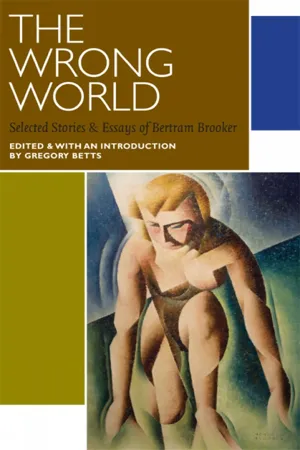
Bertram Brooker won the country's first Governor General's Award for literature in 1936 for his novel Think of the Earth, and his explosive, experimental paintings hang in every major gallery in the country. He was Canada's first multidisciplinary avantgardist, successfully experimenting in literature, visual arts, film, and theatre. Brooker brought all of his experimental ambitions to his short fiction and prose. The Wrong World presents a rich sampling of his prose work, much of it previously unpublished, which adds new insight into his aesthetic ambitions. Working during an incredible period of transition in Canadian society, Brooker's stories document Canada's evolution from a provincial colony into a modern, urban country. His essays participated in that evolution by advocating a passionate awakening of the arts, the end of prudish sentiment and censorship, and a radical rethinking of the nature of war. They capture the limitations and hypocrisies of the Canadian social contract and argue for a more just and spiritual society. His stories humanize his social vision by dramatizing the psychological and emotional cost of Canada's transition into a modern civilization. In turn devastating, penetrating and poignant, Brooker's prose works offer a sharply focussed window into the turbulent interwar years in Canada.
- 340 pages
- English
- ePUB (mobile friendly)
- Available on iOS & Android
eBook - ePub
The Wrong World
About this book
Information
Index
LiteratureTextual Chronology and Editorial Procedures
The prose works in this edition are divided into three sections: Short Fiction, The Wrong World, and Essays and Polemics. The texts that comprise the first and third sections are subsequently arranged according to the chronology of the period depicted. As few of the pieces in this collection have been previously published, it was decided that the edition would not distinguish between published and previously unpublished works. In any event, the unpublished works are as strong as—and in many ways, more interesting than—the published work. Chronology poses its own problems: Brooker produced or typeset many of the eight short stories in this collection during the same period while living in Toronto at the same address while using the same typewriter. As he rarely dated his work, it is not possible to determine or infer the exact order of composition for some of the fiction. Instead, the chronology of the events depicted in the stories was chosen to organize the texts in this edition. In contrast to the fiction, Brooker left enough evidence to construct a more precise chronology of the eight non-fiction works, which were produced over a longer period of time—a quarter of a century. These texts all include direct references and responses to historical events and publications, corroborating the composition chronology. In the particular non-fiction texts included in this edition, by a convenient coincidence, the chronology of composition is the same as the period represented or discussed in the work. As a result of Brooker’s interest in current affairs, the worlds depicted in the first and third sections of the book share a similar, linear march through time, both starting in the prairies at the turn of the century, and ending up in Toronto before the Second World War.
The seventeen titles included in this edition were selected from Brooker’s archival collections, which include nearly one hundred unpublished works of short fiction and non-fiction, alongside thousands of pages of writing in various genres and formats ranging from utterly experimental to entirely banal. The selections were chosen based on a combination of the available evidence of completion (manuscript versus printed format, multiple drafts, submission for publication, or publication) and the more subjective literary merit of the work. As a result, numerous dimensions to Brooker’s complex oeuvre—his children’s stories, his experimental fictional autobiographies, and his numerous hardboiled detective stories—are not included or represented in this edition.
In general, the latest version of a given work was chosen as the copy-text. Manuscripts for the unpublished material come from two sources: the Bertram Brooker collection in the Elizabeth Dafoe Library of University of Manitoba and the personal archives of the Bertram Brooker estate. For the stories “Head Waitress” and “Bad Order”, and the essays “The Spread of Negativism”, “The Decay of Art”, “The Price of Peace”, and “Free Prose” there exists only one extant manuscript each. The stories “Like Old Jehovah”, “The Gilliland House”, “A Glass of Catawba”, and The Wrong World have two versions each: an original typeset manuscript and a carbon copy with either handset or typeset emendations. For instances where the variant archival versions follow a clear chronological pattern of editing, the choice of copy-text was uncomplicated. In contrast, Brooker appears to have produced multiple versions of “Youth’s Manuscript” and “To All the Nations ….!” Of the former, three editions exist—identifiable by the physical markers on the cover pages as “26 Pages”, “Three Boxes”, and “Unmarked”. Dates and a precise chronology are not available, but the pattern of textual deletions suggests that “26 Pages” is the oldest version, edited down to the “Three Boxes” version, which, in turn, was edited down to the “Unmarked” edition. While it remains possible that the sequence goes the other way, and that the additional passages were inserted with each new version—the strength of the final draft and the relative weakness of the deleted parts suggest my chronology. Furthermore, a handwritten note on “26 Pages” reads “Not revised”, suggesting that it is, indeed, the first draft. In the case of “To All the Nations ….!” multiple versions of the manuscript versions are extant but parts of all have been lost. As a result, there are overlapping sections of the texts without a clear indication of chronology or finality. In other words, with the chronology confounded and significant portions of the variants missing, a stemma of versions is impossible to establish at this point in time. In this case, the two typeset versions were combined and chosen as copy-text and a transcription provided of the other pages. Without a clear indication of chronology, however, and despite the dangers and limitations of such an approach, it should be made clear that the copy-text ultimately was selected based on the principle of coherence and readability. All variants are, of course, recorded in the textual notes.
Things are only slightly more complicated with the previously published works. The excerpt from The Tangled Miracle, for instance, is based on the author’s proof in the University of Manitoba archives, which was unchanged and unedited in the final book form (confirmed by the published copy in the Thomas Fisher Rare Books Library at the University of Toronto). Similarly, no variant texts exist in the archives for “When We Awake!” However, in the case of “Mrs. Hungerford’s Milk”, the story exists in two published forms, once in his lifetime, and once posthumously, as well as one unpublished manuscript form. Given that the text was published by the Toronto-based Canadian Forum, edited by his friend and fellow mystic Barker Fairley, there seems no reason to suggest that the first published version is unreliable in any way. As such, the first published version of the story functions as the copy-text here. Similarly, “Prophets Wanted” was published but once, and has only one archived manuscript, therefore the published version was chosen as copy-text.
Finally, things are at their most complicated for this edition with Brooker’s essay “Nudes and Prudes”. The article was first published in 1931 by Brooker’s close friend William Arthur Deacon (whom he praises in the article itself) in a collection of essays called Open House. The article was reprinted in Douglas Fetherling’s Documents in Canadian Art (1987), and more recently appeared online on arthistoryarchive.com (edited by Charles Moffat, and with an introduction by David Helwig). The complication comes from the fact that, while Fetherling used the Open House version, Charles Moffat chose an archived manuscript version as copy-text instead. The differences between the two versions are substantial as the published version excised the names of individuals and galleries responsible for censorship in Toronto. This information was subsequently restored by Moffat based on the manuscript version of the article in the University of Manitoba archives. The problematic information was likely removed for political and social expedience, even though the Open House version was published by a sympathetic friend. In his letter on 17 April 1931, Deacon writes Brooker to say, “if you and I are to stand together on this issue [censorship]—why we had better stand as close as possible.” Still, the impetus for censoring the anti-censorship article seems to come from the editor: “Is it necessary to hit Gus so cruelly, and him an old man? Perhaps we’ll never get anywhere if we stop for things like that. I hate to hit an old man; but he does do a lot of harm. About libel?? Will he??”
Despite the fact that Brooker was at least nominally involved in the editorial process, and that this was the only version published in his lifetime, because of the historical significance of the excised material, and further because the social sensitivity that once merited consideration no longer exists, the archival manuscript version will serve as the copy-text here. The online version differs only subtly, mostly as a result of typos, from the archival version.
This accounts for all cases of substantive differences, that is, the actual wording, among the variant texts. Given that Brooker occasionally deployed neologisms or deliberate errors, and was decidedly ambiguous on his preference of national orthography, most instances of the so-called accidentals, that is spelling, punctuation, paragraphing, and capitalization, are left unchanged. In a few instances, typographical errors, spelling inconsistencies, and the handful of distinctly Canadian spellings that we have finally embraced both broadly and coherently have been corrected—all of which are listed in the textual notes.
Explanatory Notes
The explanatory notes provide additional information to the numerous cultural and geographic allusions characteristic of Brooker’s writing. The kinds of...
Table of contents
- Contents
- Acknowledgments
- Introduction
- Short Fiction
- The Wrong World
- Essays and Polemics
- Textual Chronology And Editorial Procedures
Trusted by 375,005 students
Access to over 1.5 million titles for a fair monthly price.
Study more efficiently using our study tools.
Frequently asked questions
Yes, you can cancel anytime from the Subscription tab in your account settings on the Perlego website. Your subscription will stay active until the end of your current billing period. Learn how to cancel your subscription
No, books cannot be downloaded as external files, such as PDFs, for use outside of Perlego. However, you can download books within the Perlego app for offline reading on mobile or tablet. Learn how to download books offline
Perlego offers two plans: Essential and Complete
- Essential is ideal for learners and professionals who enjoy exploring a wide range of subjects. Access the Essential Library with 800,000+ trusted titles and best-sellers across business, personal growth, and the humanities. Includes unlimited reading time and Standard Read Aloud voice.
- Complete: Perfect for advanced learners and researchers needing full, unrestricted access. Unlock 1.5M+ books across hundreds of subjects, including academic and specialized titles. The Complete Plan also includes advanced features like Premium Read Aloud and Research Assistant.
We are an online textbook subscription service, where you can get access to an entire online library for less than the price of a single book per month. With over 1.5 million books across 990+ topics, we’ve got you covered! Learn about our mission
Look out for the read-aloud symbol on your next book to see if you can listen to it. The read-aloud tool reads text aloud for you, highlighting the text as it is being read. You can pause it, speed it up and slow it down. Learn more about Read Aloud
Yes! You can use the Perlego app on both iOS and Android devices to read anytime, anywhere — even offline. Perfect for commutes or when you’re on the go.
Please note we cannot support devices running on iOS 13 and Android 7 or earlier. Learn more about using the app
Please note we cannot support devices running on iOS 13 and Android 7 or earlier. Learn more about using the app
Yes, you can access The Wrong World by Bertram Brooker, Gregory Betts in PDF and/or ePUB format, as well as other popular books in Literature & North American Literary Collections. We have over 1.5 million books available in our catalogue for you to explore.