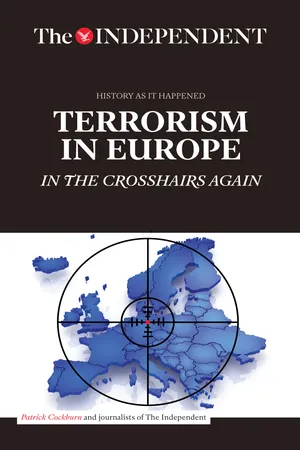
Europe is facing an unprecedented and growing terror threat as homegrown extremists inspired by jihadis and an Islamic State squeezed by the West are desperate to attack outside the 'caliphate'. Terrorism in Europe: In the Crosshairs, examines this extreme threat to Europe through a collection of articles by journalists of The Independent.
- English
- ePUB (mobile friendly)
- Available on iOS & Android
eBook - ePub
About this book
Information
Subtopic
TerrorismoCHAPTER 1
TERRORISM
MORE DEADLY IN THE 1970s & 80s

Source: Statista from Global Terrorism Database.
Sunday, 11 January 2015
SAME STORY, DIFFFERENT ACTORS
They say that those who do not know history are condemned to repeat it. The “Charlie Hebdo” atrocities of last week are many things; frightening, terrifying, atrocious, a horror, an attack on what we stand for. But, as a phenomenon they are not new, or exceptional or uniquely Muslim.
You do not have to be a young Muslim living in the 21 century to be subject to radicalisation. It has always, down the ages been possible to persuade young men (and a few – a very few young women) of all faiths and none to the believe that is noble to kill innocent people in pursuit of what they have been persuaded is a great cause. As far back as the first century, the Jewish Zealots did it against Roman rule. In the 11 century the Shia Muslim Hashashin added another word – assassin – to our vocabulary of terror by their attacks on the Persian Government of the day. In our own time we have had to deal with our own “home grown” so called “Catholic” terrorists of the IRA (who by the way killed and destroyed far more than the current wave of jihadist outrages) – as well as the outrages perpetrated by the anti-imperialist urban terrorism of young middle class white Germans in the Bader-Meinhof Gang and its successor the Rot Armee Fraktion.
Perhaps the closest parallel to what we are seeing now is the Anarchist movement of the late nineteenth and early twentieth century. All entirely “home grown” and without any kind of formal command structures, they too were a collection of “lone wolves” inspired by texts and prepared to kill and maim to abolish states and replace them with borderless self-governed entities which, leaving aside that they were based on a political idea rather than a religious one, bear a striking similarity to the caliphate model of today.
In pursuit of what they called “the propaganda of the deed”, they too killed and maimed by bomb and gun, large numbers of innocents – as well as an extraordinary number of the most powerful and prominent. On June 2 1919 simultaneous bombs attacks in New York, Boston, Pittsburgh, Cleveland and Patterson in New Jersey killed a mayor, a state legislator, three judges, two businessmen a policeman and a catholic priest. A year later perhaps the earliest “car bomb” blew up outside Wall Street killing 39 and injuring hundreds more. These were no more than the last lethal splutterings of a spate of anarchist attacks which had been going on for more than 30 years. In 1893 an anarchist bomb in Barcelona’s opera house killed or injured 72. That same year, a hungry, vagabond, socially outcast Frenchman threw a bomb into the French Chamber of Deputies. A year later another Frenchman threw a bomb hidden in a lunch box into a café killing or wounding more than 20 perfectly innocent diners. He died shouting “We who hand out death know how to take it”.
Among the very ordinary casualties of the “anarchist years”, were also some very prominent ones, too. Those assassinated included a US President, a Russian Tsar, the empress of Austria, the President of France, the King of Spain on his wedding day, the heir to the Austrian empire on the corner of a Sarajevo street, the King of Italy and countless European Ministers of the Interior.
Then, too as now the security forces complained they needed more powers to tackle the threat. After a bomb in the city, the Chicago police, even went so far as to recycle the same piece of gas piping as evidence to support the fact that they had “foiled” three subsequent bomb outrages.
None of this of course is to say that recent events are not serious. Or that we are not under threat. Or that we do not now have to respond in a serious and thoughtful manner.
But if we are to react as we should, then it is as well to remember that what we face is NOT new. And it is not unique and it is not just Islamic and we have been through this before and we should not panic or over-react. Almost every recent generation has had to respond to these kind of phenomenon.
And almost every recent generation has managed to do so without fundamentally undermining our freedoms or setting our societies at war with themselves.
It is worth recalling that throughout those same bloody anarchist years around the end of the nineteenth century, the long march towards the European ideal of states founded on individual liberty, tolerance and human rights, continued unchecked. Defending the Charlie Hebdo principle means refusing to allow either terrorism or our fear of it to deflect us from that path.
Paddy Ashdown
Monday, 25 July 2016
CAUSES RARELY SIMPLE
Everyone remembers great headlines. They also recall, with re-lived astonishment, the terrible ones. The Sun has probably provided more than its fair share of the former, but also a few of the latter. A memorable example to have sparked outrage reported that the boxer Frank Bruno had been taken to a psychiatric hospital: “Bonkers Bruno Locked Up”. For good measure, the story that followed described Bruno as a “nut”.
In the years that followed that 2003 error of judgement, media coverage of mental health was subjected to considerable scrutiny. It also improved significantly. Prejudicial descriptions of people suffering mental ill-health – “nutter”, “bonkers”, “loony” – began to lose their prominence in the tabloid lexicon. Vitally, the media came to a better understanding that mental illness and violence are not inextricably linked. Scare stories that lead readers into thinking that any person diagnosed with schizophrenia is probably a killer in waiting have become relatively rare.
The avoidance of stereotypes is back on the agenda after the raft of acts of violence across Europe in recent months. Today, the most likely reaction when we hear about a shooting or stabbing or other atrocity is to wonder if religion has played a part. If the perpetrator turns out to be a Muslim, the assumption is that he or she must – to one degree or another – have been inspired by Isis or guided by their faith.
I wrote last week about the initial reporting of an attack on French tourists in the Alps. The alleged perpetrator was said to be Moroccan-born and to have acted because his alleged victims – a woman and her daughter – were wearing skimpy clothes. Those details alone were enough to lead some to conclude an Islamist motive, though the claim about offence having been caused by the women’s attire was quickly dismissed.
After I wrote about the case, further information emerged that suggested the man might have taken offence at a gesture made by the victim’s husband. And it was said that when questioned by police, the suspect shouted “Allahu Akbar” – though his defence lawyer told local media that his client had used the words simply because he felt oppressed during his interrogation.
So will religion prove to be the underlying motivation in this case? Maybe. Maybe not. Ultimately, though, it felt like a relatively uncontroversial thing to suggest last week that we should be cautious about linking religious belief to violence until we are confident that that there really is a causal connection. It’s nothing more than the hallmark of good journalism.
Over the weekend, one Twitter user took me to task, however, for being on the side of “Islamopsychotics”, and for defending them “to the end with the mantra of whoever complains is Islamophobic”. Putting to one side the modest overreaction, I was struck by the use of the term “Islamopsychotics”, which seemed to combine several stereotypes in one.
On the face of it, the term seems self-contradictory. If a person is suffering a psychosis, they might not be criminally responsible for their actions, and so their religion per se as a motivation becomes irrelevant, except insofar as their radical interpretation of it is held to be a symptom of their illness.
But stop for a moment to consider the narratives the media constructs when it comes to terrorism or terror-like offences. The first stage is almost always to consider possible religious conviction on the part of the accused. Next – and often notwithstanding the answer to the first point – comes the question of whether the alleged perpetrator had a disturbed mind. This may reasonably mirror the enquiries of the authorities. But the consequence is that we see apparently competing reports, such as in the case of Nice attacker Mohamed Lahouaiej Bouhlel, who was described by Isis as its “soldier” and by his family has having had a long history of mental illness. The authorities initially painted a picture of a man who had been quickly radicalised, then suggested a much longer period of planning.
It is certainly true that “lone wolves” (i.e. those acting without direct planning by or support from a wider network such as Isis) often have mental health issues. Research cited by Interpol suggests that perpetrators in more than a third of “lone-actor attacks” carried out in Europe between 2000 and 2015 suffered some sort of psychiatric disorder. Yet all too often there is little detail about the exact nature of those illnesses, if indeed they exist at all beyond anecdotal remarks made by friends and family. The effect is that we gloss over the specifics in favour of creating a kind of homogenised bogeyman figure – a religious fundamentalist afflicted by mental illness: immune to rationality, a threat to know.
This is dangerous because we run the risk of conflating religious devotion with mental illness (atheist jokes aside) and of simplifying and demonising both. Worse, by alighting on a stereotype that will rarely live up to reality we miss the complexities that lie behind both the fomenting and manifestation of lone wolf violence. And that really is bonkers.
Will Gore
CHAPTER 2
SHAPING THE NEW TERROR AGE
BLACK SEPTEMBER
1972 MUNICH OLYMPICS

Saturday, 21 January 2006
THE PROTOTYPE FOR MODERN TERRORISM
Shortly after 4am on 5 September 1972, eight heavily armed militants from Black September, a faction of the PLO, arrived on the outskirts of Munich and scaled a perimeter fence protecting thousands of athletes sleeping in the Olympic Village.
Carrying assault rifles and grenades, the Palestinians ran towards No 31 Connollystrasse, the building housing the Israeli delegation to the Munich Olympic Games. Bursting into the first apartment, they took a group of Israeli officials and trainers hostage: Yossef Gutfreund, Amitzur Shapira, Kehat Shorr, Andrei Spitzer, Jacov Springer and Moshe Weinberg.
In another apartment, they captured the Israeli wrestlers and weightlifters Eliezer Halfin, Yossef Romano, Mark Slavin, David Berger (an Israeli-American law graduate) and Zeev Friedman. When the tough Israelis fought back, the Palestinians opened fire, shooting Romano and Weinberg dead. The other nine were subdued and taken hostage. The Palestinians then demanded the release of 234 prisoners held in Israeli jails.
So began a siege and a tragedy that remains one of the most significant terror attacks of modern times. The assault, and the nature of the Israeli response, thrust the Israeli-Palestinian crisis into the world spotlight, set the tone for decades of conflict in the Middle East, and launched the new era of international terrorism. Olympic events were suspended, and broadcasters filled the time on expensive new satellite connections by switching to live footage from Connollystrasse. A TV audience of 900 million viewers in more than 100 countries watched with lurid fascination.
Initially the Palestinians seemed to relish the attention. They felt the world had ignored them for decades. But after a day of missed deadlines, "Issa", the Black September leader, wearied of negotiations. During the evening he demanded a plane to fly his men and the Israelis to the Middle ...
Table of contents
- FOREWORD
- INTRODUCTION
- CHAPTER 1
- BLACK SEPTEMBER
- CHAPTER 3
- ABU NIDAL
- LIBYA
- IRAN
- BASQUE NATIONALIST SEPARATIST ORGANIZATION (ETA)
- IRISH REPUBLICAN ARMY (IRA)
- ROOTS OF TERROR
- BEEN THROUGH IT BEFORE
- BRUSSELS, 24 MAY 2014
- PARIS, 7 JANUARY 2015
- PARIS, 13 NOVEMBER 2015
- BRUSSELS, 22 MARCH 2016
- NICE, 14 JULY 2016
- MUNICH, 22 JULY 2016
- ANSBACH, GERMANY, 24 JULY 2016
- SAINT-ÉTIENNE-DU-ROUVRAY, FRANCE, 26 JULY 2016
- CHAPTER 8
- A DEADLY VENGENCE
- CHAPTER 10
- AFTERWORD
- PHOTO CAPTIONS AND COPYRIGHTS
Trusted by 375,005 students
Access to over 1.5 million titles for a fair monthly price.
Study more efficiently using our study tools.
Frequently asked questions
Yes, you can cancel anytime from the Subscription tab in your account settings on the Perlego website. Your subscription will stay active until the end of your current billing period. Learn how to cancel your subscription
No, books cannot be downloaded as external files, such as PDFs, for use outside of Perlego. However, you can download books within the Perlego app for offline reading on mobile or tablet. Learn how to download books offline
Perlego offers two plans: Essential and Complete
- Essential is ideal for learners and professionals who enjoy exploring a wide range of subjects. Access the Essential Library with 800,000+ trusted titles and best-sellers across business, personal growth, and the humanities. Includes unlimited reading time and Standard Read Aloud voice.
- Complete: Perfect for advanced learners and researchers needing full, unrestricted access. Unlock 1.5M+ books across hundreds of subjects, including academic and specialized titles. The Complete Plan also includes advanced features like Premium Read Aloud and Research Assistant.
We are an online textbook subscription service, where you can get access to an entire online library for less than the price of a single book per month. With over 1.5 million books across 990+ topics, we’ve got you covered! Learn about our mission
Look out for the read-aloud symbol on your next book to see if you can listen to it. The read-aloud tool reads text aloud for you, highlighting the text as it is being read. You can pause it, speed it up and slow it down. Learn more about Read Aloud
Yes! You can use the Perlego app on both iOS and Android devices to read anytime, anywhere — even offline. Perfect for commutes or when you’re on the go.
Please note we cannot support devices running on iOS 13 and Android 7 or earlier. Learn more about using the app
Please note we cannot support devices running on iOS 13 and Android 7 or earlier. Learn more about using the app
Yes, you can access Terrorism in Europe by Patrick Cockburn in PDF and/or ePUB format, as well as other popular books in Política y relaciones internacionales & Terrorismo. We have over 1.5 million books available in our catalogue for you to explore.