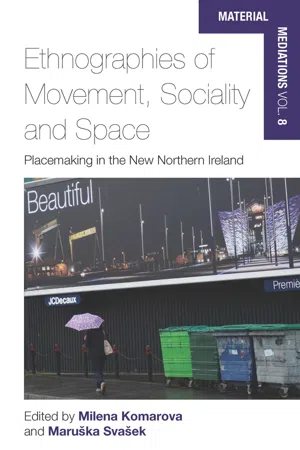
Exploring the complex dynamics of twenty-first century spatial sociality, this volume provides a much-needed multi-dimensional perspective that undermines the dominant image of Northern Ireland as a conflict-ridden place. Despite touching on memories of "the Troubles" and continuing unionist-nationalist tensions, the volume refuses to consider people in the region as purely political beings, or to understand processes of placemaking solely through ethnic or national contestations and territoriality. Topics such as the significance of friendship, gender, and popular culture in spatial practices are considered, against the backdrop of the growing presence of migrants, refugees and diasporic groups.
Trusted by 375,005 students
Access to over 1.5 million titles for a fair monthly price.
Given the vicissitudes of the human drama, it is a wonder that anyone is left physically or psychologically healthy
—S.E. Hobfoll, ‘Alone Together’
Introduction
It was the mid-seventies and I was about eight years old. We were setting out on our annual summer holiday adventure and on this occasion circumstances dictated that we travel through Derry. As this was our first visit, our only knowledge of the city was based on the regular radio and television news reports, which portrayed a place of violence and danger, of sectarian attacks, paramilitary shootings and bombings, and a heavy military presence. If my mother had considered our neighbouring city, Belfast, a dangerous war-torn disaster zone, Derry was by comparison akin to her view of Armageddon. As such she was anxious and had instructed us not to attract any unnecessary attention to our car. This included instructions not to ‘mess about’ or make any abrupt movements (which could be misinterpreted by either the security forces or paramilitaries as someone pulling a gun on them), and if we were stopped by either the security forces or paramilitaries we were not to say anything, not to smile and not to stare. Overwhelmed by trying to absorb this array of instructions and with concerns for our certain impending death, I decided to hide in the back footwell of the car. As we entered the city we were stopped at an army checkpoint. My father wound down his window. A soldier enquired as to the nature of our journey, as normal procedure required. At this point I had to come out of hiding so that he (the soldier) could check the passengers to validate our story – again normal procedure. I remember looking around at this strange landscape: large concrete blocks, corrugated iron and barbed wire; buildings and walls scrawled with graffiti; soldiers in padded, mottled uniforms crouched down as far as my eyes could see with their rifles pointed at our car. For the first time (that I can remember) in my life, I felt fear, a feeling deep down in my stomach. I didn’t know what to do. As we left the checkpoint, I resumed my hiding place until we had safely reached our holiday destination.
I would consider myself to have lived a normal childhood albeit under the rather abnormal circumstances of the Troubles.1 Although there have been many studies on the impact of the Troubles on children and young people,2 the majority of these studies have focused on the psychological and behavioural consequences of the conflict.3 Few studies have focused on the process, and therefore on how children experienced the Troubles, how they made sense of their world, the emotions they felt, and how they learned to cope with the mundane and the not-so-mundane aspects of growing up in the shadow of violence. In the opening vignette I presented a rather mundane aspect of everyday life, a car journey. However, in the context of a region engulfed in an intra-state conflict, even the ordinary can suddenly become the unexpected. Road blocks preventing access through planned routes were a common feature of car journeys and often led to unanticipated diversions through unknown spaces. On this occasion we found ourselves travelling through this notorious and yet unfamiliar city.
Much of the research in Northern Ireland focuses on dangerous spaces based on objective quantifiable data (such as the number of incidents), with less on subjective assessments based on perceptions of fear (Lysaght 2005). Space in Northern Ireland is highly politicized, rooted in centuries of historical events that have shaped and reshaped the religious, historical and cultural schisms that underpinned the conflict (Darby 1995). Space elicits emotional reactions and has the potential to be simultaneously appraised as safe or dangerous, depending on who4 controls and who is negotiating the space (Feldman 1991; Lysaght and Basten 2003; Lysaght 2005). Based on objective measures of danger, we were travelling through a dangerous space. However, as a young child I was not aware of ‘fatal incident’ or ‘number of death’ statistics, and based on these same statistics objectively I had travelled through a more dangerous space as I regularly enjoyed shopping trips to Belfast.5 My fear was not the result of my understanding of such objective information but rather the result of my subjective appraisal6 founded on what I already knew about Derry and my evolving lived experience of the city.
My appraisal of danger was in part influenced by my parents’ anxiety.7 Derry (Londonderry)8 was renowned for being a deeply segregated city.9 In these segregated urban spaces, communities developed highly localized mental topographies10 of safe and dangerous spaces, and a range of spatial codifying practices11 and spatial norms12 of behaviours to enable their ‘daily flows’ (Lysaght 2005) and movement through them (Feldman 1991; Lysaght and Basten 2003). As we had never visited Derry, we had no knowledge of the local topography and therefore did not know which areas were safe and which were not.13 Additionally, Derry was portrayed by the media as a dangerous place, and I had observed many reports of shootings, bombings, riots, rubber bullets and violence.14 Certain events, specifically those involving multiple deaths, had a significant impact throughout the region and became ‘grievous punctuations in the collective memory of the Troubles’ (Smyth and Hamilton 2003: 15). The city bore the legacy of Bloody Sunday15 and was therefore ‘tagged’ (Lysaght and Basten 2003) as a ‘dangerous place’. Yet I was a frequent visitor to my local city, Belfast, which was equally portrayed by the media as a ‘warzone’ and also bore the legacy of significant incidents such as Bloody Friday.16 Yet I considered Belfast to be an exciting and safe place rather than a dangerous place, as I had experienced Belfast, and I knew how it felt. Belfast was familiar and had fanciful shops, pretty colours and special treats. I had no such prior lived experience of Derry and, therefore, no happy memories of shopping trips or treats – only my anxious anticipation as to what I might encounter.17
My assessment of ‘danger’ was also influenced by my emerging feel for this city, based primarily on the negative visual images I was absorbing. Visual codifying practices such as kerbstone painting, murals, parades and graffiti have become part of the demarcation of space, and which serve as explicit identity cues as to which group controls that space (Lysaght and Basten 2003; Zurawski 2005; Goeke-Morey et al. 2009). I had encountered graffiti and barricades before, but in familiar surrounding where I knew what they represented. In these new and unfamiliar surroundings, I was unsure how to interpret their significance. Although some codifying practices were universal in their message (for example, red-white-and-blue painted kerbstones or the red hand of Ulster flags), their interpretation was highly influenced by where, when and how they were used. Visual displays therefore simultaneously serve as a salutation to those of the same group, as a warning to those of the other group (Zurawski 2005), or as a means of antagonizing the other group through reinforcing difference and distinctiveness (Jarman 1999; Trew 2004). All I knew was that Derry felt wrong, and so I distanced myself from it by hiding.18
Lysaght (2005) notes that knowing what to fear is crucial to experiencing fear, and as such, fear is not an irrational or uncontrollable emotion but rather a learned response to information cues. As a young child I learned to ‘read space’, an embodied and multi-sensory appraisal of information cues, in order to assess my situation as normal or abnormal, as safe or dangerous. This process involved drawing on a myriad of information sources including visual cues, media sources, and parental guidance. In the opening vignette I provided a snapshot of this process – a process I will further explore in this chapter. I discuss how I learned to ‘read space’, how appraisal influenced my coping behaviours and routines in my daily negotiation of space, and how my appraisals and behaviours changed with context and developed over time.
Much research on the Troubles has relied on traditional methods, and there is value to adopting a wider range of conceptual perspectives, research methods and methods of data analyses (Muldoon 2004). In this chapter, I present my autoethnographic account of growing up during the Troubles. Autoethnography uses personal experiences to purposefully reflect on the self within a sociocultural context (Coffey 1999) and is therefore an effective approach for gaining a deep insight into sociocultural phenomena through reflection and analysis of one’s personal experiences of those phenomena (Reed-Danahay 1997).19 In reflecting on past experiences, it is important not to equate memory with history and fact (Cappelletto 2003; Kirmayer 1996). Autoethnography seeks to ‘extract meaning from experience rather than to depict experience exactly as it was lived’ (Bochner 2000: 270). In painting a picture of one’s life, there is no one true picture but rather multiple images and traces of events (Denzin 2014). This chapter is not an event history of the Troubles. I make no claim that what I present is a historically accurate recall of events; but neither is this an act of fiction embellished with fictional characters and dramatized emotions. None of the details have been purposely changed for dramatic effect. However, they are presented from my perspective and I acknowledge that my recall may be hazy and also contested.20 Simply, these are my memories of selected events,21 as I remember them.
My Narrative
My Childhood (circa 1966–1977)
I was baptized and raised a Catholic, and the church faith was embedded within our family beliefs and rituals. We did not, however, consider ourselves to be either Irish or nationalist; my parents demonstrated no allegiance to the Republic of Ireland or to any of the nationalist political parties or republican paramilitary organizations, and they instilled tolerance and moderation as core values of our beliefs. I was born and grew up in the town of Lisburn,22 on the outskirts of Belfast. Lisburn was a predominantly Protestant town but, unlike Belfast or Derry, it had few segregated residential districts, and as such, both communities had to coexist on a daily basis in order for normal life to function. Visual symbols and rituals were prominent throughout the town and they reflected the town’s unionist affiliation. In the town centre, union flags and the red hand of Ulster flags flew from lampposts and shop and bar facades. In the more loyalist residential areas, the kerbstones and lampposts were painted red, white and blue, and union flags and the red hand of Ulster flags flew from lampposts and houses. In the mixed residential areas, the displays were less prominent, with the odd flag dotted in the landscape. We lived in such an area. However, as marching season approached, the visual displays increased, and union flag bunting decorated the town centre, flags adorned all of the lampposts in and out of the town, and the residential landscape became more decorated with flags. These visual symbols were a vital cue as they provided a very blatant indicator of the community membership, and its affiliation to that space. As we were part of the minority community in the town, we avoided the predominantly loyalist housing estates and stuck to the integrated residential and communal areas. Like most children in Northern Ireland, I attended a segregated school. This segregation made us easy targets for sectarian attacks. On a number of occasions, we arrived to broken windows, petrol-bombed classrooms or sectarian graffiti. On one occasion one of our classmates arrived at school and we were informed that his family had been burned out of their home the previous evening. He stood before us in the only clothes he had left, and we were asked to gather whatever spare clothes we had at home so that they could be passed onto his family.
In addition to the local community spaces, our town garrisoned the British army headquarters in Northern Ireland during the Troubles. The barracks was heavily fortified with corrugated-iron fencing and barbed wire, and access into and movement around the barracks was monitored and restricted, with security cameras, armed observation posts and vehicular ramps. The sky was filled by a seemingly constant clack of all manner of helicopters, which flew in and out of the army camp. They hovered and circled low in the sky and the sound was deafening. As a child they terrified me, and on hearing them I wanted to run and hide, although I knew that this was not an appropriate course of action as it would arouse their suspicion and could lead to me being shot at. The security forces were highly visible in the town and it was common to see them patrolling either on foot or in armoured vehicles. Once when I was in the car with my mother and father, we ended up driving behind an army patrol vehicle. It was usual for the soldiers to sit in the back, looking out with their guns visible. As we bumped over each pothole in the road, my mother became more agitated, eventually asking my father to pull over. As he did so rather reluctantly, she explained that she had feared that one of the guns would go off and therefore she could not rest until they were out of sight. Therefore, although I was taught no hatred of the armed forces, I came to associate their presence with danger. Although they routinely patrolled the town, I knew not to go too close to them, but I also knew not to run from them or hide from them. Over time I came to recognize what was considered to be a ‘normal’ or ‘abnormal’ level of security presence in the town, and therefore what signified routine monitoring and surveillance as opposed to the increased security routines associated with imminent security threats. I learned to differentiate the different sounds associated with the different styles of helicopter and armoured vehicle, which provided a clue to the purpose of their presence and as such the climate of the town.
After a number of bomb attacks in the early 1970s, much of the town centre became a controlled zone with restricted vehicular access. As such, although it was normal to see parked cars in the residential areas, the sight of a parked car in the town centre, near the police station or other public building, was sinister and foreboding. The larger shops conducted security searches on entering, to protect their stores from incendiary attacks and it was normal practice to have both bag and body searches on a routine shopping trip. I remember seeing one of the major stores after an attack. My senses were flooded with the destruction: the black charred remains of what were once colourful toys and trinkets; the sound of water cascading through the ceiling and down the walls; and I can still recall the rancid stench that saturated the air.
I also went on regular shopping trips to Belfast and I looked forward to visiting the large department stores with their fanciful window dressings and the Aladdin’s cave of all manner of glittering treasures. I often had tea and cake or fish and chips as an additional treat. However, the city centre was often a target for bombers, and no latitude was granted for Saturday afternoon shoppers. Often a series of scares about devices would be announced or even detonated at the same time to maximize chaos and panic. One afternoon we encountered this, for as we were evacuated from one area we were moved in the direction of an explosion. My senses were overwhelmed: the dull thud; the shattering glass propelling through the air then crashing to the ground; the screaming and shouting; and the sight of helpless policemen and shoppers trying to figure out what to do in all this chaos. For a moment my world stopped before I was jolted back to reality. I was uninjured, but the encounter left its mark, and Belfast excursions became less frequent and eventually stopped.
We also experienced the aftermath of such attacks closer to home as we lived opposite the main hotel in the town, which became a target for bombers. Often a flurry of activity would suddenly ensue in the street outside, followed by a stern knock on the front door, which signalled the order to evacuate our home, or, alternatively to open the windows, close the curtains, and hide out until the ‘all clear’ was given. As a small child this was all strangely sinister and strangely fascinating at the same time, and I remember frequently peeking from behind the curtains to watch the commotion outside. On one occasion, I could not resist the temptation to watch the little ‘robot’ defus...
Table of contents
Cover
Title Page
Copyright Page
Contents
List of Figures
Acknowledgements
Introduction: Spatiality, Movement and Place-Making
1. Growing Up with the Troubles: Reading and Negotiating Space
2. Crafting Identities: Prison Artefacts and Place-Making in Pre- and Post-ceasefire Northern Ireland
3. ‘Recalling or Suggesting Phantoms’: Walking in West Belfast
4. ‘Women on the Peace Line’: Challenging Divisions through the Space of Friendship
5. ‘You Have No Legitimate Reason to Access’: Visibility and Movement in Contested Urban Space
6. ‘Lifting the Cross’ in West Belfast: Enskilling Crucicentric Vision through Pedestrian Spatial Practice
7. Engaging amid Divisions: Social Media as a Space for Political Intervention and Interactions in Northern Ireland
8. Belfast’s Festival of Fools: Sharing Space through Laughter
9. Criss-crossing Pathways: The Indian Community Centre as a Focus of Diasporic and Cross-Community Place-Making
10. Sushi or Spuds? Japanese Migrant Women and Practices of Emplacement in Northern Ireland
11. Refugees and Asylum Seekers in Belfast: Finding ‘Home’ through Space and Time
Afterword: Cupar Way or Cupar Street: Integration and Division around a Belfast Wall
Index
Frequently asked questions
Yes, you can cancel anytime from the Subscription tab in your account settings on the Perlego website. Your subscription will stay active until the end of your current billing period. Learn how to cancel your subscription
No, books cannot be downloaded as external files, such as PDFs, for use outside of Perlego. However, you can download books within the Perlego app for offline reading on mobile or tablet. Learn how to download books offline
Perlego offers two plans: Essential and Complete
Essential is ideal for learners and professionals who enjoy exploring a wide range of subjects. Access the Essential Library with 800,000+ trusted titles and best-sellers across business, personal growth, and the humanities. Includes unlimited reading time and Standard Read Aloud voice.
Complete: Perfect for advanced learners and researchers needing full, unrestricted access. Unlock 1.5M+ books across hundreds of subjects, including academic and specialized titles. The Complete Plan also includes advanced features like Premium Read Aloud and Research Assistant.
Both plans are available with monthly, semester, or annual billing cycles.
We are an online textbook subscription service, where you can get access to an entire online library for less than the price of a single book per month. With over 1.5 million books across 990+ topics, we’ve got you covered! Learn about our mission
Look out for the read-aloud symbol on your next book to see if you can listen to it. The read-aloud tool reads text aloud for you, highlighting the text as it is being read. You can pause it, speed it up and slow it down. Learn more about Read Aloud
Yes! You can use the Perlego app on both iOS and Android devices to read anytime, anywhere — even offline. Perfect for commutes or when you’re on the go. Please note we cannot support devices running on iOS 13 and Android 7 or earlier. Learn more about using the app
Yes, you can access Ethnographies of Movement, Sociality and Space by Milena Komarova, Maruška Svašek, Milena Komarova,Maruška Svašek in PDF and/or ePUB format, as well as other popular books in Social Sciences & Cultural & Social Anthropology. We have over 1.5 million books available in our catalogue for you to explore.