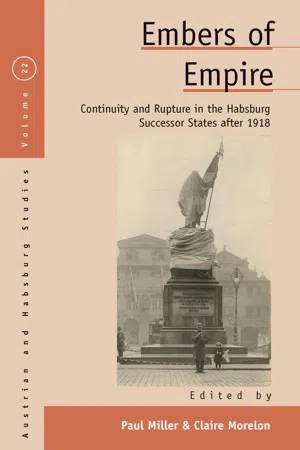
The collapse of the Habsburg Monarchy at the end of World War I ushered in a period of radical change for East-Central European political structures and national identities. Yet this transformed landscape inevitably still bore the traces of its imperial past. Breaking with traditional histories that take 1918 as a strict line of demarcation, this collection focuses on the complexities that attended the transition from the Habsburg Empire to its successor states. In so doing, it produces new and more nuanced insights into the persistence and effectiveness of imperial institutions, as well as the sources of instability in the newly formed nation-states.
eBook - ePub
Embers of Empire
Continuity and Rupture in the Habsburg Successor States after 1918
- 366 pages
- English
- ePUB (mobile friendly)
- Available on iOS & Android
eBook - ePub
Embers of Empire
Continuity and Rupture in the Habsburg Successor States after 1918
About this book
Trusted by 375,005 students
Access to over 1.5 million titles for a fair monthly price.
Study more efficiently using our study tools.
Information
Part I
PERMANENCE AND REVOLUTION: NATIONAL POLITICS IN THE TRANSITION TO THE SUCCESSOR STATES

Chapter 1
NEGOTIATING POST-IMPERIAL TRANSITIONS
Local Societies and Nationalizing States in East Central Europe
Scholars typically attribute the demise of empires in the wake of World War I to their struggle with emerging nation-states.1 Yet making the nation into the primary subject of analysis often obscures crucial differences within the new political entities. Of course, this is not to overlook the important scholarship that tackles local and regional issues either directly or as part of a larger narrative. This includes studies of transitional events in Upper Silesia; a collection of local stories from Austria-Hungary; new work on postwar violence throughout East-Central Europe; and even more targeted studies of such ethnic groups as the Mazurians and the Budweisers.2 All these works depict important episodes in the broader history of the crystallization of sometimes rather heterogeneous nations around their new nation-states.3
However, what are generally lacking in the historiographical literature are comprehensive comparative studies of local level transitions. We know surprisingly little, for example, about how the various revolutions assumed administrative and political power in individual localities; to what extent the old elite was replaced; and whether there was a period of revolutionary or counter-revolutionary cooperation across ethnic boundaries (and if so, how long it lasted). Similarly under-researched topics include the installation of local governments in the new nation-states; the nature and extent of local measures; personnel changes in local institutions; and the reconfiguration of politics, social roles, and public practices. Not even the top-down nationalizing efforts have been thoroughly surveyed at the local level. Indeed, most studies simply assume—on the basis of randomly selected examples and the not necessarily unbiased reports collected by state officials—that central orders and regulations were implemented “seamlessly.”4
This chapter operates from the opposite assumption—that is, once the Habsburg Empire and its political institutions had collapsed, local elites and ordinary citizens, although their role in state affairs had grown markedly in the preceding decades,5 were confronted with daunting tasks that previously had been left to the state, and for which they had little, if any, experience.6 Regardless of whether local leaders had been revolutionaries, they were forced to govern during this transitional period in unfamiliar roles and, largely, without effective support from central organs. Additionally, in the struggle to determine the territorial extent of the successor states, those people living in areas occupied and claimed by the new sovereigns had to face the emerging state and its homogenizing visions on their own. This led to the creation of what may be considered a new state space at the local level—one which directly affected the outcome of the state-building process itself, not least of all due to the limited capacity and efficiency of the new states but also, as we will see, the perseverance of local structures and institutions.7
In this chapter, I address these issues through the state-building processes in regions that had belonged to Hungary and came under Czechoslovak and Romanian rule in 1919—Slovakia (or Upper Hungary, as it was called in the dualist era) and Transylvania, respectively. These were diverse, multiethnic areas with predominantly Hungarian and German urban populations despite an overall higher proportion of Slovaks and Romanians. While the majority of inhabitants spoke the language of their new rulers, the border zones contained Hungarian-speaking majorities, even in the countryside. And some areas further from the new frontiers (the Saxon settlements in Southern Transylvania, the Banat, the Szeklerland, Maramureș, and the Spiš) were characterized by a strong Hungarian and German presence, often constituting the regional majority.
Nor was diversity limited to language or nationality. Some of these areas were industrial zones (most notably the mining towns in the Banat or Jiu Valley) with large working-class populations. Others were home to sizable groups of religious minorities, such as Jews and Greek Catholics in Northern Transylvania and Carpatho-Ukraine. These regions had distinct social, cultural, and administrative traditions as well.8 How they would confront state-building efforts based on different and even foreign practices remained to be seen.
In order to highlight the important ways in which a local perspective can change our understanding of state formation, this chapter begins by discussing the different faces—social, national, and democratic—of the revolutions in 1918. It then examines the process of establishing a political administration, with an emphasis on the peculiar linguistic and symbolic features of the new local regimes and landscapes. The last part assesses how the different regions expressed themselves politically and socially in this early state-building period.
The Three Faces of One Revolution
The revolutions that took place in Eastern Europe between 1917 and 1919 strove to reconfigure politics, economics, and society such that more people would be enfranchised and national development would go hand-in-hand with greater economic equality. Of course, revolutionary elites were typically more interested in preserving their prerogatives than in acceding to the demands of ordinary people, who often made their own, local revolutions. But the leaders of the new nation-states promised to solve their problems together.
Hungary was a prominent case with respect both to the national and social aspects of revolutionary state-building. When the Hungarian National Council, the interim legislative body of the country, declared independence from Austria-Hungary, it not only extended political rights through universal suffrage, but also created integrating institutions like workers’ and soldiers’ councils; promised minority rights and proper representation for nationalities; and offered to alleviate social ills by redistributing wealth (mainly through agrarian reform and the introduction of extensive social benefits). But these efforts confronted the similar goals of the Slovak, Czech, and Romanian National Councils, which sought to implement change on their own terms and in their own, respective national frameworks. From this perspective, then, national initiatives were crucial in the early phases of nation–state-building in that they prevented cross-ethnic cooperation at the highest government levels.
Rather than simply accepting historical Hungary’s existence and reform efforts, the Czech, Slovak, and Romanian National Councils envisioned their own independent nation-states. Thus, the national/political aspect of state-building overshadowed the social/economic one already by late October 1918. Unsurprisingly, differing political visions were the main sources for rivalry between revolutionary bodies, often disrupting interethnic cooperation among administrative elites. An oft-cited example is the negotiations between Oszkár Jászi, the Hungarian Minister for National Minorities, and representatives of the Romanian National Council at Arad. The stakes of these negotiations in late November 1918 were no less than the territorial consolidation of Hungary, as the Romanian National Council was demanding the immediate takeover of twenty-three counties with Romanian populations (thereby extending its rule to the Eastern zone of the Great Plain and the whole of the Banat). Despite the wide-ranging concessions offered by Jászi, who proposed establishing a system of national cantons with broad autonomy, the Romanian politicians insisted upon having full sovereignty over all Romanian inhabited territories.9
A similar scenario played out in Upper Hungary. On 6 December 1918, Milan Hodža, a former member of the Hungarian Parliament and a representative of the Slovak National Council, came to terms with the Hungarian government over a demarcation line that left most of the contested territories with predominantly Hungarian populations under Hungarian control. However, he was soon denounced by the Czechoslovak government, which had been working with delegates to the Paris Peace Conference in order to establish a new border that put the disputed zone in its hands. As it happens, this border runs very close to the present one.
At the local level, by contrast, cross-ethnic cooperation was more common, thus making it harder to distinguish the political and social aspects of the revolution. Moreover, local revolutions were often truly local in that they did not simply replicate what happened in the centers of national power. Instead, their main drivers were the social discontent of their respective populations, as well as the violence engendered by returning soldiers. Unsurprisingly, then, local leaders were often less concerned with national, state-building issues than material problems at home, which likewise meant that their construction of enemies did not straightforwardly fall along ethnic lines.
Transylvania, a new province of Romania that was approximately 30 percent ethnic Hungarian and 10 percent German, is a case in point. There, the local revolution and violence targeted everything associated with the old order. Not only did returning soldiers loot rampantly, but the local population took advantage of the breakdown in authority, which in any case was more often concerned with disarming the returning veterans than pursuing the local bands.10 People in multiethnic regions often attacked state authorities regardless of their ethnicity, and looting was by no means confined to Hungarian property. The Romanian National party politician Ilie Lăzar learned this first-hand when, as a Honvéd (Hungarian military) officer, he travelled to Máramarossziget (Sighetu Marmației) in order to establish Romanian rule in the county. Instead, he was robbed clean by a band of returning Romanian soldiers who had come to “rescue” the Orthodox priest with whom Lăzar was lodging, and who were not deterred by the fact that the “Hungarian” officer also happened to be an ethnic Romanian.11
Faced with such violence, state authorities often had to rely on National Councils to regain control. A circular from the Hungarian Interior Ministry admitted as much in December 1918: “During those unforgettable days, when the people’s will broke centuries of forced servitude, the National Councils provided an invaluable service for the true cause of liberty. … Hungary’s liberated people owe their eternal gratitude to them.”12 The Councils had the capacity to run local administrations, organize armed national guards, and distribute provisions as part of their larger effort to reorganize society along national lines. But to what extent were local Councils the true embodiment of grassroots demands for a national order? At least three aspects of their activities indicate that the situation was more complex than the Councils typically presented it.
First, many of these National Councils were organized following external initiatives, often by the delegates of county or even regional Councils.13 In these cases, the delegates brought with them a blueprint for action, describing whom to mobilize and how to legitimize the takeover. The scripted nature of these events in many localities suggests that the vision of a spontaneous revolution generating new institutions along national lines found much less support at the local level than it did among urban intellectuals and political elites. Moreover, the sequence of events was surprisingly similar in such disparate regions as the Barcaság (Burzenland, Țară Bârsei) around Brassó (Kronstadt, Brașov); the Nagy-Küküllő (Târnava Mare) river zone; and Szászrégen (Sächisch Reen, Reghin), especially north and south. First, the Councils were established in the major regional cities (Brassó, Nagyszeben [Hermannstadt, Sibiu], and Szászrégen), all of which declared some form of national autonomy. A few days or weeks later, after securing the cooperation of county administrators, they sent representatives to villages in which the National Council had less presence. These representatives sought out influential local figures, instructed them on how to set up their own councils, and participated in the festivities for newly elected officials tasked with “initiating” the council. Control over the local councils could be quite strict as well. A memorandum adopted by the inaugural session of the Maroslaka (Huduc, today Maiorești) Romanian National Council, for example,...
Table of contents
- Cover
- Title Page
- Copyright Page
- Contents
- List of Illustrations
- Acknowledgments
- Introduction
- Part I. Permanence and Revolution: National Politics in the Transition to the Successor States
- Part II. The Habsburg Army’s Final Battles
- Part III. Church, Dynasty, Aristocracy: The Postwar Fate of Imperial Pillars
- Part IV. History, Memory, Mentalité: Processing The Empire’s Passing
- Index
Frequently asked questions
Yes, you can cancel anytime from the Subscription tab in your account settings on the Perlego website. Your subscription will stay active until the end of your current billing period. Learn how to cancel your subscription
No, books cannot be downloaded as external files, such as PDFs, for use outside of Perlego. However, you can download books within the Perlego app for offline reading on mobile or tablet. Learn how to download books offline
Perlego offers two plans: Essential and Complete
- Essential is ideal for learners and professionals who enjoy exploring a wide range of subjects. Access the Essential Library with 800,000+ trusted titles and best-sellers across business, personal growth, and the humanities. Includes unlimited reading time and Standard Read Aloud voice.
- Complete: Perfect for advanced learners and researchers needing full, unrestricted access. Unlock 1.5M+ books across hundreds of subjects, including academic and specialized titles. The Complete Plan also includes advanced features like Premium Read Aloud and Research Assistant.
We are an online textbook subscription service, where you can get access to an entire online library for less than the price of a single book per month. With over 1.5 million books across 990+ topics, we’ve got you covered! Learn about our mission
Look out for the read-aloud symbol on your next book to see if you can listen to it. The read-aloud tool reads text aloud for you, highlighting the text as it is being read. You can pause it, speed it up and slow it down. Learn more about Read Aloud
Yes! You can use the Perlego app on both iOS and Android devices to read anytime, anywhere — even offline. Perfect for commutes or when you’re on the go.
Please note we cannot support devices running on iOS 13 and Android 7 or earlier. Learn more about using the app
Please note we cannot support devices running on iOS 13 and Android 7 or earlier. Learn more about using the app
Yes, you can access Embers of Empire by Paul Miller, Claire Morelon, Paul Miller,Claire Morelon in PDF and/or ePUB format, as well as other popular books in History & Eastern European History. We have over 1.5 million books available in our catalogue for you to explore.