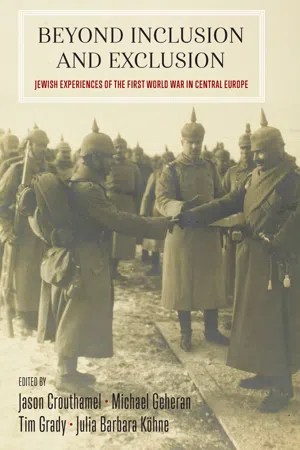
During the First World War, the Jewish population of Central Europe was politically, socially, and experientially diverse, to an extent that resists containment within a simple historical narrative. While antisemitism and Jewish disillusionment have dominated many previous studies of the topic, this collection aims to recapture the multifariousness of Central European Jewish life in the experiences of soldiers and civilians alike during the First World War. Here, scholars from multiple disciplines explore rare sources and employ innovative methods to illuminate four interconnected themes: minorities and the meaning of military service, Jewish-Gentile relations, cultural legacies of the war, and memory politics.
eBook - ePub
Beyond Inclusion and Exclusion
Jewish Experiences of the First World War in Central Europe
- 408 pages
- English
- ePUB (mobile friendly)
- Available on iOS & Android
eBook - ePub
Beyond Inclusion and Exclusion
Jewish Experiences of the First World War in Central Europe
About this book
Trusted by 375,005 students
Access to over 1.5 million titles for a fair monthly price.
Study more efficiently using our study tools.
Information
PART I
AT THE MARGINS
MINORITIES AND THE MILITARY
1
HOPES AND DISAPPOINTMENTS
German and French Jews during the Wars of 1870/71 and 1914–18
In August 1914, the German Jewish weekly newspaper Der Israelit released two articles that it had published for the first time forty-four years earlier, during the hottest phase of the Franco-Prussian War. One of these articles praised the patriotic commitment of the German Jews. It stressed that they participated in the war “voluntarily and joyfully.” The article put a special emphasis on the fact that even if the Jews were still “the pariahs of society,” this did not diminish their patriotism in any respect. As early as the German campaign against Napoleon I, their “fathers and grandfathers” had been “German patriots to the tips of their toes,” although this had meant that they had to fight against the French, who “had come as liberators” for the German Jews still suffering “under a heavy and odious yoke.”1 Indeed, in many German territories the Jews had gained equal civic rights due to the legislation introduced under the Napoleonic occupation.
In the age of nationalism, the nation demanded the absolute commitment of its members. Nationalists claimed that patriotism should be superior to any other loyalty. Periods of war were the touchstone to prove this. For Jews the pressure to confirm their national loyalty was particularly high. Ever since discussions about their civic status had been sparked for the first time at the end of the eighteenth century, adversaries who opposed their emancipation had called into question whether the Jews, allegedly waiting for their return to Palestine, would regard their European nation as their fatherland. Thus, they concluded, as there could be no trust in the willingness of the Jews to fulfill their civic duties, and especially to defend their country in case of war, they could not attain civic rights either. Even if in the course of the nineteenth century and especially in its second half, Judeo-phobes complemented these allegations with ethnic or racial arguments, the mistrust towards the Jewish readiness to fight for their home country still remained a central element of antisemitic ideology. Doubts about Jewish patriotism were also common during the Franco-Prussian War of 1870/71—in Germany as well as France.2 Certainly, in both countries, the war also put the patriotism of adherents of the respective Christian minority denomination to the test. French Protestants had to rebut allegations that they were sympathizing with the Germans, while German Catholics met doubts as to their patriotism because the head of their Church was the Roman Pope.3 Yet the suspicions against Jews undoubtedly were stronger.
The Jews considered the war an opportunity to disprove such defamations. Many of them enthusiastically contributed to patriotic manifestations of all kinds. In both countries, they excelled in patriotic donations, in the nursing of the wounded, or in charitable organizations. In order to demonstrate their national belonging, Jewish publicists and preachers repeatedly pointed to their willingness to make sacrifices. Also, by pointing to their participation in every war of the nineteenth century, Jews in France and Germany tried to prove their patriotic reliability.4 This had already been the goal of the cited article from 1870; the new publication of the article in 1914 again pursued the same aim, referring now to an even longer tradition of patriotic Jewish war effort.
In this chapter, I study in a synchronically and diachronically comparative perspective how French and German Jewish opinion leaders defined the relationship between Judaism and nationality and how these definitions developed between the Franco-Prussian War and the First World War. My thesis is that the patriotic participation in these wars engendered much more ambivalence for German Jews than for their French co-religionists. This can be attributed largely to the polarization of the two different definitions of the nation during the war of 1870/71. In the decades between the two wars as well as during the First World War itself, this ambivalence pluralized German Jewish self-definitions, whereas the Franco-Jewish self-understanding remained more stable and homogenous.
The reissue of the article in 1914 reveals the ambivalence German Jewish patriotism had to face during the Franco-Prussian War and the First World War alike. In 1914, the editors of Der Israelit added a footnote to the text, clarifying that the legal status of the German Jews had improved considerably since 1870. At the same time, however, this footnote deplored the fact that anti-Jewish discrimination was still very common in the German Empire. In November 1914, Jeschurun, another Jewish periodical, complained in an even sharper manner that the hopes of integration, which German Jews had cherished in respect to their commitment during the war of 1870, had been clearly disappointed. The author of the article stated: “The participation of Jews at war has not succeeded in permanently stifling the prejudices against them.”5
On the French side, by contrast, Jewish authors did not feel challenged to justify their patriotism in the same manner. This might be surprising: between 1871 and 1914, antisemitism had also gained currency in France—the Dreyfus affair is only one example of this. Nevertheless, French Jews did not manifest any disappointment about their social status during the First World War. Indeed, Franco-Jewish expressions of patriotism had hardly changed. The difference between German and French Jewish self-definitions is the consequence mainly of the divergence of the two dominant definitions of the nation in the two countries, a divergence that the war of 1870/71 itself had sharpened to a considerable degree.
German Jewish as well as Franco-Jewish self-definitions have attracted a good deal of scholarly attention in recent decades. Early research often followed a Zionist interpretation, criticizing the numerous manifestations of Jewish commitment to their nation as “assimilationist” self-denial. This criticism was directed against French and German Jews alike, although its proponents explained it differently and in connection to the two divergent models of emancipation in the two countries: the revolutionary and the evolutionary models.6 To the French Jews, emancipation was granted in the course of the French Revolution. Historians argued that the ideas of the Enlightenment and revolution went along with a strong pressure for homogenization and eventually led to a widespread abandonment of Jewishness.7 Historiography on German Jews, by contrast, claimed that the German model of emancipation of the Jews particularly promoted assimilation, because it was widely considered a condition for gaining equal rights that Jews should first prove to be “worthy” citizens, and this meant that they were expected to cast off as much of their Jewishness as possible.8
The concept of Jewish assimilation did not remain undisputed, however. Historians have long highlighted that many Jews—in France as well as in Germany—upheld a strong attachment to their Jewishness and often tried to influence their non-Jewish environment as well as design their nation in a specific and self-confident way.9 In recent years, studies in transnational or global history have confirmed this view from a new perspective. Their primary focus is on the increasing networks of Jewish internationalism in the nineteenth century, which they convincingly describe as an important trait of Jewish identity.10 However, little attention has been paid to the question of how war between nations challenged the ideal of transnational Jewish solidarity. The aim of this chapter is to fill this gap. It can help us to gain a deeper understanding of the complex fabric of Jewish self-definitions, which can be explained neither by considering the national context alone nor by exclusively concentrating on transnational relations. Focusing on the Franco-Prussian War of 1870/71 first, and on the First World War second, it is possible to trace the relationship between nationalism, the ideal of Jewish solidarity, and Jewish self-definitions in a long-term perspective.
In the first part of this chapter, I analyze how French and German Jews defined the nation during the Franco-Prussian War of 1870/71 and particularly how they measured the relationship between religion and nation. In the second part, I will first focus on how the growing antisemitism in the last third of the nineteenth century and at the beginning of the twentieth century changed Jewish self-definitions and their understanding of nationhood and religion. Against this background, I will also compare the French and German Jewish public sphere of the First World War with that of the war in 1870/71.
A broad range of German Jewish and Franco-Jewish weekly periodicals, as well as rabbinical wartime sermons from both countries, give insight into the issues discussed here. These sources are not representative of the whole Jewry of both countries, but were intended mainly for an educated elite that felt attached to Judaism and was interested in Jewish matters. Yet these sources have a high analytical value, especially from a transnational perspective. From their beginnings in the first half of the nineteenth century, Jewish periodicals of both countries regularly interchanged information and ideas. They considered each other as partners cooperating in order to push forward the emancipation of the Jews in Europe and beyond.11 This intensive transnational interchange distinguished Jewish periodicals from Catholic or Protestant ones, where news from abroad was rare, although not entirely absent.12
Jewish Self-Definitions in the Face of the National War of 1870/71
The Franco-Prussian War of 1870/71 was a crucial period for the polarization of French and German definitions of the nation. The main reason for this was the German annexation of Alsace-Lorraine after the French defeat. A wide majority of Germans justified the takeover of the two provinces as the legitimate recuperation of a region that France had once unlawfully incorporated. In their eyes, the fact that the mother tongue of many Alsatians was German proved that the region still belonged to Germany not only for historical but also for cultural reasons. In this line of argument, culture and language were the two main factors that determined nationality. The majority of the French, however, rejected this concept of a Kulturnation. They propagated instead the concept of voluntarism for the nation as Staatsnation, according to which the patriotic feeling of adherence alone defined nationality. Thus, in their eyes, the German annexation of Alsace and Lorraine was unlawful because it did not take into consideration the fact that most Alsatians were opposed to it.13 For Jews, the question of how the nation in which they lived was defined was especially important, because it had direct consequences for their social and legal status. For this reason, the debate over these definitions fed into Jewish self-understanding. It is worthwhile to look more closely at the outcome of these debates in both countries.
French Jews unanimously agreed on how to define the nation. “Ubi libertas, ibi patria”—where there is freedom, there is the fatherland: this was the motto that Franco-Jewish authors repeatedly proclaimed during the war.14 Again and again, they affirmed that the emancipation of the Jews in the course of the French Revolution explained the patriotic commitment they displayed. In September 1870, one journalist wrote: “For such a long time we have been bereaved of a f...
Table of contents
- Cover
- Title Page
- Copyright Page
- Contents
- List of Figures and Tables
- Acknowledgments
- Introduction
- Part I. At the Margins: Minorities and the Military
- Part II. Relations: Contested Identities during the First World War
- Part III. Representation: The Culture of War
- Part IV. Contested Memories: Working through the Legacies of War
- Index
Frequently asked questions
Yes, you can cancel anytime from the Subscription tab in your account settings on the Perlego website. Your subscription will stay active until the end of your current billing period. Learn how to cancel your subscription
No, books cannot be downloaded as external files, such as PDFs, for use outside of Perlego. However, you can download books within the Perlego app for offline reading on mobile or tablet. Learn how to download books offline
Perlego offers two plans: Essential and Complete
- Essential is ideal for learners and professionals who enjoy exploring a wide range of subjects. Access the Essential Library with 800,000+ trusted titles and best-sellers across business, personal growth, and the humanities. Includes unlimited reading time and Standard Read Aloud voice.
- Complete: Perfect for advanced learners and researchers needing full, unrestricted access. Unlock 1.5M+ books across hundreds of subjects, including academic and specialized titles. The Complete Plan also includes advanced features like Premium Read Aloud and Research Assistant.
We are an online textbook subscription service, where you can get access to an entire online library for less than the price of a single book per month. With over 1.5 million books across 990+ topics, we’ve got you covered! Learn about our mission
Look out for the read-aloud symbol on your next book to see if you can listen to it. The read-aloud tool reads text aloud for you, highlighting the text as it is being read. You can pause it, speed it up and slow it down. Learn more about Read Aloud
Yes! You can use the Perlego app on both iOS and Android devices to read anytime, anywhere — even offline. Perfect for commutes or when you’re on the go.
Please note we cannot support devices running on iOS 13 and Android 7 or earlier. Learn more about using the app
Please note we cannot support devices running on iOS 13 and Android 7 or earlier. Learn more about using the app
Yes, you can access Beyond Inclusion and Exclusion by Jason Crouthamel, Michael Geheran, Tim Grady, Julia Barbara Köhne, Jason Crouthamel,Michael Geheran,Tim Grady,Julia Barbara Köhne, Jason Crouthamel, Michael Geheran, Tim Grady, Julia B. Köhne in PDF and/or ePUB format, as well as other popular books in History & Jewish History. We have over 1.5 million books available in our catalogue for you to explore.