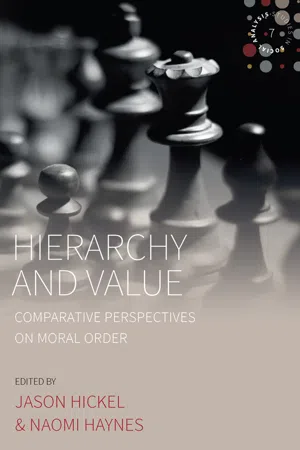
Globalization promised to bring about a golden age of liberal individualism, breaking down hierarchies of kinship, caste, and gender around the world and freeing people to express their true, authentic agency. But in some places globalization has spurred the emergence of new forms of hierarchy—or the reemergence of old forms—as people try to reconstitute an imagined past of stable moral order. This is evident from the Islamic revival in the Middle East to visions of the 1950s family among conservatives in the United States. Why does this happen and how do we make sense of this phenomenon? Why do some communities see hierarchy as desireable? In this book, leading anthropologists draw on insightful ethnographic case studies from around the world to address these trends. Together, they develop a theory of hierarchy that treats it both as a relational form and a framework for organizing ideas about the social good.
eBook - ePub
Hierarchy and Value
Comparative Perspectives on Moral Order
- 160 pages
- English
- ePUB (mobile friendly)
- Available on iOS & Android
eBook - ePub
Hierarchy and Value
Comparative Perspectives on Moral Order
About this book
Trusted by 375,005 students
Access to over 1.5 million titles for a fair monthly price.
Study more efficiently using our study tools.
Information

Chapter 1
BATTLE OF COSMOLOGIES
The Catholic Church, Adat, and ‘Inculturation’ among Northern Lio, Indonesia
Signe Howell
Western ideas, values, objects, and practices may, or may not, find resonance in a community whose ontological reference points are very different. Where old and new metaphysical and moral systems confront one another, local reactions and resulting effects upon values, categories, and practices are not predictable. For example, when Christianity is introduced into regions where other forms of religious values and practices are well established, this may result in immediate acceptance and the abandonment of existing metaphysics (e.g., Knauft 2002; Robbins 2004, 2009), or, as in the case of the Indonesian Lio,1 it may meet resistance. Catholicism was introduced to the Lio in the late 1920s, and today most Lio individuals will say that they are Catholic. In this chapter I will explore to what extent it can be argued that Catholicism has replaced their previous cosmology (adat) as a point of existential orientation. I shall show that the Catholic priests and the Lio ‘priest-leaders’ are competing for overall supremacy in the religious field, and I argue that, so far, Lio cosmology retains an overall paramount position. This is so, I suggest, because Lio adat, unlike the Catholic religion, is holistic—that is, it “valorizes the social whole and neglects or subordinates the human individual” (Dumont 1986: 279). Within holistic ideologies, the parts are organized according to a hierarchical system of value in which the whole encompasses the parts (cf. Dumont 1979, 1986). Lio adat encompasses its opposite, Catholicism, except in a few isolated contexts when Catholic dogma and practice are superior (as discussed below). Following Dumont, I suggest that on such occasions this can be understood as a reversal of values that occurs at a lower level in the overall system, a Lio metaphysics in which adat and Catholicism both play a part. If their relationship is symmetrical, then a reversal signifies nothing. If, on the other hand, it is asymmetrical, then a reversal indicates a change in level (Dumont 1986: 230). Hierarchy in the Lio case may be understood as a model of value expressed relationally in wholes and parts.
Lio is a highly stratified society, made up of aristocrats, commoners, and, in earlier times, slaves, whose council of ‘priest-leaders’ (mosa laki) wields political, religious, and ritual authority. The priest-leaders’ authority is grounded in the cosmogenic past, manifested and perpetuated through aristocratic patrilineal descent and the prescriptive alliance system, as well as by demonstrably superior esoteric knowledge and personal fierceness, all of which are enacted through ritual. Rites of what I call ‘cosmic kinship’ are critical in the hierarchical structures at all points in the dynamics of reproduction of Lio social order. An example of this is the fact that all land is under the priest-leaders’ authority: it is handed out to individual families to cultivate in return for an annual tribute to be made during a special ceremony. It is a statement of the unequal relationship between them and must be viewed together with the annual pre-planting ceremony, performed by the superior priest-leader and his wife, and the first harvest ceremony, similarly performed by them. The fecundity of the soil is dependent upon the power of the priest-leader couple (the quality of their relationship with the ancestors and spirits world), and the tribute from the farmers acknowledges their dependency upon this power.2 The priest-leaders’ personhood is qualitatively different from (superior to) that of the rest of the population. It is also (so far) superior to that of Catholic priests. I shall argue that while Catholicism and adat (traditional religious system) may engage people according to different contexts, Catholicism and the Catholic priests’ attempts to merge the two, through the ideology and practices of inculturation, fail to capture the people’s imagination and emotions.
Value and Hierarchy
I find it useful that, to follow Robbins (2009: 66), values be understood as parts of culture that structure other parts, and that “radical cultural change should be understood to have taken place only when values have changed—either because new ones have been introduced or because the relations between traditional values have shifted.” It is by this yardstick that I shall interpret the relationship between the values of the Catholic Church and Lio adat. Values are by definition hierarchical, and “[w]e cannot define the meaning, or ‘value’, of any one element without understanding its place in a total system … it must be viewed in contrast to other elements within the same system” (Graeber 2001: 13, 14). The anthropologist’s task is to understand what motivates people to act the way they do, rather than act in any other way.
According to Dumont, hierarchy must not be confused with social stratification, but treated as a way of organizing a system, or schema, of relative values in which the dominant value is superior to all others and constitutes the particularity—the whole—of each schema. Hierarchy, in such cases, is fundamental to the whole society. This, he argues, is characteristic of many non-Western societies. By contrast, according to contemporary Western ideology,3 egalitarianism (which is coupled to the idea-value of the individual) is the dominant value (Dumont 1982, 1986; Rio and Smedal 2009). This opposition between holistic and individualistic (hierarchal and egalitarian) ideologies is useful for my analysis of Lio reactions to the challenges presented by the Catholic missionaries. I shall suggest that Lio adat is an example of a hierarchically ordered holistic schema. By contrast, Catholicism, despite the hierarchical nature of the Church’s organization, preaches an egalitarian ideology in which the dominant value is the individual and the individual soul.
I shall explore the notion of hierarchy at two levels. Drawing upon Dumont (1979, 1982, 1986), I shall argue that Lio hierarchical relations constitute social and ritual organization and practice in which the whole is superior to the individual, but that the Catholic religion is founded upon an ideology of egalitarianism in which, arguably, the value of the individual is superior to that of the whole. Unlike Lio adat, which results in a holistic understanding that permeates all aspects of life, the Catholic religion (in Lioland) occupies only a demarcated niche of religion alone. This, I suggest may account for the failure of Catholic proselytizing to emerge triumphant in the silent battle for religious and moral supremacy between Catholic priests and Lio priest-leaders. I say this despite the recent Catholic policy of ‘inculturation’—the so-called two-way incorporation of concepts and practices between Catholic and ‘pagan’ dogma in Indonesia. Notwithstanding avowals to the contrary, inculturation as practiced by Catholic priests on Flores seeks to replace the hierarchically organized cosmology (adat) that constitutes Lio hierarchical and holistic symbolic order and social practice with an egalitarian and individualistic Catholic dogma and practice. The call for dialogue is turning out to be little more than a matter of folklorizing Lio adat beliefs and practices rather than taking them seriously as contributions to religious life in general. However, on a day-to-day basis, Catholicism and adat engage people’s imaginations according to different contexts and, as such, are not in direct conflict. Nevertheless, attempts by the Catholic priests to merge the two through the rhetoric of the Vatican policy of inculturation can be interpreted as a takeover bid. Although most Lio individuals today will say that they are Catholic, adat continues to constitute values, concepts of personhood, and sociality for the majority of the population.
Although, as the editors point out in the introduction, social stratification is not to be confused with the hierarchical ordering of values, I will suggest, contra Dumont, that a hierarchical conceptual schema in holistic societies may be expected to parallel a hierarchical (socially stratified) socio-political order and that the two should be examined together as part of the whole value system. This, I argue, is the case of the Lio—the conflation of the cosmological and socio-political may account for Lio resistance to abandoning adat. It may also explain why the much more ‘loosely structured’ egalitarian New Guinea societies more easily embrace Christianity at the expense of their kastom, or traditional culture (see Knauft 2002; Robbins 2004), for the ‘Big Men’ of those societies are not the product of descent lines that are legitimized in the cosmogenic past and confirmed through asymmetric alliances across generations.
Adat and Church: Two Opposed Value Systems
The Lio adat schema is fundamentally hierarchical and holistic, or, as Dumont would put it, the dominant value of the whole, with certain key elements, encompasses the inferior value of the individual. The dominant value of Catholic dogma is the individual. The value of the individual and individual choice is emphasized in Catholic teaching to the Lio, perhaps as a means toward undermining the authority of adat and the adat leaders. However, in doing so, the significance of sociality and of belonging is reduced. The claimed universal nature of the Church does not have the same impact on Lio imaginaries as does the lived experience of ancestors and spirits. The Trinity is a rather remote concept. One key to understanding the persistence of Lio adat is precisely the way in which the cosmogenic past constitutes their metaphysics as a hierarchical classification of elements, symbolic as well as social. According to this order, some categories of people (the aristocrats) are by definition superior. They are the legitimate guardians of adat. Adat is manifest in their person as well as in time, space, and place—all of which they control, or try to (Howell 2001).
This authority reveals itself most clearly at key ritual moments when the cosmogenic past collapses into the present, thereby paving the way for a future that reproduces the past and the present for the benefit of all. Such moments are enacted in the sacred spaces of the core village that embody and manifest the cosmology: the temple (keda), the ceremonial space in front of the temple (kangga), and the wooden sculptures inside the temple of the original ancestral pair, as well as a number of mythological animals and skulls of sacrificed water buffaloes. Ideologically, the core village is of ancient origin and has occupied the same site since the beginning of time. Graves of dead priest-leaders are within and on top of the kangga, and this is where people dance on ceremonial occasions and where they perform sacrifices. The space denotes cosmogenic times and the origin of sociality constituted through kin categories and the MBD-FZS marriage system.4 It does not just remind them of their origins; it makes them re-enact them through words and action in complex ritual cycles. In all these respects, Catholicism fails to provide a real overall alternative. In emphasizing the dominant value of the individual and individual choice and by promoting an egalitarian ethos within the congregation, Catholic priests try to undermine the authority of the adat priest-leaders—and adat values. Even though it is decreasingly adhered to in practice, Lio prescriptive matrilateral cross-cousin marriage ideology permeates people’s sense of identity and constitutes political and ritual practice. By contrast, the Church advocates free choice of marriage partners and insists on a wedding ceremony that takes place in church. While this egalitarian ethos appeals to some ambitious commoners who through descent are excluded from entering the group of priest-leaders, the Catholic religion does not emerge to most Lio as a “total social phenomenon” (Howell 2001: 149; see also Mauss [1925] 1966) and therefore, I suggest, fails to supersede adat.
The Indonesian policy of maintaining three separate domains of public life, that is, religion (agama), the state (pemerintah), and tradition (adat),5 allows for a parallel co-existence of the domains rather than a competition between them. In principle, none is superior to any other, as each fulfills different functions (Howell 2001). Religion is intended to refer to the five monotheistic world religions—Islam, Protestantism, Catholicism, Bali Hinduism, and Buddhism—which are not hierarchically ordered. In order to obtain an identity card and derive the benefits of the modern nation-state, such as education, health services, freedom of movement, and participation in official events, every Indonesian citizen must belong to one of them, and his or her religious adherence is included on the identity card. This separates religion from the many adat traditions that are found throughout the nation. It also removes from religion the seemingly more mundane activities of daily life, such as earning a living or reproducing family and collective life, thus relegating religion into a separate niche. However, such a division is not in line with adat perceptions of many of the social groups in Indonesia. Certainly, Lio adat does not operate based on distinctions between the different aspects of life, and this, I suggest, is a major reason why its hold on people’s existential orientation and emotions continues, and why Catholicism in the region, despite efforts by the priests, largely remains within a rather narrow niche of religion. Being Catholic is for many people a necessary requirement of modern life, but it is not constitutive of their sense of personal and social identity.
The physical layout of Lio villages further demonstrates an important difference between adat and the Catholic religion. While the Church and the priest’s residence and offices are built of white-painted brick outside the village compound, manifesting to the village population an alien modernity that marks a distance—spatial and conceptual—between the Catholic religion and themselves, the keda is right in the center of the compound, surrounded by ceremonial clan houses. Built according to traditional designs and methods, and made of wood and thatched straw roofs, each clan house is headed by a priest-leader and his priest-leader wife.6 Lio hierarchical order is expressed and realized through ancestry and the ancestral past. Everyone in the village domain belongs to one of the clans. Each priest-leader couple is responsible to the members of a clan, but for clan ritual performances, they are not of equal significance: there is a hierarchical ordering of the seven priest-leaders based on descent and marriage over time. The proven lineage through mother and father back to the inhabitants of the original village on the sacred mountain renders clan priest-leaders superior to descendants of migrants or slaves in the hierarchical ordering of relationships. Together, the clans become a category that stands for the whole society, yet there are also levels of hierarchical relations within the Lio clan order. The council of priest-leaders is headed by the ‘trunk’ priest-leader, whose status and role encompass the clan priest-leaders. He is the part that stands for the whole, the equivalent to the right hand that stands for the whole body (Dumont 1986: 227–233; Hertz [1907] 1960), encompassing not only the other priest-leaders, but also the rest of the community. Hierarchy becomes manifest as a model of value (as per Dumont). The ‘trunk’ priest-leader guards the keda, the ultimate living symbol of the cosmogenic past’s relationship to the present, and he orchestrates the life-giving rituals that affect every Lio regardless of clan affiliation. He has final say in matters both political and religious.
This is not to suggest that the Catholic religion on Flores is not very influential. It clearly is, as today the vast majority of Lio individuals are Catholic. The question is whether Catholicism is as meaningful to its adherents as is adat. Here one must distinguish between those who have a vested interest in the superiority of their own domains—Catholic priests and Lio priest-leaders—and the rest of the population. Lio commoners have less to lose. They move with apparent ease between the domains according to context. What is certain is that, for the time being, most Lio manage to practice the official separation between the Catholic religion and adat without allocating absolute superiority to either regardless of context. Context promotes different values and activates different modes of sociality. What must be determined is whether the contexts are of equal value or if, following Dumont, a reversal of values must indicate a lower level within the whole. Bringing Dumont’s ideas to bear on the philosophical question of how values relate to one another, Robbins (2013) suggests a typology of four configurations: monism, monism with stable levels, (relatively) stable pluralism, and unsettled pluralism (see also Smedal, this book). While Lio might be said to practice a version of Robbins’s (relatively) stable pluralism—whereby the two ideological domains take a dominant posi...
Table of contents
- Cover
- Title Page
- Copyright Page
- Contents
- Acknowledgments
- Preface: Toward a Political Anthropology of Hierarchy
- Introduction Hierarchy and Value
- Chapter 1 Battle of Cosmologies: The Catholic Church, Adat, and ‘Inculturation’ among Northern Lio, Indonesia
- Chapter 2 Vertical Love: Forms of Submission and Top-Down Power in Orthodox Ethiopia
- Chapter 3 The Good, the Bad, and the Dead: The Place of Destruction in the Organization of Social Life, Which Means Hierarchy
- Chapter 4 Civilization, Hierarchy, and Political-Economic Inequality
- Chapter 5 Islam and Pious Sociality: The Ethics of Hierarchy in the Tablighi Jamaat in Pakistan
- Chapter 6 Demotion as Value: Rank Infraction among the Ngadha in Flores, Indonesia
- Afterword The Rise of Hierarchy
- Index
Frequently asked questions
Yes, you can cancel anytime from the Subscription tab in your account settings on the Perlego website. Your subscription will stay active until the end of your current billing period. Learn how to cancel your subscription
No, books cannot be downloaded as external files, such as PDFs, for use outside of Perlego. However, you can download books within the Perlego app for offline reading on mobile or tablet. Learn how to download books offline
Perlego offers two plans: Essential and Complete
- Essential is ideal for learners and professionals who enjoy exploring a wide range of subjects. Access the Essential Library with 800,000+ trusted titles and best-sellers across business, personal growth, and the humanities. Includes unlimited reading time and Standard Read Aloud voice.
- Complete: Perfect for advanced learners and researchers needing full, unrestricted access. Unlock 1.5M+ books across hundreds of subjects, including academic and specialized titles. The Complete Plan also includes advanced features like Premium Read Aloud and Research Assistant.
We are an online textbook subscription service, where you can get access to an entire online library for less than the price of a single book per month. With over 1.5 million books across 990+ topics, we’ve got you covered! Learn about our mission
Look out for the read-aloud symbol on your next book to see if you can listen to it. The read-aloud tool reads text aloud for you, highlighting the text as it is being read. You can pause it, speed it up and slow it down. Learn more about Read Aloud
Yes! You can use the Perlego app on both iOS and Android devices to read anytime, anywhere — even offline. Perfect for commutes or when you’re on the go.
Please note we cannot support devices running on iOS 13 and Android 7 or earlier. Learn more about using the app
Please note we cannot support devices running on iOS 13 and Android 7 or earlier. Learn more about using the app
Yes, you can access Hierarchy and Value by Jason Hickel, Naomi Haynes, Jason Hickel,Naomi Haynes, Naomi Haynes, Jason Hickel in PDF and/or ePUB format, as well as other popular books in Social Sciences & Cultural & Social Anthropology. We have over 1.5 million books available in our catalogue for you to explore.