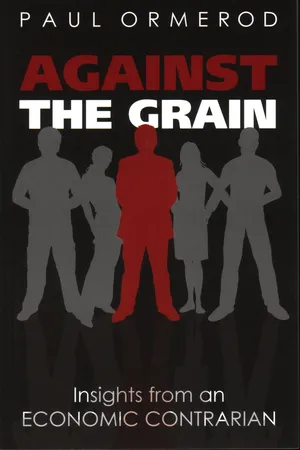
Economists and economics have been harshly criticised recently. This book accepts many of the criticisms of conventional theory but argues that the fundamental insights of economics are capable of reinterpretation and reinvention to deal with a host of contemporary concerns – social networks, globalisation, pay inequality, climate change, automation and the growth of 'nudge' policy amongst many others. The author uses his weekly column in the London business newspaper City A.M. to explain new developments in economic thinking and empirical research to a general audience. This book reproduces many of his most provocative columns with accompanying commentary and full references. The author's witty and informed analysis of events provides an ideal introduction to important ideas for anybody interested in how the modern economy works.
- 224 pages
- English
- ePUB (mobile friendly)
- Available on iOS & Android
eBook - ePub
About this book
Information
Edition
1- IntroductionIn the summer of 2012, I was invited to write a weekly opinion column for City A.M. newspaper. It is a free, business-focused newspaper, launched in 2005, and is distributed at more than 250 commuter hubs across London and the Home Counties, as well as 1,600 offices throughout the City, Canary Wharf and other areas of high business concentration. The paper has a strong online presence at www .cityam.com.The general views of the newspaper are broadly supportive of the free-market economy, of capitalism and private enterprise.It is therefore very appropriate that this selection of my columns is being supported and published by the Institute of Economic Affairs.1 As Allister Heath, editor of City A.M. from 2008 to 2014 and now editor of the Sunday Telegraph, wrote: ‘the IEA is the home of good economic analysis applied to public policy.’As a description of what I aim to do in my columns, Allister Heath’s statement could hardly be bettered. In the confines of 500 words each week, I try to shed light on a contemporary issue in political economy.I use the phrase ‘political economy’ rather than ‘economics’ deliberately. The great founding figures of the discipline in the late eighteenth and early nineteenth centuries, such as Adam Smith and David Ricardo, regarded themselves as addressing broad questions of public import, rather than being confined to mere technical analysis.In the mid-twentieth century, it was Friedrich Hayek, Nobel Laureate and a great inspirational figure for the IEA, who encapsulated this view:The physicist who is only a physicist can still be a first class physicist and a most valuable member of society. But nobody can be a great economist who is only an economist—and I am even tempted to add that the economist who is only an economist is likely to become a nuisance if not a positive danger.The point simply cannot be made too frequently that we have seen several major natural experiments, which contrast the performances of economies based upon market-oriented principles with those based upon the planned economy principles of socialism. These contrasts include the United States and the Soviet Union, East and West Germany, North and South Korea, India and China under different forms of socialism and India and China under different forms of capitalism. Venezuela is but the latest example of a failing socialist experiment. Countries which were very poor in the mid-twentieth century and which have adopted the principles of market-oriented economics, however, have since flourished.The key task of political economy is to provide a scientific understanding of how capitalism – by far the most successful social and economic system which humans have invented – actually works.This bookEach of the sections of this book has its own fairly short introduction. This is meant to set the scene for how the overall topic of the section fits into economics. These discussions are not meant in any way to supplant economics textbooks or offer a comprehensive survey of the scientific literature on the topic. They are intended to provide a bit more information on each topic than is possible in this general introduction.There is also a short note before each article, describing how it fits in and explaining the particular context in which it was written.There is intended to be a structure to the sequence in which the sections, into which the articles are grouped, appear. Inevitably, there is quite often some overlap, and a piece will have points which are relevant to headings other than the one under which it appears. This reflects the fact that many aspects of the modern world are complex, and economists need to call on a range of different concepts in their analyses.The collection starts with the area where economics is at its very strongest, and where knowledge of economics greatly assists the understanding of what might otherwise be puzzling phenomena. This is of course the area of market structures and incentives, which are fundamental to the success of the market-oriented economies of capitalism.A wide range of issues can be analysed under this broad heading, and the scope of the pieces reflects this fact. This is also by some considerable margin the longest section of the book, reflecting the importance of markets and incentives in economics.The other sections contain articles on themes where either economics is still very much grappling with how to tackle the problems, or where fresh approaches might be needed.One section, in acknowledgment of the seminal work of Hayek, is on the limits to knowledge and the inherent uncertainty which surrounds many human decisions. Closely related to this, though discussed in a separate section, is the theme of innovation.Following on from this, there is a group of pieces set out under the heading of ‘networks’.The last section is the area where I am most critical of existing economics, and the area which most grabs the attention of the media: macroeconomics.This is not the place to discuss at length my views on the developments in economics over the past fifty years or so. Interested readers can see them in a chapter in Johnson et al. (2017). But a short overview may be useful both in understanding the rationale of grouping the pieces into their different sections, and giving a broad perspective on their general themes.Microeconomics and macroeconomicsLike any academic discipline, economics is divided up into various different areas of study. The most important of these is a very simple one. An academic paper or lecture is either about ‘micro’ economics or ‘macro’ economics.The American humourist P. J. O’Rourke rather neatly captured what has traditionally been the distinction between the two in his book Eat the Rich2 (O’Rourke 1998):One thing that economists do know is that the study of economics is divided into two fields, ‘microeconomics’ and ‘macroeconomics’. Micro is the study of individual behaviour, and macro is the study of how economies behave as a whole. That is, microeconomics concerns things that economists are specifically wrong about, while macroeconomics concerns things economists are wrong about generally.Much of the focus in the media is on macroeconomics. For example, how much will the economy (GDP) grow next year? What will be the rate of inflation? Should austerity be abandoned? Economists frequently differ in their opinions on these topics.But it is in fact the micro level which is the area in which most economics is done. Economics is essentially a theory about how individuals choose between alternatives in any given situation. And in this area, there is far more agreement than disagreement among professional economists, whether in universities, in commercial companies, in financial markets or in central banks.My views on the two are easy to summarise. Over the past few decades, in my opinion, microeconomics has made a lot of progress. The same cannot be said of macroeconomics, which in some important respects has gone backwards.Just one slightly technical point is appropriate here. In the paragraphs immediately above, reference is made to individual behaviour. The theory is more general than just individual humans.Economists themselves often refer to ‘agents’ instead of ‘individuals’. By this they mean, to use a rather cumbersome description, an individual decision-making unit. So, as well as being a person, it can be a firm, a government, a central bank, a regulatory body.Economists certainly realise that a firm, say, is a complex entity. How decisions are made within a company is a complicated process. B...
Table of contents
- The author
- Foreword
- 1 Introduction
- 2 Market structures and incentives
- 3 Uncertainty and the limits to knowledge
- 4 Innovation
- 5 Networks
- 6 Macroeconomics
- About the IEA
Trusted by 375,005 students
Access to over 1.5 million titles for a fair monthly price.
Study more efficiently using our study tools.