1
JAMES GLEICK
AT THE BEGINNING: MORE THINGS IN HEAVEN AND EARTH
James Gleick last visited the Royal Society when researching his recent biography Isaac Newton. His first book, Chaos, was a National Book Award and Pulitzer Prize finalist and an international bestseller, translated into more than twenty languages. His other books include Genius: The Life and Science of Richard Feynman, Faster: The Acceleration of Just About Everything and What Just Happened: A Chronicle from the Information Frontier.
THE FIRST FORMAL MEETING OF WHAT BECAME THE ROYAL SOCIETY WAS HELD IN LONDON ON 28 NOVEMBER 1660. THE DOZEN MEN PRESENT AGREED TO CONSTITUTE THEMSELVES AS A SOCIETY FOR ‘THE PROMOTING OF EXPERIMENTAL PHILOSOPHY’. EXPERIMENTAL PHILOSOPHY? WHAT COULD THAT MEAN? AS JAMES GLEICK SHOWS FROM THEIR OWN RECORDS, IT MEANT, AMONG OTHER THINGS, A BOUNDLESS CURIOSITY ABOUT NATURAL PHENOMENA OF ALL KINDS, AND SOMETHING ELSE – A KIND OF EXUBERANCE OF INQUIRY WHICH HAS LASTED INTO OUR OWN DAY.
To invent science was a heavy responsibility, which these gentlemen took seriously. Having declared their purpose to be ‘improving’ knowledge, they gathered it and they made it – two different things. From their beginnings in the winter of 1660–61, when they met with the King’s approval Wednesday afternoons in Laurence Rooke’s room at Gresham College, their way of making knowledge was mainly to talk about it.
For accumulating information in the raw, they were well situated in the place that seemed to them the centre of the universe: ‘It has a large Intercourse
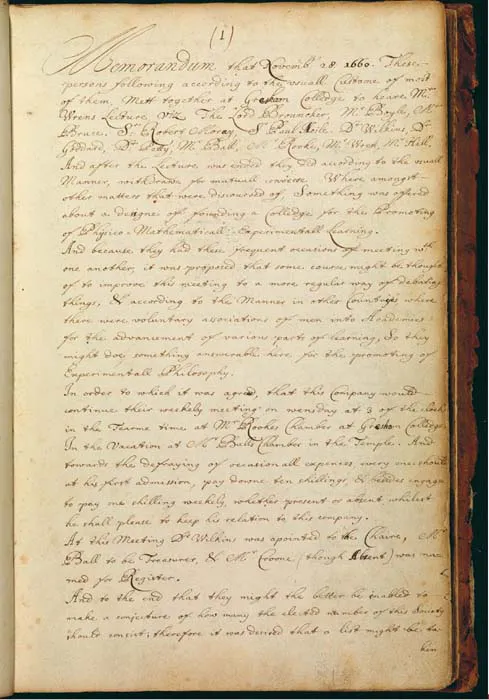
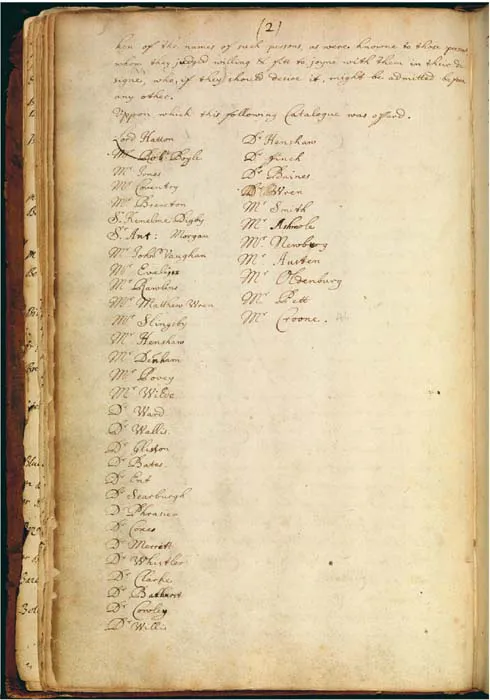
A record of the founding of the Royal Society and the first meeting, 28 November 1660.
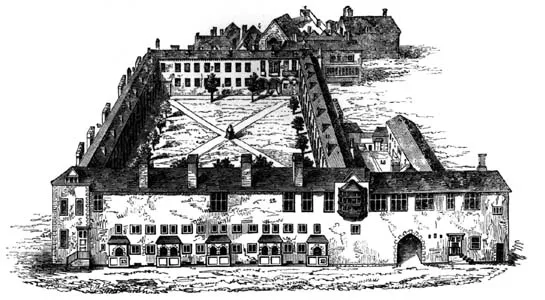
Gresham College, home of the Royal Society, 1660–1710.
with all the Earth:…a City, where all the Noises and Business in the World do meet:…the constant place of Residence for that Knowledge, which is to be made up of the Reports and Intelligence of all Countries.’ But we who know everything tend to forget how little was known. They were starting from scratch. To the extent that the slate was not blank, it often needed erasure.
At an initial meeting on 2 January their thoughts turned to the faraway island of Tenerife, where stood the great peak known to mariners on the Atlantic trade routes and sometimes thought to be the tallest in the known world. If questions could be sent there (Ralph Greatorex, a maker of mathematical instruments with a shop in the Strand, proposed to make the voyage), what would the new and experimental philosophers want to ask? The Lord Viscount Brouncker and Robert Boyle, who was performing experiments on that invisible fluid the air, composed a list:
- ‘Try the quicksilver experiment.’ This involved a glass tube, bent into a U, partly filled with mercury, and closed at one end. Boyle believed that air had weight and ‘spring’ and that these could be measured. The height of the mercury column fluctuated, which he explained by saying, ‘there may be strange Ebbings and Flowings, as it were, in the Atmosphere’ – from causes unknown. Christopher Wren (‘that excellent Mathematician’) wondered whether this might correspond to ‘those great Flowings and Ebbs of the Sea, that they call the Spring-Tides’, since, after all, Descartes said the tides were caused by pressure made on the air by the Moon and the Intercurrent Ethereal Substance. Boyle, having spent many hours watching the mercury rise and fall unpredictably, somewhat doubted it.
- Find out whether a pendulum clock runs faster or slower at the mountain top. This was a problem, though: pendulum clocks were themselves the best measures of time. So Brouncker and Boyle suggested using an hourglass.
- Hobble birds with weights and find out whether they fly better above or below.
- ‘Observe the difference of sounds made by a bell, watch, gun, &c. on the top of the hill, in respect to the same below.’
And many more: candles, vials of smoky liquor, sheep’s bladders filled with air, pieces of iron and copper, and various living creatures, to be carried thither.
A stew of good questions, but to no avail. Greatorex apparently did not go, nor anyone else of use to the virtuosi, for the next half-century. Then, when Mr J. Edens made an expedition to the top of the peak in August 1715, he was less interested in the air than in the volcanic activity: ‘the Sulphur
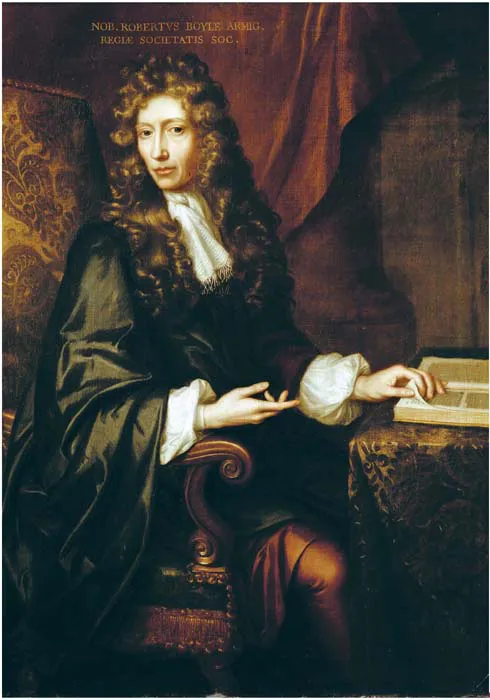
Portrait of Robert Boyle by Johann Kerseboom.
discharg[ing] its self like a Squib or Serpent made of Gun-powder, the Fire running downwards in a Stream, and the Smoak ascending upwards’. He did wish he had brought a Barometer – the device having by now been invented and named – but he would have had to send all the way to England, and the expense would have come from his own pocket. Nonetheless he was able to say firmly that there was no truth to the report about ‘the Difficulty of breathing upon the top of the place; for we breath’d as well as if we had been below’.
No one knew how tall the mountain was anyway, or how to measure it. Sixteenth-century estimates ranged as high as 15 leagues (more than 80,000 metres) and 70 miles (more than 110,000 metres). One method was to measure from a ship at sea; this required a number for the radius of the Earth, which wasn’t known itself, though we know that Eratosthenes had got it right. The authoritative Geographia of Bernhardus Varenius, published in Cambridge in 1672 with Isaac Newton’s help, computed the height as 8 Italian miles (11,840 metres) – ‘quae incredibilis fere est’ – and then guessed 4 to 5 miles instead. (An accurate measurement, 3,718 metres, had to wait till the twentieth century.) But interest in Tenerife did not abate – far from it. Curiosity about remote lands was always honoured in Royal Society discourse. ‘It was directed,’ according to the minutes for 25 March, ‘that inquiry should be made, whether there be such little dwarvish men in the vaults of the Canaries, as was reported.’ And at the next meeting, ‘It was ordered to inquire, whether the flakes of snow are bigger or less in Teneriffe than in England…’
Reports did arrive from all over. The inaugural issue of the Philosophical Transactions featured a report (written by Boyle, at second hand) of ‘a very odd Monstrous Calf’ born in Hampshire; another ‘of a peculiar Lead-Ore of Germany’; and another of ‘an Hungarian Bolus’, a sort of clay said to have good effects in physick. From Leyden came news of a man who, by stargazing nightly in the cold, wet air, obstructed the pores of his skin, ‘which appeared hence, because that the shirt, he had worn five or six weeks, was then as white as if he had worn it but one day’. The same correspondent described a young maid, about thirteen years old, who ate salt ‘as other children doe Sugar: whence she was so dried up, and grown so stiff, that she could not stirre her limbs, and was thereby starved to death’.
Iceland was the source of especially strange rumours: holes, ‘which, if a stone be thrown into them, throw it back again’; fire in the sea, and smoking lakes, and green flames appearing on hillsides; a lake near the middle of the isle ‘that kills the birds, that fly over it’; and inhabitants that sell winds and converse with spirits. It was ordered that inquiries be sent regarding all these, as well as ‘what is said there concerning raining mice’.
The very existence of these published transactions encouraged witnesses to relay the noteworthy and strange, and who could say what was strange and what was normal? Correspondents were moved to share their ‘Observables’. Observables upon a monstrous head. Observables in the body of the Earl of Balcarres (his liver very big; the spleen big also). Observables were as ephemeral as vapour in this camera-less world, and the Society’s role was to grant them persistence. Many letters were titled simply, ‘An Account of a remarkable [object, event, appearance]’: a remarkable meteor, fossil, halo; monument unearthed, marine insect captured, ice shower endured; Aurora Borealis, Imperfection of Sight, Darkness at Detroit; appearance in the Moon, agitation of the sea; and a host of remarkable cures. An Account of a remarkable Fish began, ‘I herewith take the liberty of sending you a drawing of a very uncommon kind of fish which was lately caught in King-Road…’
It fought violently against the fisher-man’s boat…and was killed with great difficulty. No body here can tell what fish it is…I took the drawing on the spot, and do wish I had had my Indian Ink and Pencils…
From Scotland came a careful report by Robert Moray of unusual tides in the Western Isles. Moray, a confidant of the King and an earnest early member of the Society, had spent some time in a tract of islands for which he had no name – ‘called by the Inhabitants, the Long-Island’ (the Outer Hebrides, we would say now). ‘I observed a very strange Reciprocation of the Flux and Re-flux of the Sea,’ he wrote, ‘and heard of another, no less remarkable.’ He described them in painstaking detail: the number of days before the full and quarter moons; the current running sometimes eastward but other times westward; flowing from 9½ of the clock to 3½ ebbing and flowing orderly for some days, but then making ‘constantly a great and singular variation’. Tides were a Royal Society favourite, and they were a problem. Humanity had been watching them for uncounted thousands of years, and observing the coincidence of their timing with the phases of the Moon, without developing an understanding of their nature – Descartes notwithstanding. No global sense of the tides could be possible when all recorded information was local. And even now, Moray emphasised the peculiarity of his observations; and quailed at the idea of generalising.
To penetrate into the Causes of these strange Reciprocations of the Tides, would require exact descriptions of the Situation, Shape, and Extent of every piece of the adjacent Coasts of Eust and Herris; the Rocks, Sands, Shelves, Promontorys, Bays, Lakes, Depths, and other Circumstances, which I cannot now set down with any certainty, or accurateness; seeing, they are to be found in no Map.
He had drawn a map himself some years earlier, but it was gone. ‘Not having copied [it], I cannot adventure to beat it out again.’
As often as they could be arranged, experiments were performed for the assembled virtuosi. Brouncker prosecuted his experiment of the recoiling of guns, Wren his experiment of the pendulum, William Croone his experiment with bladders and water. When Robert Hooke took charge of experiments, they came with some regularity. Even so, many more experiments were described, or wished for, than were carried out at meetings. The grist of the meetings was discourse – animated and edifying. They loved to talk, these men.
They talked about ‘magnetical cures’ and ‘sympathetical cures’ and the possibility of ‘tormenting a man with the sympathetic powder’. They talked about spontaneous equivocal generation: ‘whether all animals, as well vermin and insects as others, are produced by certain seminal principles, determined to bring forth such and no other kinds. Some of the members conceived, that where the animal itself does not immediately furnish the seed, there may be such seeds, or something analogous to them, dispersed through the air, and conveyed to such matter as is fit and disposed to ferment with it, for the production of this or that kind of animal.’ They talked about minerals discovered under ground, in ‘veins’, wondering whether they grew there or had existed since the creation. Some suggested that metals and stones were produced ‘by certain subterraneous juices…passing through the veins of the earth’.
They talked about why it was hotter in summer than in winter; no one knew, but George Ent had a theory. It was ordered to be registered in a ‘book of theories, which was directed to be provided’. George Villiers, the Duke of Buckingham, newly admitted to the Society, produced what he promised was the horn of a unicorn. Legend had it that a circle drawn with such a thing would keep a spider trapped until it died, so they performed the experiment: ‘A circle was made with powder of unicorn’s horn, and a spider set in the middle of it, but it immediately ran out. The trial being repeated several times, the spider once made some stay on the powder.’
Still, the discourse was liberating. ‘Their first purpose,’ said Thomas Sprat, writing his ‘history’ of the Society when it was barely fledged, ‘was no more, than onely the satisfaction of breathing a freer air, and of conversing in quiet one with another, without being ingag’d in the passions, and madness of that dismal Age’. The rules were clear: nothing about God; nothing about politics; nothing about ‘News (other than what concern’d our business of Philosophy)’. And what news was that? John Wallis specified, ‘as Physick, Anatomy, Geometry, Astronomy, Navigation, Statics, Mechanics, and Natural Experiments’.
James Long, newly admitted in April 1663, delivered the news, as the amanuensis reported in his minutes, ‘that there were ermines in England’. He promised to produce some. ‘He mentioned also, that bay-salt being thrown upon toads would kill them…he made mention likewise of a kind of stones with natural screws, and promised to show some of them.’
At the next meeting, Long talked about the generation of ants: they come out of pods full of eggs. He added that he had seen a maggot under a stag’s tongue; that land-newts are more noxious than water newts; and that toads become venomous in hot weather and in hot countries such as Italy. Croone mentioned that he had seen a viper with a young one in its belly, and Long added, ‘The female viper hath four teeth, two above and two below; but the male only two and those above.’ Hooke showed some new drawings he had made from observations with his microscope, including a spider with six eyes – lately he had been bringing something new to almost every meeting. Moray described a watch with particularly hard steel, which reminded Long that he had once seen a breast-piece so tough that a pistol bullet only dented it.
Long was a military man, having been first a captain and then colonel of horse in a Royalist regiment. John Aubrey describes him as a good swordsman and horseman and a devotee of ‘astrology, witchcraft and natural magic’. He does seem to have found him rather voluble – ‘an admirable extempore orator for a harangue’. They went hawking together, and what Aubrey recalled was that Long never stopped gabbing. He certainly found his voice at the Royal Society. The minute-taker sometimes sounds weary:
Col. Long having related divers considerable observations of his concerning insects…
…said, that an iron back in a chimney well heated, useth to make a noise like that of bell-metal.
…observed, that a bean cut into two or three pieces produces good beans.
…desired farther ti...