CHAPTER 1
Ad infinitum—An Empire Lived in Latin
… HVMANITAS VOCABATVR, CVM PARS SERVITVTIS ESSET.
… called “civilization,” when it was just part of being a slave.
Tacitus, Agricola, xxi
THE HISTORY OF LATIN is the history of the development of western Europe, right up to the point when Europe made its shattering impact on the rest of the world. In fact, only seen from the perspective of Latin does Europe really show itself as a single story: nothing else was there all the way through and involved in so many aspects, not Rome, not the Empire, not the Catholic Church, not even Christianity itself.
For the people who spoke and wrote it, the language was their constant companion; learning it was the universal key for entry into their culture; and expression in it was the unchanging means for taking social action. And this relationship with Latin, for its speakers and writers, lasted for two and a half thousand years from 750 BC. There was a single tradition through those millennia, and it was expressed—almost exclusively until 1250, and predominantly and influentially for another five hundred years thereafter—in Latin. Romans’ and Europeans’ thoughts were formed in Latin; and so the history of Latin, however clearly or vaguely we may discern it, is utterly and pervasively bound up with the thinking behind the history of western Europe.
Latin, properly understood, is something like the soul of Europe’s civilization. But the European unity that the Romans achieved and organized was something very different from the consensual model of the modern European Union. It was far closer in spirit to the kind of unity that Hitler and Mussolini were aiming at. No one ever voted to join the Roman Empire, even if the empire itself was run through elected officials, and LIBERTAS remained a Roman ideal. ROMANITAS—the Roman way as such—was never something voluntarily adopted by non-Roman communities.* Conquest by a Roman army was almost always required before outsiders would come to see its virtues, and knowledge of Latin spread within a new province.
At the outset, the Latin language was something imposed on a largely unwilling populace, if arguably—in the Roman mind, and that of later generations—for their greater good. There was no sense of charm or seduction about the spread of Latin, and in this it differs from some other widespread languages: consider the pervasive image of Sanskrit as a luxuriant growth across the expanse of India and Southeast Asia, or indeed the purported attractions of French in the nineteenth century as an alluring mistress. Speakers of Latin, even the most eloquent and illustrious, saw it as a serious and overbearing vehicle for communication. In the famous words of Virgil:
TV REGERE IMPERIO POPVLOS, ROMANE, MEMENTO | you, Roman, mind to rule peoples at your command |
—HAE TIBI ERVNT ARTES—PACISQVE IMPONERE MOREM | (these arts will be yours), to impose the way of peace, |
PARCERE SVBIECTIS ET DEBELLARE SVPERBOS | to spare the conquered, and to battle down the proud.1 |
EXPOLIA, “Strip him.”
The most excellent Flavius Leontius Beronicianus, governor of the Thebaid in southern Egypt in the early 400s AD,† ruled a Greek-speaking province. Greek had been the language of power there since the days of the Ptolemies more than seven centuries before, but the judicial system over which he presided was Roman. Its official records were kept in Latin, even of proceedings that actually took place largely in Greek and perhaps marginally (and through Greek interpreters) in Egyptian. The record we have, apparently verbatim, is in a mixture of Latin and Greek. Fifteen centuries later, it turned up on an Egyptian rubbish dump.
Slaves called to witness in Roman trials had always been routinely beaten, in theory as a guarantee of honesty; but on this day Beronicianus seems to have been in two minds. EXPOLIA. The governor was speaking Latin, and so the first the witness would have known of what was to happen was when his shirt was taken off him. The governor went on in Greek, “For what reason did you enter proceedings against the councillor?” remarking to the staff officer (also in Greek), “Have him beaten.” The record states that the witness was thrashed with ox sinews, and then the governor said in Greek, “Don’t beat free men.” And turning to the staff, PARCE, “Leave off.”2
What was it like having your life run for you in Latin? Even after three centuries of Roman rule, Latin stood as a potent symbol of irresistible, and sometimes arbitrary, power, especially to those who did not know the language.
By the nature of things, we do not have many direct accounts of being on the receiving end of government administered in Latin. Our sources are writings that have survived, whether on papyrus and parchment through two millennia of recopying, or on scraps of masonry that have directly defied erosion and decay. And where Latin was dominant, Latin users largely monopolized literacy. We seek almost in vain for non-Latin attitudes to the advent of Latin.
In fact, some of the most vividly subjective statements of the impact of Roman rule and the advent of Latin come from the pen of a man who had held the highest elective office in the Roman state, the historian Cornelius Tacitus. He described the British in the second century as ready to tolerate military service, tribute, and other impositions of empire, up to but not including abuse, “being already schooled to obey, but not yet to accept slavery.”* He also articulated the anti-Roman arguments of those who backed the British queen Boudicca’s revolt, after a first generation of Roman rule: “Once we used to have one king at a time, but now we get two imposed, the legate to ravage our lifeblood, and the procurator our goods, one served by centurions, the other by slaves, all combining violence with insolence … and look at how few the invaders are, compared with our numbers.”3
Clearly, the major inconveniences of life under the Empire were taxes and military conscription, and neither was helped by the manifestly arbitrary way that those in charge could abuse their offices. But for many in the first generation to be conquered, the far greater threats were of personal enslavement and deportation, a life made up of all duties and no rights, next to which this “moral slavery” that exercised Tacitus was no slavery at all. This very real prospect, aggravated by the thought that the new recruits would always be the worst treated, was something else that he imagined looming large in the minds of Calgacus and his army of North Britons about to make their last stand against Rome.4
On the other hand, once the immovability of the Roman yoke had become established, there were compensations, if only for those nearer the top in their societies.* Tacitus also commented cynically on the efforts made by the British elite to accommodate themselves to Roman control (PAX ROMANA). The governor Agricola, he said, in a deliberate policy of flattery, “instructed the sons of the chiefs in liberal arts, and expressed a preference for the native wit of the British over the studies of the Gauls, so as to plant a desire for eloquence in people who had previously rejected the Roman language altogether. So they took to our dress, and wearing the toga. Gradually they were drawn off into decadence, with colonnades and baths and chic parties. This these innocents called civilized life [HVMANITAS], whereas it was really part of their enslavement.”5
So language was early seen as one of the benefits of the new dispensation. Later, this enthusiasm threatened to get out of hand: Juvenal, a contemporary of Tacitus’ at Rome, commented on the Empire-wide popularity of the Romans’ traditional education in rhetoric:
Today the whole world has its Greek and Roman Athens; the eloquent Gauls have taught the British to be advocates, and Thule is talking of hiring an oratory teacher.6
In the early days, even some Romans bore the linguistic brunt when the spreading PAX ROMANA temporarily outran the sphere of Latin’s currency. Ovid was the very model of Roman urbanity, a leading poet and wit in the time of Augustus, HOMO EMVNCTAE NARIS as they would have put it, ‘a man with an unblocked nose’. With a divine irony, if not poetic justice, he was exiled in AD 8 to Tomi, a town on the western coast of the Black Sea (modern Constantsa) with less than a generation of Romanization behind it. Evidently, he suffered from the lack of Latin there. There was so little of it that his reputation counted for nothing. Instead, he described rather vividly the typical problems of a visitor who “does not speak the language”: “They deal in their own friendly language: I have to get things across through gestures. I’m the barbarian here, uncomprehended by anyone, while the Getans laugh witlessly at words of Latin. They openly insult me to my face in safety, perhaps even twitting me for being an exile. And all too often they believe the stories made up about me, however much I shake my head or nod at their words.”7
But these were just transitional difficulties for Latin speakers in the empire’s borderlands. Over the long centuries of Roman domination, the language, even in its written form, came to be used at all levels, perhaps even among building workers. At Newgate in London, a tile has turned up with the graffito AVSTALIS DIBVS XIII VAGATVR SIB COTIDIM ‘Gus has been wandering off every day for thirteen days’.8 One hundred and fifty miles away, in the health resort and holiday centre that Romans developed at Bath, a hundred ritual curses and oath tokens have emerged from the waters, written in Latin (sometimes backward): DOCIMEDIS PERDIDIT MANICILIA DVA QVI ILLAS INVOLAVI VT MENTES SVA PERDET OCVLOS SVS IN FANO VBI DESTINA ‘Docimedis has lost a pair of gloves. May whoever has made off with them lose his wits and his eyes in the temple where (the goddess) decides’. Although the British language was never fully replaced in Britain (as the modern survival of Welsh and Cornish show), the rulers’ language, Latin, clearly came to penetrate deeply into the days and ways of ordinary life.
All over the empire, from Britain to Africa, and from Spain to Asia, men were joining the army, acquiring a command of Latin, and when they settled at the end of their service—sometimes in colonies far from their origins—planting it there. The new Latin speakers made their mark permanently all over the Empire in the spread of their inscriptions. They are typically on tombstones, but the Mediterranean civic life that the Roman veterans brought to their new homes across Europe left written memorials of many kinds. And from these, it is clear that the language spread from military fathers to other members of the family.
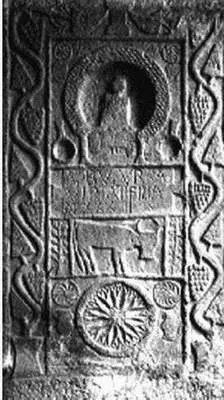
Memorial to Annia Buturra. Although the legend is in Latin, the imagery is Basque: the red heifer of Mari and the thistle-head ‘flower of the sun’ eguzki-lorea.
In Isca Silurium (Caerleon in south Wales), for example, a daughter, Tadia Exuperata, erected beside her father’s grave a memorial to her mother, Tadia Vallaunius, and her brother Tadius Exuperatus, “dead on the German expedition at thirty-seven.”9 At the spa of Aquae Sulis (Bath), where Romans tried to re-create a little luxury to remind them of home, the armourers’ craft guild recorded the life of “Julius Vitalis, armourer of the twentieth legion recruited in Belgium, with nine years’ service, dead at twenty-nine.”10 Some inscriptions give glimpses of domestic sagas: Rusonia Aventina, visiting from Mediomatrici (Metz) in Gaul (perhaps to take the waters?), was buried at the age of fifty-eight by her heir L. Ulpius Sestius.11 Some read more like statements by the proverbial “disgusted of Tunbridge Wells”: “C. Severinus, Regional Centurion (retd), restored with virtue and the spirit of the emperor the purity of this holy place wrecked through insolence.”12
In Gastiain, Navarra, Spain, a memorial to a daughter reads, “To the Gods and Spirits (DIIS MANIBVS). Annia Buturra, daughter of Viriatus, thirty years old, placed here.” The opening phrase is classic for a Latin epitaph, but the effigies of a young woman seated on a ledge above, and a heifer looking out mournfully below, all surrounded by a frieze of vine leaves and grapes, show belief in a Basque underworld.13
Across Europe in Liburnia, modern Croatia, fragments of a sarco...