![]()
PART ONE
Getting started
The best way to get started with yoga is to begin! Start practising and learning the asanas (postures) and you will immediately begin to understand how yoga works on the body and the mind. Try to fit in a little yoga each day and you will soon notice the difference in your body, as it becomes more flexible and strong, and also your mind, as it becomes more focused.
![]()
HATHA YOGA
There are different ways to start the journey into yoga, but in Western society the route most often taken is the practice of Hatha Yoga. This term is used to describe the predominant study of the third and fourth limbs – the postures and breathing techniques.
AWARENESS OF BREATH
Once you begin to memorize and understand some of the postures, you will also learn to use the breath as directed, and utilize it as an aid to movement. This is where some of the magic of yoga will become apparent. In our modern society, we are unused to being aware of our breathing and using it to help us in our tasks. We mostly ignore the breath and what it can do for the body and often forget to breathe completely. How often have you held your breath when trying to do something challenging?
Power of breath
Hatha Yoga will teach you not only an awareness of breath but also a realization of its power to aid the body and quieten the mind. The asanas will give you an awareness of your body, how it works and how to strengthen and flex it, in a way you never knew existed.
PRACTICE IS IMPORTANT
The enlightenment of yoga begins with practice – there is no other way! All the Indian yogis agree on this and it really is true – by practising the asanas you will start to understand why all the hype about yoga is justified. As Sri K. Pattabhi Jois says: ‘Do your practice and all is coming’.
![]()
GET IN THE MOOD
Start by finding an area in which to practise your yoga. Any space where you can lie full length and have some room on either side is fine. You can wear anything light and loose in which you can move easily. Bare arms are preferable, particularly for some of the more challenging positions.
HOW MUCH SPACE DO I NEED?
The ideal thing about yoga is that it does not take up a huge amount of space, unlike, say, aerobics or running, and you do not need basketfuls of equipment. You will need an area that is object free, well ventilated (as you will be sweating) and somewhere well away from noise and interruptions to allow your mind to concentrate on the task in hand. A carpet can be used, but you may find that you slip on this, so a non-slip yoga mat is better.
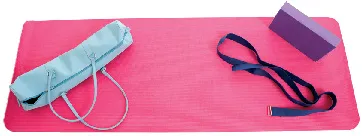
Mats, blocks and straps
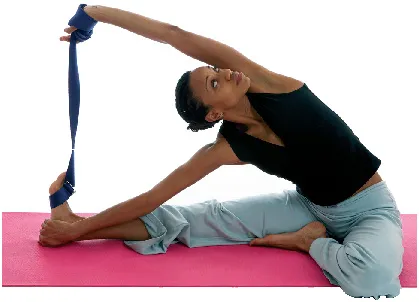
As you progress in certain positions you may find it advantageous to have a foam block for support and a strap for facilitating stretching but that is all the equipment you will need besides your yoga mat which you can purchase online.
LISTEN TO YOUR BREATHING
Unlike most other exercise, music or DVDs are not needed because you will be turning your focus inwards – onto your body and its breathing rhythms. You will be listening to your breathing and using this as your cue to move from position to position. As you progress, you will notice that your surroundings become less and less important as you become more focused on your movement and meditation.
Yoga mats are now available in handy carry bags. Using blocks and straps will aid your yoga postures.
TIMING
A full yoga session can take in excess of one-and-a-half hours, but when you are starting out it is best to begin by practising short and often. Don’t think that 10 minutes is not worth it because it is. One of the first sequences you will be learning is the Sun Salutations, and you can fit these into any time slot that you can make free in the course of a busy day.
Don’t rush anything
Yoga is regulated by the breath, so if you perform it mindfully you won’t be able to rush through any positions – it will take the time it takes. This is a useful first lesson for a stressed yoga novice!
![]()
FINDING A CLASS
Nowadays there are huge numbers of yoga classes available to the general public in gyms, health clubs and municipal centres. You can just turn up for most classes; the teacher should be able to accommodate you, whether you are a beginner or an advanced practitioner. If you do join a new class, do make sure that your teacher is aware of any injuries or physical problems you may have. This way, they can advise and enable you to work around any physical restrictions and even to help heal them.
It is important to choose the kind of class that suits you as there are many different ones. Below is a brief description of the more common classes available.
ASHTANGA YOGA
This form of yoga is very athletic and you jump from position to position. The second series of this type of yoga also involves gymnastics, including handstands, backward bends and some interesting extreme positions. A variant of this style of yoga is sometimes termed as ‘Power Yoga’. You should not attempt this type of yoga unless you are very fit, active and flexible.
IYENGAR
Based on the teachings of Yogi B. K. S. Iyengar, this is one of the most popular forms of yoga. It favours holding the poses for much longer to develop the correct alignment and posture in each position.
KUNDALINI
This style uses the breath as the central part of the practice. Often the class will begin with chanting and there will be more deep exploration of the breath in relation to the movement.
BIKRAM
Bikram Yoga gets its name from its founding yogi Bikram Chouhouri, and is a set series of 26 postures that must be done in 40-degree heat. The idea of the
Individual tuition
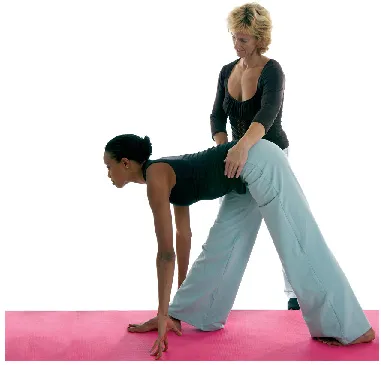
Don’t forget that you can also hire a teacher to work one-on-one with you. This may be beneficial at the beginning in helping to explain how to attempt some of the more complicated postures and how to use the breath to help you.
Yoga styles in this book
This book uses postures that come mainly from the Ashtanga and Iyengar styles of yoga, but you may also find them featured elsewhere.
heat is to focus the mind and loosen the body, along with sweating, which is thought to be detoxing. This form of yoga is sometime referred to as ‘Hot Yoga’.
SIVANANDA
This form of yoga is more general, focusing on 12 poses along with periods of relaxation and breath work. This is a popular yoga form.
![]()
BEGINNING YOUR PRACTICE
To develop your practice to the point where it really makes a difference to your life and your body, try to do a little yoga every day. You need very little space, time or equipment, so there are no excuses.
The beauty of regular yoga practice is that you can begin to undergo a calming of the mind and an opening up of the body. This book will help you to experience the beginning of this breakthrough in movement and thought, and it will keep you challenged until you are ready to move on to a full series of postures.
HOW TO APPROACH YOUR PRACTICE
First of all, you must acquaint yourself with the different postures that you are going to perform at the beginning of each session. Most forms of yoga begin with the Sun Salutation series, and this is what you will focus on as your initial ‘warm up’.
Start by learning, off by heart, the Sun Salutation A postures (see page 56). When you have mastered these, you can move on to the Sun Salutation B postures, approaching them in a similar way.
Guidelines
- Work through each move slowly, take your time and work on getting the movement right and feeling confident and balanced in each position – this may take several sessions.
- Don’t worry about memorizing movements in the early stages – as you take time to work through each one, it will be absorbed into your body, so that you come to remember it.
- Then go back and work with the notes in this book to ensure you are performing the right breaths for the right movements. Each movement has an accompanying out or in breath (exhalation or inhalation). These are important because they help the body to achieve the linking movements and positions.
- Once you have learned the positions and their breath accompaniments you can start to move through the sequence as if it were a dance. Slowly progress, move by move, from one position to another in a seamless thread of movement.
- While you are doing this, concentrate your mind on perfecting each posture you move from and into. Use the notes in this book to focus on the aspects of the posture you should be working on.
- The beauty of the postures in yoga is that each one can be worked on indefinitely to achieve the perfect position, giving the mind something to think about with regard to the movement you are performing.
- You will discover, as you regularly practise Sun Salutation A, that your body will move in a rhythmic way as you work from posture to posture and your breath echos the rhythm. Your mind will be free from everyday thoughts as it focuses on each movement and how you should be doing it – when you should be breathing and which areas of muscle you should be contracting or extending.
- You will suddenly notice that you are moving, br...