The Night Sky
eBook - ePub

The Night Sky

  1. English
  2. ePUB (mobile friendly)
  3. Available on iOS & Android
eBook - ePub

The Night Sky

About this book

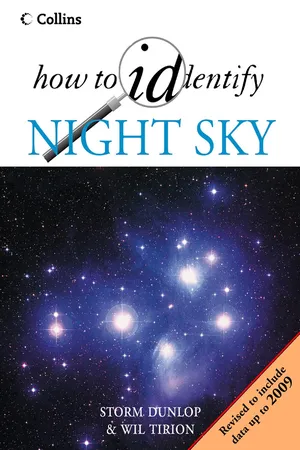
(Illustrations are best viewed on a tablet. )(Illustrations are best viewed on a tablet. )An introductory guide to navigating your way around the night sky and identifying what you can see on any given night. An introductory guide to navigating your way around the night sky and identifying what you can see on any given night. Please note that this is the 2004 edition. Chart data is accurate to the end of 2009. Please note that this is the 2004 edition. Chart data is accurate to the end of 2009. Designed as a comprehensive introduction for the beginner and those who want to find out more, How to Identify the Night Sky covers everything that can be seen with the naked eye and binoculars, as well as what is visible using a small telescope. Designed as a comprehensive introduction for the beginner and those who want to find out more, How to Identify the Night Sky covers everything that can be seen with the naked eye and binoculars, as well as what is visible using a small telescope. There are sections on how to observe and understand the objects that comprise the night sky, the moon, the movements of the stars and planets throughout the year and astronomical events. There are sections on how to observe and understand the objects that comprise the night sky, the moon, the movements of the stars and planets throughout the year and astronomical events. The constellations are given a comprehensive treatment. For each one there is a chart, a photograph, a description of its features and history, the best dates and times of visibility, the mythological representation and a list of interesting objects. The constellations are given a comprehensive treatment. For each one there is a chart, a photograph, a description of its features and history, the best dates and times of visibility, the mythological representation and a list of interesting objects.

Frequently asked questions

Yes, you can cancel anytime from the Subscription tab in your account settings on the Perlego website. Your subscription will stay active until the end of your current billing period. Learn how to cancel your subscription.
No, books cannot be downloaded as external files, such as PDFs, for use outside of Perlego. However, you can download books within the Perlego app for offline reading on mobile or tablet. Learn more here.
Perlego offers two plans: Essential and Complete
  • Essential is ideal for learners and professionals who enjoy exploring a wide range of subjects. Access the Essential Library with 800,000+ trusted titles and best-sellers across business, personal growth, and the humanities. Includes unlimited reading time and Standard Read Aloud voice.
  • Complete: Perfect for advanced learners and researchers needing full, unrestricted access. Unlock 1.4M+ books across hundreds of subjects, including academic and specialized titles. The Complete Plan also includes advanced features like Premium Read Aloud and Research Assistant.
Both plans are available with monthly, semester, or annual billing cycles.
We are an online textbook subscription service, where you can get access to an entire online library for less than the price of a single book per month. With over 1 million books across 1000+ topics, we’ve got you covered! Learn more here.
Look out for the read-aloud symbol on your next book to see if you can listen to it. The read-aloud tool reads text aloud for you, highlighting the text as it is being read. You can pause it, speed it up and slow it down. Learn more here.
Yes! You can use the Perlego app on both iOS or Android devices to read anytime, anywhere — even offline. Perfect for commutes or when you’re on the go.
Please note we cannot support devices running on iOS 13 and Android 7 or earlier. Learn more about using the app.
Yes, you can access The Night Sky by Storm Dunlop, Wil Tirion in PDF and/or ePUB format, as well as other popular books in Physical Sciences & Astronomy & Astrophysics. We have over one million books available in our catalogue for you to explore.

CONSTELLATIONS

The constellations described in the following pages include certain southern constellations that are not normally readily visible from mid-northern latitudes, but which may be seen from countries around the Mediterranean, and from the southern United States. Some of these (such as Puppis and Columba) are partially shown on the monthly and seasonal charts, low on the southern horizon.
The constellations are generally arranged in alphabetical order, but for convenience, certain small, neighbouring constellations (such as Aries and Triangulum) are shown on a single chart. In general, the northernmost constellation is given in its correct place in the sequence. The page numbers for individual constellations that are not in alphabetical order are given in the table opposite.
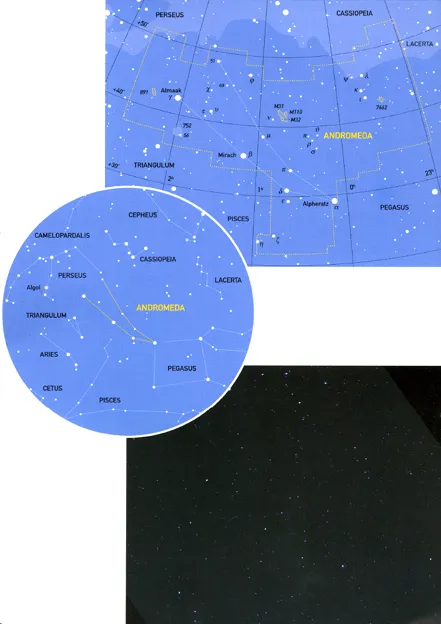
Each constellation is shown in three forms: on a finder chart showing the surrounding constellations; as a detailed chart; and as a photograph. The orientation of all three is identical to make identification easier. It should be borne in mind, however, that the apparent magnitudes of stars may be somewhat altered during the photographic and reproduction processes. Visually, some stars may seem brighter or fainter than they appear on the photographs.
A selection of interesting objects is given, all of which are shown on the appropriate chart. Additional, larger-scale charts are given for a number of objects, including special charts to show variable stars and their comparisons.
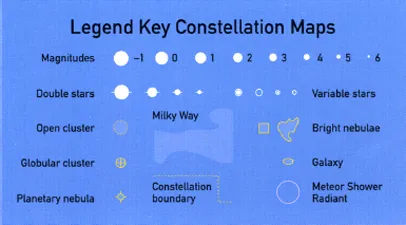
The accompanying key shows the magnitude scale and the symbols that are used on the charts.


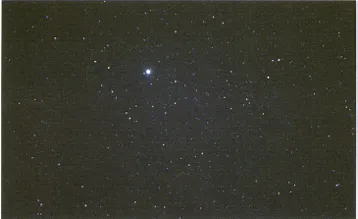
The brightest ‘star’ is Jupiter, here in Capricornus
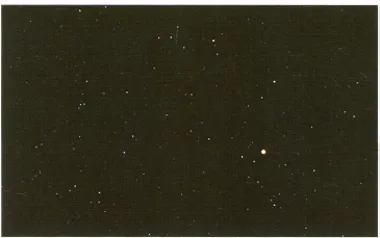
Aquarius. with the ‘Water Jar’ (top left centre) and the planet Saturn.
CONSTELLATIONS
Columba (with Lepus)
Corona Australis (with Sagittarius)
Crater (with Corvus)
Equuleus (with Delphinus)
Piscis Austrinus (with Grus)
Serpens caput (with Ophiuchus)
Serpens cauda (with Scutum)
Triangulum (with Aries)
Vulpecula (with Sagitta)

ANDROMEDA
ANDROMEDAE • And

SOUTH AT 22:00 local time: Nov 10
VISIBLE AT 22:00 local time Jly–Dec
AREA: 722 sq. deg. (19th)
Although none of the stars in this constellation are particularly bright, it is easy to locate, running northeastwards from the Great Square of Pegasus. The star α Andromedae (Alpheratz) forms both the ‘head’ of Andromeda, and the fourth corner of the Square of Pegasus. The popular names for this constellation include ‘The Princess’ and ‘The Chained Maiden’, because mythologically it represents Andromeda, the daughter of Cepheus and Cassiopeia, who, following the pronouncements of an oracle, was chained to a rock as a sacrifice to Cetus, the sea monster that was ravaging the coast. She was rescued by Perseus, who turned Cetus to stone, using the head of Medusa, whom he had previously slain.
υ And (01h37m, +41°25’) is a star (mag. 4.1) slightly more massive and brighter than the Sun. It has been found to have a planet, with a minimum mass of 0.65 that of Jupiter, orbiting extremely close to the star (at about 0.056 AU), with a period of just 4.61 days. Like the planets orbiting τ Boo and 51 Peg, it has been called a ‘hot Jupiter’. There is evidence of two other large planets in this system.
56 And (01h56m, +37°16’) is an optical double consisting of two unrelated stars: one an orange giant, mag. 5.7, and the other a more distant red giant, mag. 5.9. The double is easily resolved in binoculars.
M31 (00h43m, +41°16’), the Great Andromeda Galaxy, which is visible to the naked eye as a hazy spot of light, is a giant spiral, somewhat larger and more massive than our own galaxy. It is simple to find by following the line of stars from β And (Mirach), through μ, and on to just northwest of υ. It has several satellite galaxies, the most prominent of which are M32, detectable in binoculars, and M110 (00h40m, +41°41’), which requires a larger aperture.
M32 (00h47m, +40°52’), is a dwarf elliptical galaxy, which, although visible in binoculars, may be mistaken for a star. Its magnitude is variously quoted as 8 or 9.
NGC 752 (01h58m, +37°41’) is a large open cluster, northeast of 56 And. It is best observed with binoculars, but sharp-eyed observers are said to be able to see it with the naked eye.

AQUARIUS
AQUARII • Aqr • THE WATER CARRIER

SOUTH AT 22:00 local time: Oct 10
VISIBLE AT 22:00 local time: Jly–Nov
AREA: 980 sq. deg. (10th)
This ancient constellation represents a water carrier, pouring water from the mouth of a jar (the ‘Water Jar’ or γ of Aquarius’ asterism consisting of the three stars around ζ Aqr). The water is always shown flowing down towards Fomalhaut. α PsA, the brightest star in Piscis Austrinus. As seen from the Middle East, the bright star β Aqr, Sadalsud, appears in the east just before dawn at the start of the rainy season. This may be why the constellation is associated with life-giving water. The constellation was also supposed to represent Ganymede, who was carried off by Zeus, and became cup-bearer to the gods.
α Aqr (22h06m, –00°19’), Sadalmelik, is an extremely bright yellow supergiant, apparent mag. 2.9, which is actually about 30,000 times as luminous as the Sun, and has a similar surface temperature.
β Aqr (21h32m, –05°34’), Sadalsud, is remarkably similar to α Aqr, in that it is also a bright yellow supergiant. Despite being slightly closer to us, its apparent magnitude is almost the same (3.0). Both stars are about 120 times the diameter of the Sun.
M2 (21h34m, –00°49’), a large bright globular cluster, mag. 6.5, easily detectable in binoculars, but requiring a moderate-sized telescope to show any detail. It is best located by sweeping almost due north from β Aqr.
M72 (20h54m, –12°31’), is much fainter globular cluster than M2, with a magnitude of about 9.5, at the limit even for most good binoculars.
M73 (20h59m, –12°38’) is a ‘Y’-shaped asterism of four stars, which are not...

Table of contents

  1. Cover
  2. Title Page
  3. Contents
  4. How to Use this Book
  5. Observing the Night Sky
  6. The Celestial Sphere
  7. Monthly Charts
  8. The Moon
  9. The Planets
  10. Objects in the Sky
  11. Constellations
  12. Additional Tables
  13. Further Information
  14. Glossary
  15. Index
  16. Copyright
  17. About the Publisher