- English
- ePUB (mobile friendly)
- Available on iOS & Android
eBook - ePub
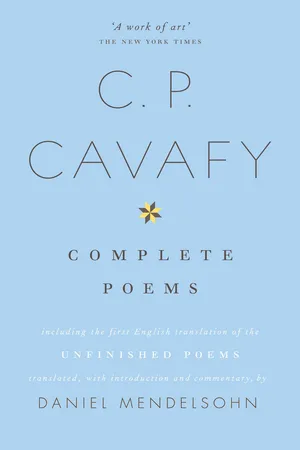
The Complete Poems of C.P. Cavafy
Information
NOTES
IMPORTANT CAVAFIAN CHARACTERS
A small number of historical figures and families recur so frequently in Cavafy’s poetic landscape that readers would do well to get to know them before undertaking a reading of the poems—or, indeed, of these Notes. Accordingly, I have provided general introductions to this crucial handful of “Cavafian Characters” immediately below, before the Notes themselves. This is partly to give the reader a generous sense of who these people and dynasties are before he or she reads, in greater detail, about the specific incidents described in the poems and explained in the Notes; also, having an easily consulted concise biography of these characters will spare the reader having to scramble within the Notes to find the necessary information whenever one of these important and oft-encountered characters appears.
Otherwise, the Notes are straightforward. As the information about publication dates appears in the text of the poems itself, I have omitted discussion of the dates of composition and publication unless the details bear importantly on our understanding of the poem. The specific words or phrases from the text of a poem that seem to require explanation in the Notes—names of people or places, dates, etc.—appear in small capital letters.
All translations are mine unless otherwise indicated; translations of Cavafy’s “Notes on Poetics and Ethics” quoted in the Introduction and the Notes are by Manuel Savidis.
Mark Antony, Triumvir and Ruler of the Roman East
MARCUS ANTONIUS (MARC ANTONY), soldier, statesman, co-ruler of Rome during the turbulent times when the Republic was crumbling, friend of Julius Caesar and lover and then husband of Cleopatra of Egypt, and above all a Roman who was besotted with all things Greek—not least, the greatest metropolis of the Greek-speaking East, Alexandria—is the subject of seven of Cavafy’s poems. It is not difficult to see why he exerted such a fascination on the poet. This remarkable figure, in whose biography a considerable personal brilliance contrasted with an ultimate failure in a way that particularly appealed to Cavafy (as witness his poems about the Byzantine emperor John Cantacuzenus, below), embodied the tensions between Greek and Roman culture, between the rising Europe of the West and the more sophisticated, often decadent and multicultural East, to which the poet would return so often, in so many ways. Cavafy’s special interest in what it meant to be Greek over the centuries was also excited by this complicated figure, a Roman who was irresistibly drawn to, and eventually absorbed by, Hellenistic culture.
Marc Antony was born in 83 B.C., as dramatic political and social upheavals in the Roman Republic were setting the stage for violent civil war that would result in the creation of the Empire—events in which Antony himself was to play a decisive role. After an apparently turbulent youth, he served in Palestine and Egypt in his mid-twenties, and soon after became attached to the staff of Julius Caesar, whose interests at home and abroad Antony vigorously supported. After the assassination of Caesar in 44 B.C., Antony shared supreme power at Rome with Caesar’s adopted son, Octavian (later the emperor Augustus), and Marcus Lepidus as one of the triumviri, the three supreme leaders of the state; as part of his duties, he oversaw the reorganization of the eastern portion of Rome’s empire.
It was during this phase of his career that Antony met Cleopatra, in the year 41 B.C., when she was twenty-eight and he forty-two. This remarkable, shrewd, ambitious, and brilliant queen had already been the lover of Julius Caesar, to whom she had borne a son, Caesarion (the subject of Cavafy’s “Caesarion”); with her Antony began a relationship soon after their meeting, and she bore him twins, Alexander Helios and Cleopatra Selene, the year after they met. By 37 B.C., the alliance between Antony and Cleopatra had become political as well as personal: as Antony, supreme Roman leader in the East and increasingly enamored of Greek and Eastern ways, restored to Egypt certain portions of its former empire—even portions that belonged, properly speaking, to Rome—Cleopatra put Egypt’s resources at Antony’s disposal. In 34 B.C. the couple celebrated an elaborately symbolic ceremony known as the “Donations,” during which Cleopatra and her children were recognized as the rulers of an empire comprising all the lands that had been conquered by Alexander the Great three centuries before. The ceremony (to which Cavafy returns in his poem “Alexandrian Kings”) was filled with religious and cultural symbolism, and suggested a revival of the Alexandrian vision of Greek empire in the East.
Following the Donations, relations between Antony and his fellow triumvir Octavian worsened dramatically, and the next year there was a bitter exchange of accusations between the two powerful men. Among other things, Octavian in Rome published the (alleged) contents of Antony’s will, in which the Roman soldier asked to be buried in his beloved Alexandria; this was taken, as Octavian knew it would be, as a gross insult to Roman sensibilities. Finally, in 32 B.C., Octavian declared war on Cleopatra—and, therefore, on Antony. After their defeat by Octavian and his fleet at the Battle of Actium in 31 B.C., Antony and Cleopatra both committed suicide (in August of the following year). Ironically, Antony and Octavian would remain intertwined through their descendants: through his two daughters, both called Antonia, Marc Antony was an ancestor of the emperors Gaius (“Caligula”), Claudius, and Nero, and of Messalina, the adulterous wife of Claudius who was eventually executed for her sexual excesses.
Apollonius of Tyana, Sage and Magician
The first-century A.D. sage and miracle worker APOLLONIUS OF TYANA (a town in the Roman province of Cappadocia, in central Asia Minor) was a figure of lasting fascination for Cavafy, who during his lifetime published three works about the remarkable Apollonius—“But Wise Men Apprehend What Is Imminent” (1896; 1899; 1915), “If Indeed He Died” (1897; 1910; 1920), “Apollonius of Tyana in Rhodes” (?; 1925)—and left the draft of another, “Among the Groves of the Promenades,” now published as one of the Unfinished Poems. This cycle of poems makes clear the poet’s great intimacy with our primary source for the life of Apollonius, which itself is one of the most remarkable works of Greek literature under the Roman Empire: the sprawling, rather baroque Life of Apollonius of Tyana by the third-century littérateur Flavius Philostratus, episodes from which provide the inspiration for all of Cavafy’s Apollonius poems.
An itinerant Neopythagorean philosopher who lived through much of the first century A.D., Apollonius is reported to have traveled widely, as far as Ethiopia and India; these travels inevitably give Philostratus’s Life much of its vivid, Odyssey-like color. After his death, Apollonius became renowned both for his defiance of Roman despots—the climax of the first half of the Life is a confrontation with Nero; the climax of the second half, a confrontation with Domitian—and for his magical powers, which were said to have included the ability not only to heal the sick and raise the dead, but to see into the near future. (Philostratus’s Life, composed as Christianity was rising to its ultimate power in Roman society, much later became a useful text for those seeking to present the philosophical and miracle-working Oriental Greek as a pagan rival to Christ.) For instance, the sage of Tyana is said not only to have had a telepathic vision of the assassination of Domitian (the subject of “Among the Groves of the Promenades”), but also to have predicted a plague that struck the city of Ephesus in Asia Minor. It was, in fact, this prediction that was later held against him when he was accused by an Egyptian enemy of various crimes and impieties, among them sorcery. Apollonius was subsequently tried before the notoriously cruel emperor Domitian (Titus Flavius Domitianus, 51–96 A.D.). In the Life, whose relationship to the historical truth is, to be sure, often casual, the trial scene—a grand occasion for displays of rhetorical pyrotechnics—takes up nearly all of the final book.
Already in an 1892 essay on Keats’s Lamia (a poem that takes its donnée from Philostratus’s tale of a lady vampire), Cavafy refers to the Life of Apollonius as a “storehouse of poetic material,” and indeed two of the four Apollonius poems can be confidently dated to the mid-to late 1890s, just a few years later. This was the decade in which, as the scholar Diana Haas has shown in great detail in her important study of the religious issues in Cavafy’s early work (Le problème religieux dans l’oeuvre de Cavafy: Les années de formation [1882–1905], Sorbonne, 1996), the poet was struggling to find a way to write meaningfully about religious belief, and the work of this period indeed betrays an interest in the supernatural, the uncanny, and telepathic knowledge that was to last his entire life. (They are also phenomena that recur in the fin-de-siècle Continental poetry—Symbolist, Esoteric, Decadent—that influenced him so strongly in those years.) That interest is evident not only in the many poems treating those themes (and hardly only in connection with Apollonius: see, for example, “Theodotus,” “Since Nine—,” “Caesarion,” and the Unfinished Poems “Athanasius” and “From the Unpublished History”) but also in his taste for tales of the fantastic (cf. his own ghost story, “In Broad Daylight”) and in his belief, greatly influenced by the Parnassians and articulated with particular emphasis in a number of the early poems, that the poet was a kind of seer gifted with second sight. (See, for instance, the Unpublished Poem “Correspondences According to Baudelaire.”)
Cavafy’s religious crisis of the 1890s suggests a further explanation for the origins of his interest in Apollonius during those years. This was when he was trying to arrive at a unified vision of Hellenic identity from the Hellenistic monarchies through the fall of Constantinople to his own day—a vision, ultimately, that would allow him to synthesize Greek history, the Orthodox faith (from the early Christian era to his own time), and also a pagan homoeroticism. It is in this context that we do well to recall the Italian historian Arnoldo Momigliano’s observation that the supernaturally gifted pagan hero of the Life of Apollonius of Tyana was, in fact, a figure whose literary influence can be felt in St. Athanasius’s Life of Saint Anthony, the prototype for the Christian hagiography. Apart from his considerable inherent interest, then, Apollonius is a crucial figure because, as Cavafy surely understood, he is yet another link in a chain that binds the pagan and Christian Greek worlds.
It should be said, too, with respect to the Life of Apollonius of Tyana, that the biographer was of as great an interest to Cavafy as the subject was. Flavius Philostratus (ca. 170–240 A.D.) was a distinguished man of letters, of Greek origin, and a favorite of Julia Domna, wife of the emperor Septimius Severus; it was at her request that the Life was written. Cavafy’s championing of Philostratus may therefore be seen as deeply connected to his sense of himself as a “Hellenistic” figure—an inhabitant of Greater Greece, a passionate heir to Greek culture living far from mainland Greece itself. An almost prickly impatience with the cultural snobberies of the European intellectual establishment (with its almost exclusive focus on “high” Classicism and Athens) is, indeed, evident in the Lamia article:
Foreign scholars generally speak condescendingly about Philostratus and his works, just as they speak condescendingly about many writers of the decadent phase, as they are accustomed to call it, of Greek literature.
Julian the Apostate
The Roman emperor JULIAN (331?–363 A.D.), called “THE APOSTATE” because of his efforts to restore the newly Christianized Roman Empire to pagan worship, is the figure who more than any other preoccupied Cavafy’s creative mind throughout his...
Table of contents
- Title Page
- Contents
- Introduction: The Poet-Historian
- A Note on Pronunciation of Proper Names
- I: Published Poems
- II: Repudiated Poems (1886–1898)
- III: Unpublished Poems (1877?–1923)
- IV: The Unfinished Poems (1918–1932)
- Notes
- Further Reading
- Acknowledgments
- Textual Permissions
- A Note About the Translator
- Also by Daniel Mendelsohn
- Copyright
- About the Publisher
Trusted by 375,005 students
Access to over 1.5 million titles for a fair monthly price.
Study more efficiently using our study tools.
Frequently asked questions
Yes, you can cancel anytime from the Subscription tab in your account settings on the Perlego website. Your subscription will stay active until the end of your current billing period. Learn how to cancel your subscription
No, books cannot be downloaded as external files, such as PDFs, for use outside of Perlego. However, you can download books within the Perlego app for offline reading on mobile or tablet. Learn how to download books offline
Perlego offers two plans: Essential and Complete
- Essential is ideal for learners and professionals who enjoy exploring a wide range of subjects. Access the Essential Library with 800,000+ trusted titles and best-sellers across business, personal growth, and the humanities. Includes unlimited reading time and Standard Read Aloud voice.
- Complete: Perfect for advanced learners and researchers needing full, unrestricted access. Unlock 1.5M+ books across hundreds of subjects, including academic and specialized titles. The Complete Plan also includes advanced features like Premium Read Aloud and Research Assistant.
We are an online textbook subscription service, where you can get access to an entire online library for less than the price of a single book per month. With over 1.5 million books across 990+ topics, we’ve got you covered! Learn about our mission
Look out for the read-aloud symbol on your next book to see if you can listen to it. The read-aloud tool reads text aloud for you, highlighting the text as it is being read. You can pause it, speed it up and slow it down. Learn more about Read Aloud
Yes! You can use the Perlego app on both iOS and Android devices to read anytime, anywhere — even offline. Perfect for commutes or when you’re on the go.
Please note we cannot support devices running on iOS 13 and Android 7 or earlier. Learn more about using the app
Please note we cannot support devices running on iOS 13 and Android 7 or earlier. Learn more about using the app
Yes, you can access The Complete Poems of C.P. Cavafy by Daniel Mendelsohn in PDF and/or ePUB format, as well as other popular books in Literature & European Literary Collections. We have over 1.5 million books available in our catalogue for you to explore.