![]()
PART ONE
The land of the Romans
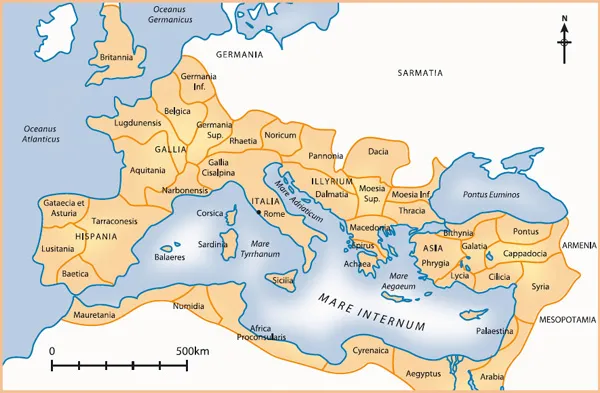
Roman territory extended far beyond Rome itself, coming to include, in due course, the entire Italian peninsula, the coastline of the Mediterranean and most of what is now western Europe, as well as territories in northern Africa and the Middle East. Conquered lands were made Roman provinces, thus ensuring that the Roman way of life had a long-lasting and widespread influence.
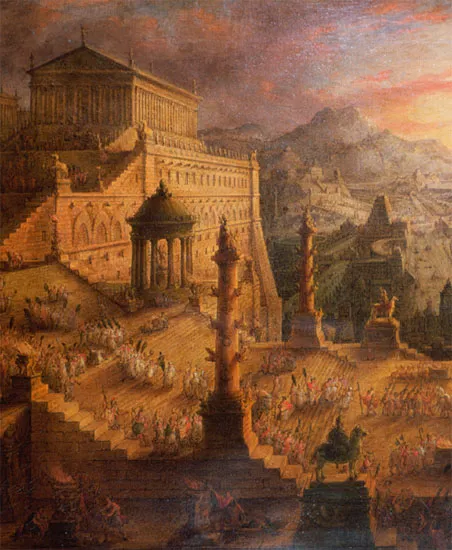
View of Ancient Rome
For hundreds of years, Rome, to which all roads were said to lead, was the most magnificent city in the ancient world.
![]()
THE ROMAN WORLD
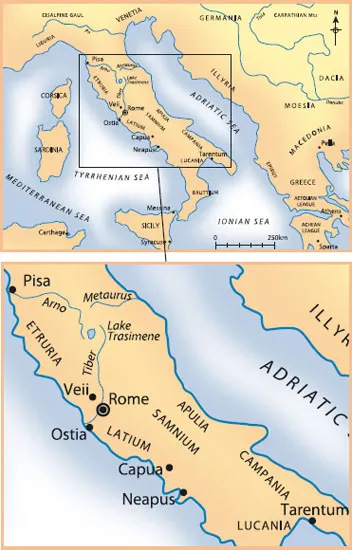
Italy itself has a varied landscape, ranging from fertile plains and marshes to the rocky mountainsides of the Apennines running down the central spine of the country. Some of the most fertile areas are located on the west coast, and it was here that the Roman civilization first emerged on the banks of the Tiber, which provided easy access to the coast, some twenty-five kilometres (six miles) downstream. Later Roman prosperity was to depend greatly upon Italy’s central position within the Mediterranean basin and trade routes with other peoples.
NEIGHBOURING PEOPLES
Early Roman expansion was at the expense of such neighbouring peoples as the Sabines and the Etruscans. This was a prolonged process, with Rome itself often falling victim to invasion by hostile tribes before Roman supremacy was eventually established throughout central Italy. Most of the kings of Rome, in fact, were of Sabine or Etruscan origin.
Rome’s contact with such neighbouring peoples, through trade and many other transactions as well as through warfare, was to play a crucial part in the early development of Roman culture.
![]()
THE ROMAN EMPIRE
All of Italy was under Roman control by the middle of the third century (264 BC), after which Roman armies ventured further afield, seizing much of Hispania (modern Spain) from Rome’s rival Carthage and bringing Macedonia under its influence by 168 BC. In 133 BC, Pergamum became the first of Rome’s provinces in Asia. Gallia Narbonensis (southern Gaul) was made a Roman territory in 121 BC, while Cyrene in north Africa became the Roman province of Cyrenaica in 96 BC. The conquest of Bithynia, Pontus, Syria and Crete between 75 BC and 64 BC extended Rome’s possessions in the eastern Mediterranean.
EXPANSION
Julius Caesar had conquered the rest of Gaul by 49 BC and even ventured north into Britain, while Egypt was added by Octavian in 31 BC. Rome’s territories continued to grow after the foundation of the empire under Augustus, who put down rebellions and established Roman rule over all of mainland Europe west and south of the Rhine and Danube rivers. The Roman empire reached its further extent in the early years of the second century AD under the emperor Trajan, who successfully conquered Dacia (modern Romania) and large parts of the Middle East.
Frontiers
Roman influence was not confined to the borders of the empire. Roman troops often penetrated far beyond frontiers into lands held by hostile peoples in order to neutralize the threat of invasion, to support allies of Rome or to defend trading or other interests. The borders themselves were not necessarily strongly fortified. Hadrian’s Wall, with its mighty wall and linked forts, was the most heavily defended frontier, and the German frontier was similarly protected by a timber wall and forts, but elsewhere there were relatively light border fortifications, if any at all.
Disintegration of the empire
By now too large to be governed effectively, the empire slowly contracted after Trajan’s reign and was split into two – with rival capitals in Rome and Constantinople – and eventually disintegrated after repeated civil wars and barbarian invasions.
![]()
ROMAN PROVINCES
Rome organized conquered territories as provinces, each under the rule of a Roman governor of senatorial rank. The number and size of Rome’s provinces varied over the centuries, some regions enjoying greater peace and prosperity than others.
AFRICA
In 146 BC, having defeated Carthage in the second Punic war, the Romans founded the province of Africa (their first on the African continent), which was roughly equivalent to modern northern Tunisia and western Libya and included the remains of Carthage itself. Later, Roman rule was extended to include the entire north African coastline, from the province of Mauretania (now western Algeria and northern Morocco) in the west to Aegyptus (modern Egypt) in the east. The importance of the region lay not only in its strategic influence, but also in its massive agricultural output, which included cereals, fruit and olive oil. It was also a rich source of slaves and wild animals for Rome’s circuses.
ASIA
Rome’s first province in Asia was Pergamum, which was acquired in 133 BC. Later military campaigns added much more territory to the east and the south, with the addition of the province of Judaea linking with Roman territories in northern Africa and thereby completing Roman control of the entire Mediterranean coastline. Important cities in the region included Ephesus, Antioch and Byzantium which, as Constantinople, became the capital of the Roman empire in 326 AD.
BRITANNIA
The Roman legions first visited Britain in 55 BC and 54 BC under Julius Caesar, attracted by tales of tin mines and other riches, but they only established a more permanent presence with the second invasion of 43 AD, occupying the mainland as far north as the border of Caledonia until 410 AD. Having landed at Richborough in Kent, the legions won a series of victories against the Catuvellauni tribe and their allies and captured their leader Caratacus, who was sent to Rome to be presented to the emperor Claudius (who was impressed by his bearing and spared his life).
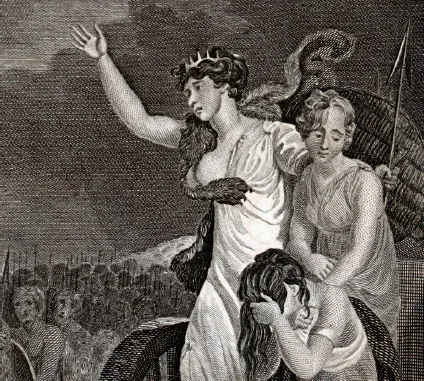
The Roman humiliation of Boudicca sparked a revolt that nearly drove the Romans from Britain.
Rebellions
Roman rule was disrupted by rebellions, most notably the Iceni revolt of 61 AD led by Queen Boudicca, which led to the sacking of Londinium (modern London) and several other towns before ending in defeat in battle against the legions and the suicide of Boudicca. The Caledonians were defeated by the governor Agricola at Mons Graupius in 84 AD, and the threat of invasions from northern barbarians was warded off from 120 AD by the building of Hadrian’s Wall, which connected northern Britain’s west and east coasts. A second wall, the Antonine Wall, was built further north circa 142 AD following reoccupation of the Scottish lowlands.
The Romans gradually withdrew from Britannia, their northernmost province, in the early fifth century. Their legacy included roads, villas, forts, bath complexes and towns as well as advances in agriculture and industry.
GAUL
Gaul (or Gallia) was the name given by the Romans to a large area of western Europe now divided between northern Italy, France, Belgium and western Switzerland as well as parts of the Netherlands and Germany. The Romans established their first province on the northern side of the Al...