![]()
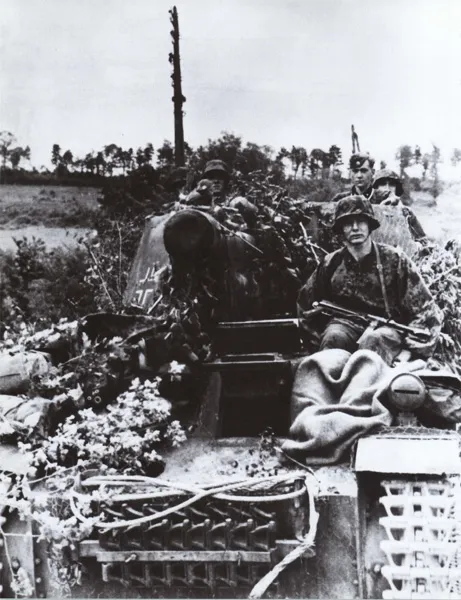
Wespe (Wasp) SP 10.5cm gun of a Waffen SS division in Normandy.
Imperial War Museum 11 (MH12164)
6
Sword
John Gough,
radio-operator aboard a destroyer at Harwich.
‘Early in the evening of 5 June the entire ship’s company who could be spared from duty mustered on deck and our captain briefly put us in the picture as to the part we were assigned to play in the events planned for the next day. To close the proceedings he removed his cap, lowered his head and spoke the opening words of the prayer Lord Nelson had confessed in his cabin before Trafalgar. “May the Great God whom I worship grant to my country and for the benefit of Europe in general a great and glorious victory, and may no misconduct in anyone tarnish it, and may humanity after victory be the predominant feature in the British Fleet.” Those words were as relevant as they had been way back in October 1805.
‘Within half an hour or so we slipped anchor and headed into the Channel to catch up and overtake the grey columns of troop transports and landing craft which for several hours had been leaving the Solent and now stretched to the horizon and beyond. We had our own rendezvous with the pages of history when the next day we would, in company with many other naval vessels, lead them to the beaches of Normandy. D-Day dawned and Sword beach came into view. Ahead of us were a group of minesweepers and astern a mighty fleet of transports and landing craft filling the scene as far as the eye could see. Overhead the sky was filled with an aerial armada of bombers. The din was tremendous and added to it was the roar of the big guns of the heavier ships bombarding the shore. Before long the bombardment ceased and the first of the assault craft began ferrying the army ashore from the big transports.
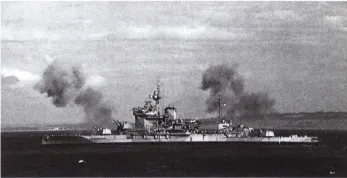
HMS ‘Warspite’ blasting targets ashore with its 15-inch guns. This veteran battleship, which had taken part in the Battle of Jutland in 1916, arrived in the Eastern Task Force area at 05:25 on 6 June and provided notable gunfire support (Bombardment Force D) (Assault Convoy S6), expending 219 rounds of main ammunition by 16.00. She suffered superficial blast damage on the 7th and returned to the Solent.
Imperial War Museum 11 (A23914)
‘From our viewpoint a mile or so off the beach it was evident that the operation was going well. There was sporadic opposition from hidden German guns, which had escaped the initial bombardment, and here and there landing craft were hit but the majority were reaching the beach unscathed. At 08:00 I had to return to the wireless office to take my turn on watch and so for the rest of the morning had to rely on a running commentary provided by off-watch staff. That night we returned to Portsmouth carrying 20 wounded Canadians who had been transferred to us by an assault craft.
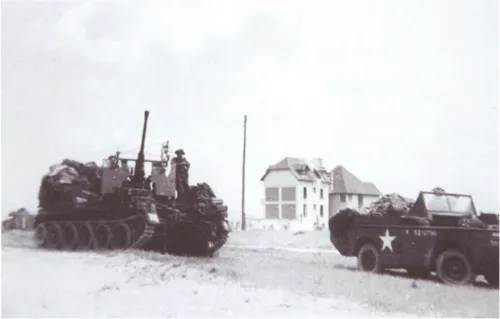
Bofors gun on its Crusader chassis moving in from the beach on D-Day.
Imperial War Museum 11
Beach Timetable
07:25 British 3rd Infantry Division and 27th Armoured Brigade, 18 minutes later than scheduled, go ashore with 40 DD tanks (six are lost) and flame-throwers and come under mortar fire.
08:21 They break through the enemy defences.
12:15 Panzer tanks reported north of Caen. 21st Panzer Group commanded by Leutnant General Edgar Feuchtiger disobeys orders and attacks between Caen and Bayeux.
12:30 British 185th Brigade move inland from Sword.
13:30 Brigadier Lord Lovat’s 1st Special Service Brigade, composed of four Army and one Royal Marines Commando, reach Pegasus Bridge en route to help other units of the Airborne Division.
14:00 Fighting on Periers Ridge overlooking Sword.
16:00 Infantry reach Bieville three miles from Caen but are stopped by tanks of the 21st Panzer Division. Infantry destroys 16 tanks.
18:00 British advance on Caen halted.
19:00 21st Panzer Division led by 50 tanks mounts massive counter-attack. Drive fails just short of the cliffs, with the loss of 13 tanks.
By nightfall six square miles of beach is under British control. 29,000 landed. Casualties, 1,000.
Les ‘Tubby’ Edwards
signalman, HMS ‘Locust’, a gunboat in LSH Force SI, which was escorting landing craft.
‘The whole sky was filled with friendly aircraft of all types – Stirlings, Halifaxes and Dakotas. Inevitably some were hit. A Stirling, which was well ablaze, seemed to be heading for our ship. But suddenly the plane banked to her right and dived into the sea. It was our belief that the pilot deliberately ditched in order to avoid our ship, thus saving many lives.’
Mission diary
Ed ‘Cotton’ Appleman
engineer-gunner, B-24 Liberator ‘Duration Baby’, 93rd Bomb Group, 2nd Bomb Division, 8th Air Force.
‘Mission No. 14 and the day that everyone has been waiting for. They ran four missions today but we didn’t have to go on but one of them. We carried 12 x 500 lb bombs and hit bridges near Caen, France where the boys were making their landing. The Channel was full of Allied boats of all kinds and we could see them just off the French coast making their landings. They had good fighter cover and we had none, but I imagine they needed it. We saw no flak and no fighters. Made two runs on the target and still didn’t get our bombs away, but everyone else did. For some reason we didn’t get our bomb bay open in time. I hope those boys on the ground had it as easy as we did. Sixteen to go. Six hours, 35 minutes.
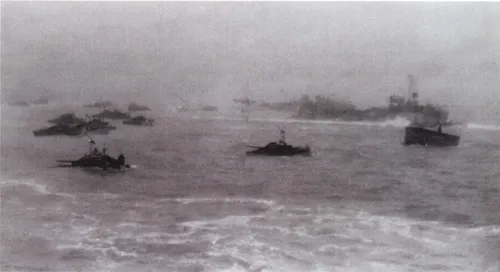
Rare photo taken from the first LCT to reach shore of the early part of the landing at dawn of the Sherman DD tanks reaching the shore. Tank extreme right is still swimming with its flotsam screen raised. All the others have touched ground and lowered their screens at once to allow their guns to fire. Another LST is coming in on the right. The mine clearing and DD tanks of the assault wave, guided by the midget submarine X23, reached the beach around 07:30.
Chris Ellis I Collection
Gunner Len Woods,
53rd Medium Regiment Royal Artillery.
‘On 1 June we embarked on to an LST at Gosport. On board were men from various regiments but from the 53rd there were just seven with a 15-cwt [hundred-weight] truck. We were the Survey and Recce party. We laid in the Solent in the most appalling weather until 19:30 on 5 June when we set sail, arriving off Sword beach at 10:00 on 6 June. A Reuters newsman who was on board sent the first bulletin back to the UK by pigeon, as there was strict radio silence. The LST had a top and bottom deck. The lower deck was first to unload and then a lift brought the vehicles from the upper deck to the lower deck for their turn. We unloaded by driving on to pontoon rafts, which then ferried us to the beach. After the lower deck had been cleared a German plane (remember there were only supposed to be two German planes over the whole beachhead) machine-gunned our ship and dropped a bomb, which exploded under the bow doors. This distorted the bow doors and wrecked the lift. In order to finish unloading we had to pull away from the beach and tie up alongside another LST that had already unloaded and run our vehicles across from one ship to the other by means of wooden planks. It was a quirk of fate that with the thousands of ships in the area, one of the two German planes in the air managed to hit us.
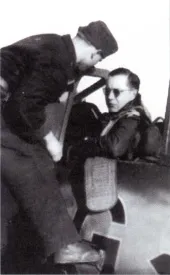
‘I arrived in France on D-Day, travelled through Belgium, Holland and Germany and yet remained unscathed. My brother-in-law landed in Normandy two weeks later and was killed within days of his arrival.’ The only Luftwaffe presence over the invasion beaches that morning were two Fw 190s flown by Oberstleutnant Josef ‘Pips’ Priller, Kommodore, Jagdgeschwader 26 ‘Schlageter’, and his regular Kacmarek (wingman), Uffz. Heinz Wodarczyk of the Stab flight at Priller’s Lille-Nord command post. These were the only two fighters available to JG26. Near Le Havre the pair climbed into the solid cloudbank and emerged to see the invasion fleet spread out before them. Priller, in his usual Fw 190A-8 ‘Black 13’ Jutta, and Wodarczyk each made a full-throttle (400 mph) 50-foot, low-level strafing run over Sword beach with cannons and machine guns before landing at Creil. Priller scored his 100th victory on 15 June when he shot down a B-24 Liberator of the 492nd Bomb Group. Wodarczyk was killed in action on 1 January 1945. Oberst. Priller survived the war with 101 victories.
Oberstleutnant Josef ‘Pips’ Priller.
Hobart’s Funnies
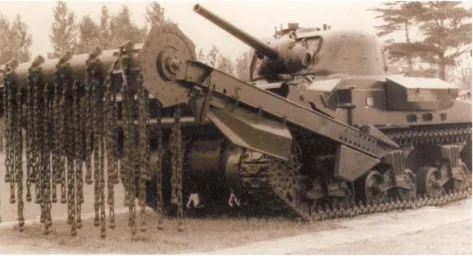
After the disaster at Dieppe a whole gamut of brutal new weaponry was devised (some by Churchill himself) specifically to break through concrete, wire and minefields along the French coast. Churchill personally rescued from the Home Guard a talented expert, Major General Percy Hobart, who formed, trained and then led a huge secret armoured division, which stormed the Normandy beaches and helped take all the Channel ports and every major river crossing. All these tank-based secret weapons, usually with animal names (Crab, Crocodile, etc.), supported every British and Canadian army formation and many American units in the 11 months of fighting in north-western Europe in 1944–45. 79th Armoured Division was by far the largest formation in the British Army, although it never fought as a division or a brigade, and rarely as a regiment In vital ‘penny pockets’ of AVREs, flails, flame-throwers, or armoured troop carriers, they were indispensable. They were unique and every fighting formation in Europe was grateful for Hobart’s Zoo. This irascible, bullying Major General formed 7th Armoured Division in North Africa, 11th Armoured Division in Yorkshire, and created the monsters of 79th Armoured.
J. A. C. Hugill
aboard LCT 7073, one of 70-odd petrol-driven boats ordered hurriedly in November 1943.
‘We reached the North Foreland Buoy, just north of Deal, at 22:00. Just now the paratroops would be dropping. I wished them luck. Parachuting is rather a nerve-racking business. There must be many people in the Whitehall area walking about with their fingers crossed tonight, I thought. I was feeling detached about the whole thing now, but never let myself stray far from a piece of wood to touch. The wind freshened still more, and it looked as if the landing was going to be really foul. There was an angry sky as the light faded, and I was reminded of a somewhat fanciful picture of the Battle of Jutland that used to hang in my grandfather’s house when I was a little boy. (At least they said it was Jutland.) The sky was just like that.
‘I warned everyone to sleep with a clasp knife handy, in case anything happened, so that they could cut themselves clear of the camouflage net, which was stretched over the tank deck. Then I went up on the bridge and waited for the shells to come over from Gris-Nez. None came. We were passing through the Straits at the not exactly breakneck speed of five knots. At 03:30 I went below to turn in. The sub-lieutenant in charge of the mobile naval radar set which was with us had elected to sleep outside, in the interests of fresh air and space. Sleep came to us with difficulty. But it came. In addition to the two pongos and me, there was also the flotilla engineer officer, a pleasant Canadian with a snore like the open diapason of an organ.
Flail tank.
Chris Ellis I Collection
‘At 05:00 the sub came into the wardroom dripping wet from the rain. We cursed him sleepily as he fitted himself into the group on the wardroom floor like the last piece of a jigsaw puzzle. For some reason we all awoke exactly at 07:25 and looked at one another.
‘“Did someone talk about an invasion taking place this morning?” asked one.
‘“Don’t natter,” we answered.
‘It was hard to realize that this was Der Tag.
‘The wind was freshening and the old cow was waddling and ducking more and more disagreeably. So much water was coming over the bows that we couldn’t get the hydro-cooker alight. The sub and I dived down into the starboard locker for some tins of self-heating cocoa to warm the shivering men. They were all pretty wet. So were we by the time we had finished.
‘After breakfast we took turns standing by the gun pits as extra lookouts or sat in the wardroom reading. There was an air of complete unreality about the whole business, and the bright sun, and the cold wind and spray, made me feel brittle for some reason. I finished reading Humphrey Clinker, which was perfect escapist literature and opened Triple Fugue, which was not. As we passed Beachy Head I began to wonder if my stomach wasn’t full of butterflies. Up forward, a lot of the troops were being or had been seasick, some, I found, with a whole-hearted abandon not entirely admirable. I must try not to be sick in front of the pongos, I thought, and climbed up to the bridge to talk to the 1st lieutenant. There were miles of LCT ahead and astern of us and the large LST at the head of our convoy looked like Roman triremes in the distance.
‘At 13:00 we disobeyed all rules and regulations and switched on the BBC, rather in the manner of one pinching oneself to make sure he is awake. Yes, there it was, sure enough. The airborne had landed and the first flight was doing well on the beaches. Our turn soon. Just before 14:00 we turned south and were on the last leg of our journey. We were due to land in about fiv...