- English
- ePUB (mobile friendly)
- Available on iOS & Android
EARLY HUMANS_NN LIB134 EB
About this book
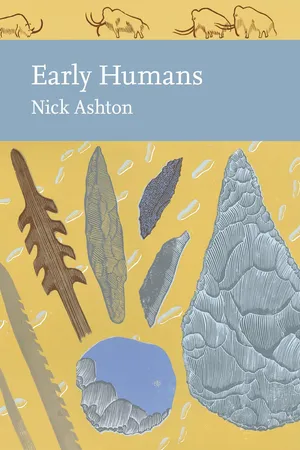
Our understanding of the British Palaeolithic and Mesolithic has changed dramatically over the last three decades, and yet not since H. J. Fleure's A Natural History of Man in Britain (1951) has the New Naturalist Library included a volume focused on the study of early humans and their environment.
In this long overdue new book, distinguished archaeologist Nick Ashton uncovers the most recent findings, following the remarkable survival and discovery of bones, stone tools and footprints which allow us to paint a picture of the first human visitors to this remote peninsula of north-west Europe.
As part of the Ancient Human Occupation of Britain project and subsequent research, Ashton is involved in an unrivalled collaborative effort involving archaeologists, palaeontologists, and earth scientists at different British institutes, including the Natural History Museum and the British Museum. Using an interdisciplinary approach, the book explores the latest discoveries such as footprints at Happisburgh, Norfolk that are thought to be nearly one million years old, flint artefacts at Pakefield in Suffolk and mammoth remains at West Runton, among others. These remarkable remnants help our quest to unravel the interactions between the changing environments and their ancient human occupants, as well as their lifestyles and migrations.
Early humans colonised our remote corner of the European mainland time and again, despite being faced with ice age climates with far-reaching consequences. Setting the scene on the Norfolk coast almost a million years ago, Ashton tells the story of the fauna, flora and developing geography of Britain against the backdrop of an ever-changing climate. Above all, he explores how early people began as brief visitors to this wild remote land, but over time through better ways of acquiring food and developing new technologies, they began to tame, shape and dominate the countryside we see today.
Tools to learn more effectively

Saving Books

Keyword Search

Annotating Text

Listen to it instead
Information
Table of contents
- Title Page
- Copyright
- Dedication
- About the Editors
- Contents
- Editors’ Preface
- Author’s Foreword and Acknowledgements
- 1 Introduction
- 2 The Birth of the Stone Age
- 3 The History, Geography and Biology of Britain
- 4 Wilderness and the First Pioneers: One Million Years Ago
- 5 Lost Rivers and Coastlines: 600–500,000 Years Ago
- 6 Ice-Age Faunas and Floras: 450,000 Years Ago
- 7 The Great Interglacial: 400,000 Years Ago
- 8 Emergence of Neanderthals and the Mammoth Steppe: 320–200,000 Years Ago
- 9 Island Britain: 125,000 Years Ago
- 10 Repopulation: Neanderthals and Modern Humans: 60–30,000 Years Ago
- 11 The End of the Last Ice Age: 15–11,000 Years Ago
- 12 After the Ice and Into the Present World: 11–6,000 Years Ago
- 13 Conclusion: The History of Britain and the Wider World
- Glossary
- References
- General Index
- The New Naturalist Library
- About the Author
- About the Publisher
Frequently asked questions
- Essential is ideal for learners and professionals who enjoy exploring a wide range of subjects. Access the Essential Library with 800,000+ trusted titles and best-sellers across business, personal growth, and the humanities. Includes unlimited reading time and Standard Read Aloud voice.
- Complete: Perfect for advanced learners and researchers needing full, unrestricted access. Unlock 1.4M+ books across hundreds of subjects, including academic and specialized titles. The Complete Plan also includes advanced features like Premium Read Aloud and Research Assistant.
Please note we cannot support devices running on iOS 13 and Android 7 or earlier. Learn more about using the app