![]()
MEN’S HIGHLAND DRESS
IT IS interesting to know what the old Highland dress consisted of, for it has changed very little. Stewart of Garth gives the following description:—
“The coat or jacket was sometimes of green, blue or black cloth. The waistcoat and short coat were adorned with silver buttons, tassels, embroidery or lace, according to the fashion of the times or the taste of the wearer. But the arrangements of the belted plaid were of the greatest importance in the toilet of a Highlandman of fashion … it was fastened across the breast by a large silver bodkin or circular brooch often enriched with precious stones or imitations of them, having engraved mottoes consisting of allegorical sentences or mottoes of armorial bearings. These were employed to fix the plaid on the left shoulder. A large purse of goat’s or badger’s skins answering the purpose of a pocket, and ornamented with a silver or brass mouthpiece and many tassells, hung before. A dirk with a knife and a fork stuck in the side of the sheath, and sometimes a spoon, together with a pair of steel pistols, were essential accompaniments. The bonnet which gentlemen generally wore with one or more feathers completed the national garb. The dress of the common people differed only in the deficiency of finer or brighter colours and of silver ornaments, being otherwise essentially the same, a tuft of heather, pine, holly, oak, etc., supplying the place of feathers in the bonnet. The garters were broad and of rich colours wrought in a small primitive kind of loom the use of which is now little-known, and formed a close texture which was not liable to wrinkle, but which kept the pattern in full display. The silver buttons were frequently found among the better and more provident of the lower ranks, an inheritance often of long descent.”
It might be added here that the stockings were worn only as high as the thick of the calf and the kilt was usually a few inches short of the knee-cap, so that much more naked leg was displayed than in modern days.
One of the peculiarities of Highland dress to-day is that it is virtually the only form of everyday dress which permits the use of personal heraldry, whether the insignia is that of clansman, duine uasail, chief or nobleman. Cap-badge, dirk, sgian dubh, dirk-belt buckle, sporran cantle, the silver buttons on evening dress doublets, ladies’ sash brooches, and plaid brooches all lend themselves to this heraldic purpose, and all can be usefully decorated with engravings of the wearer’s personal arms or else the clansman’s badge with buckle and strap. Often the principal charge on the shield—such as fish, boar’s heads, mullets and so on—can be used in button form. In more intricate cases, the charges can be engraved on round or diamond-shaped silver buttons.
Before examining Highland dress item by item, something should be said about ties. In recent times there has been criticism of the use of striped ties with the kilt, since, it is suggested, tartan ties are more correct. This, however, is mistaken. The tartan tie is a very recent innovation, frequently used by clansmen when they are not wearing the kilt; but there is no rule at all which makes it the only appropriate neckwear. It is because Highland dress has proved adaptable that it has survived, and when it is worn in lieu of a lounge suit (as it commonly is) exactly the same choice of ties is at the wearer’s discretion. Gaudy ties are naturally out of place, but regimental, school, club and other ties in daily use are quite in order with day dress. Many Highlanders to-day regard the tartan tie as a souvenir for tourists and would not dream of owning one, but the wearer’s taste is the only guide in this matter.
The only argument against striped ties is that the Highlanders in former times did not wear them. But they did not wear ties at all, they wore neck-cloths, jabots, or nothing. Likewise they were naked beneath the kilt because underwear was unknown to them. On this last point a cult has arisen, and Scots get a good deal of amusement from assuring Englishmen that it simply is not done to wear anything underneath the kilt. At the same time, tailors sell cute little pairs of tartan shorts (which they sometimes wrongly call “trews”) for underwear. The truth, however, is that normal types of men’s underwear—briefs or pants—are quite the most sensible thing to wear. There is no reason to pay a lot of money for tartan panties, and there is nothing specially manly, Highland or correct about wearing nothing at all. Supporting underwear is recommended medically for wear with any form of male costume, the kilt not excepted.
The Kilt
(GAELIC: Feileadh-beag)
The kilt is the basis of Highland dress, except in the few cases where trews are worn. It should be properly made to measure, by a reputable firm of kilt makers: if it does not fit properly it will be more of a burden than a pleasure. It should never be worn with braces, although boys and girls often wear it with a bodice, since their figures are not sufficiently formed to support it.
There is a good deal of nonsense spoken about length. We do not wear it to-day as short as used to be the case, but two often-quoted rules, both wrong, should be scotched: the first, that it should reach the middle of the knee-cap; the second, that it should reach the ground when kneeling. The correct length for ordinary wear is the top of the knee-cap. When a hard tartan is worn for tramping on the moors, the kilt should be even shorter—just above the back of the knee to prevent chaffing.
The choice of tartan is for the wearer to decide, but a clansman ought always to wear his clan tartan. For day wear the hunting tartan is generally worn, and for evening wear the dress or clan tartan, where more than one tartan exists. But it is entirely optional, and there is nothing “wrong” about wearing one tartan all the time, as indeed clansmen with only one clan tartan are forced to do.
The kilt is supported by buckles and straps attached to it at hip-bone level, and if properly made fits snugly to the waist and hips. It folds over from left to right in front, and the edges of the pleats at the rear lie towards the wearer’s right hand.
KILT PINS
The Kilt Pin
(GAELIC: Prine féilidh)
It is customary to wear a kilt pin with the kilt. This is normally fastened to the lower right hand corner of the front flap (wearer’s right). There is no hard and fast rule about the position of the kilt pin, but it is generally about five inches up from the foot of the flap and three inches in from the edge. It is not necessary to pin the outer flap of the kilt to the inner, although doubtless that was the original purpose of the kilt pin. If one does so, it becomes necessary to pin and unpin the kilt every time it is put on or taken off, and this soon results in holes in the kilt, apart from being a nuisance.
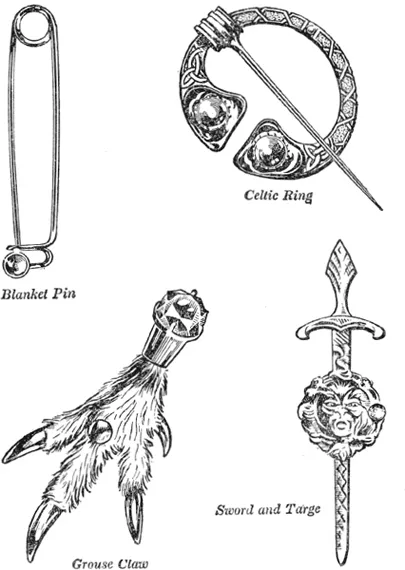
There are many attractive designs for kilt pins, usually in silver or silver-mounted. Dirks, swords, swords and targes, Celtic tracery bodkins, clansmen’s crest badges, grouse or ptarmigan claws, often mounted with cairngorm stones—all are equally attractive. Some people wear a plain blanket pin by day and a jewelled pin for dress occasions. This is purely optional, and where the kilt is worn in lieu of a lounge suit (as it most often is) there is no need for this austerity.
The Sporran and Chain
(GAELIC: Sporan)
With the kilt is worn the sporran (except by athletic competitors in Highland games who shed their sporrans for the occasion). The sporran may be of leather, fur or long hair, and may be plain or ornamented. The simplest sporran is a plain leather bag, but it is more usual to wear it with tassels, and some sort of flap fastening. Some people are under the impression that for day wear the sporran should be of plain leather worn with a leather strap. But this is not so. Many seventeenth and eighteenth century leather sporrans are silver or brass-mounted, and it is just as correct to wear a sporran ornamented in this way, and suspended from a chain. It looks better, and one should always remember that the Highlander liked gay and rich attire. Attempts to “tone down” Highland dress are un-Scottish and contemptible.
Some firms make sporrans after old patterns. Traditionally, the sporran is thonged outside in, and then turned the proper way out. This gives a much stronger join at the seams than a machine-stitched one, and the stitching is concealed. In addition the straps or tassels can be functional, being attached to a po...