![]()
CHAPTER ONE
A PLACE BEYOND THE SKY
(1903–1950)
THE BOOK IN the shop window caught the boy’s attention immediately. The vibrant purple dust jacket depicted a bullet-shaped machine trailed by an arc of orange flame. If there was any doubt in Archie Clarke’s mind what the illustration was intended to depict, the book’s title, The Conquest of Space, made it obvious. It was a spaceship. The captivating image reminded him of the colorful covers of the American science-fiction magazines that he had seen in the back room of Woolworth’s.
Spectacled fourteen-year-old Archie peered into the small W. H. Smith bookshop located a short distance from his grandmother’s house on England’s Bristol Channel. Dressed in short pants and an Oxford shirt, Archie was walking with his aunt Nellie toward Minehead’s main shopping arcade. It was 1932, and Archie had recently lost his father, after a long illness exacerbated by injuries sustained during a German poison-gas attack in World War I. He routinely visited his grandmother and aunt in the small but active southwest England beach resort during the weekends and holidays, leaving his mother freer to attend to his younger siblings on the remote family farm a few miles away.
Nellie Willis, a tall young woman with an intelligent face framed by a brown bob, doted on her clever nephew. She could see that the book displayed in the shop window fascinated him. Despite the family’s struggling finances, she gave Archie the “six and seven”—six shillings and seven pence—to purchase it and bring it home.
But when Archie opened the book, he discovered it wasn’t the adventure story that he had expected. Instead, he was looking at a book detailing the fundamentals of rocket science—astronautics—supplemented with an imagined account of the first journey to the Moon. Until this moment Archie had assumed space travel was a fantasy. Now he learned that it was actually possible for humans to leave their planet and explore space and that it could happen in the not-too-distant future.
Decades later, as one of the world’s leading masters of science fiction and the co-author of 2001: A Space Odyssey, Arthur C. Clarke would point to that day in 1932 as the moment his life changed. His imagination had been energized by a book, prompting him to wonder about what it might be like when humans began to explore space. In the early 1930s, few in government, media, or business regarded human space travel as a serious possibility. But in Archie Clarke’s mind it held transformative and liberating options. If the human species could escape the confines of gravity, was it conceivable that other fantastic possibilities might come to pass in the near future as well?
Archie’s fascination with the promise of space travel would motivate and determine the direction of his life following that chance encounter with The Conquest of Space. He joined a small cadre of visionaries, theorists, and space-travel advocates whose youthful dreams, curiosity, and determination led directly to humanity’s first steps on an alien world only three decades later.
The theoretical mathematics upon which all rocket science was based had begun to circulate in prominent scientific journals only a decade before the publication of The Conquest of Space. In the early twentieth century, three independent-minded theorists, intrigued by the idea of space travel after reading works of science fiction as adolescents, attempted to solve the theoretical physics necessary to carry out an actual escape from Earth’s gravity. Working autonomously, Russia’s Konstantin Tsiolkovsky, American professor Robert Goddard, and physicist Hermann Oberth in Germany conducted their research and study in each of the three countries that would later witness the most decisive events of the early space age. All three theorists were social outsiders intrigued by utopian ideals, and each harbored a personal belief that space travel would inevitably transform human destiny.
The first stirrings of the modern space age arose not in a wealthy industrial nation but in agrarian czarist Russia. At the turn of the century, a popular spiritual philosophy called cosmism—a mixture of elements from Eastern and Western thought, animism, theosophy, and mystical aspects of the Russian Orthodox Church—had influenced a new generation of writers, scientists, and intellectuals. For Russian cosmists, space travel would be the ultimate liberation; once the shackles of the Earth’s gravity had been removed and humans inhabited space, the souls of the dead would be resurrected and all humanity would partake in cosmic immortality.
The founding philosopher of Russian cosmism, Nikolai Fedorov, a noted librarian and scholar, chose to personally tutor a bright but impoverished teenager who had been prohibited from attending school due to severe deafness. The student, Konstantin Tsiolkovsky, had an eccentric and strikingly independent intellect and within a few years was hired as a small-town schoolmaster, despite his disability. In his spare time, Tsiolkovsky conducted independent research on many scientific subjects, including space travel. He had read Jules Verne’s From the Earth to the Moon during his adolescence, and later he even tried his hand at writing his own fictional scientific romances.
© NASA
Russia’s Konstantin Tsiolkovsky, a rural Russian schoolteacher whose 1905 paper first introduced the mathematical equation on which all rocket science is founded. A utopian, Tsiolkovsky believed that human space flight would lead to universal happiness. In a letter he wrote, “Earth is the cradle of humanity, but one cannot live in a cradle forever.”
In 1903 Tsiolkovsky published a scientific paper that contained the first appearance of what came to be known as the “rocket equation,” a mathematical formula comparing a rocket’s mass ratio to its velocity, the essential calculation necessary to determine how to escape a planet’s gravity. Unfortunately, the importance of his publication went unnoticed; the Russian scientific community ignored his work, dismissing it as the musings of an amateur. His paper would remain unread for another twenty years. Undaunted, Tsiolkovsky continued his studies, going on to publish nearly four hundred scientific papers on such matters as space-vehicle weightlessness, the operation of multi-staged launch vehicles, the orbital dynamics of differing rocket burns, and the scientific advantages of polar orbits.
A full decade after Tsiolkovsky’s groundbreaking paper, in 1913, a French aircraft designer named Robert Esnault-Pelterie independently published his own version of the rocket equation. But once again few took notice. In the United States, Robert Goddard, the second of the three pioneers of rocketry and a part-time instructor and research fellow at Clark University in Worcester, Massachusetts, was quietly conducting his own rocket research. Entirely unaware of Tsiolkovsky or Esnault-Pelterie, he submitted patent applications for both a liquid-fueled rocket and a multi-stage vehicle.
Like Tsiolkovsky, Goddard had also experienced social isolation during his formative years. A frail only child, he was kept out of school for extended periods due to ill health. As a result, he didn’t graduate from high school until age twenty-one. During his solitary time at home he read stacks of books from the local library, particularly volumes from the science and technology shelves. He also read H. G. Wells’s science-fiction classic The War of the Worlds, which made a lasting impression. At age seventeen in 1899, while aloft in the branches of a cherry tree on his family’s New England farm, Goddard experienced an epiphany that moved him so deeply that he noted the date on which it occurred. “As I looked towards the fields at the east, I imagined how wonderful it would be to make some device which had even the possibility of ascending to Mars. I was a different boy when I descended the tree from when I ascended for existence at last seemed very purposive.”
© NASA
Clark University professor Robert Goddard, who in 1926 launched the world’s first liquid-fueled rocket from a farm in Auburn, Massachusetts. Throughout most of his career he revealed few details about the progress of his research. However, spies in the United States working at the behest of the Soviet Union and Hitler’s Germany attempted to breach Goddard’s wall of secrecy.
During World War I, while teaching at Clark University, Goddard obtained research funding from the War Department for an experimental tube-launched solid-fuel rocket rifle, an early version of what would become the bazooka. He also proposed a rocket that could ascend seventy miles into the atmosphere and carry high explosives or poison gas at least two hundred miles. But after the Armistice, no American military officials thought long-range missiles a subject worthy of further research, so Goddard sought to find support elsewhere.
It was a technical paper funded and published by the Smithsonian Institution in 1920 that suddenly placed Goddard’s name on newspaper front pages around the world. “A Method of Reaching Extreme Altitudes” proposed that a rocket could be used for the scientific exploration of the atmosphere, placing artificial satellites into orbit, aiding weather forecasting, and physically hitting the Moon. His paper made no mention of human space travel to the Moon; however, many newspaper reports heralded his study with dramatic headlines implying Goddard was working on a moon rocket that would transport human passengers.
Within weeks, The New York Times announced that a twenty-four-year-old pilot of the New York City Air Police had willingly volunteered to be the first person to fly to Mars. Concerned that the United States must maintain its position with other nations in the air, Captain Claude Collins said he would ride the world’s first interplanetary rocket, provided a ten-thousand-dollar life-insurance policy was part of the arrangement. The Times treated Goddard somewhat less admiringly than it did Captain Collins when it published a scathing editorial taking the college professor to task for believing that a rocket would function in the vacuum of space. The Times slammed Goddard, claiming he was unfamiliar with basic Newtonian physics and showed a “lack of knowledge ladled out daily in high schools.” His pride wounded, Goddard soon grew wary of the popular press. Sensational stories about the American professor’s forthcoming moon-rocket flight continued to appear in publications around the globe throughout the early 1920s. And occasionally Goddard was complicit, supplying dramatic quotations apparently intended to entice potential investors, such as his plan for a giant passenger rocket capable of crossing the Atlantic Ocean in a few minutes.
However, when Goddard actually made history with the world’s first successful launch of a liquid-fueled rocket on March 16, 1926, in Auburn, Massachusetts, no journalists were present, and no account appeared in contemporary newspapers. The date is now celebrated as the dawn of the space age, but for most of his career Goddard carefully guarded information about his research, afraid that others might steal his secrets and profit from his work.
THE SENSATIONAL ATTENTION accorded Goddard’s Smithsonian paper appeared in the European press just as the third of the trio of rocketry pioneers, a former medical student from Austro-Hungaria named Hermann Oberth, was readying his work for academic review. Born in 1894, Oberth was a brilliant student of mathematics and had been fascinated by the idea of spaceflight since age twelve, when he committed to memory passages from Jules Verne’s From the Earth to the Moon. Oberth had tried to interest military strategists in a proposal for long-range missiles during the First World War, but his paper went unread. After the war he revised his work, this time focusing on the basic mathematics underlying space travel. However, when he submitted the paper as his doctoral dissertation, it was rejected as “too fantastic.”
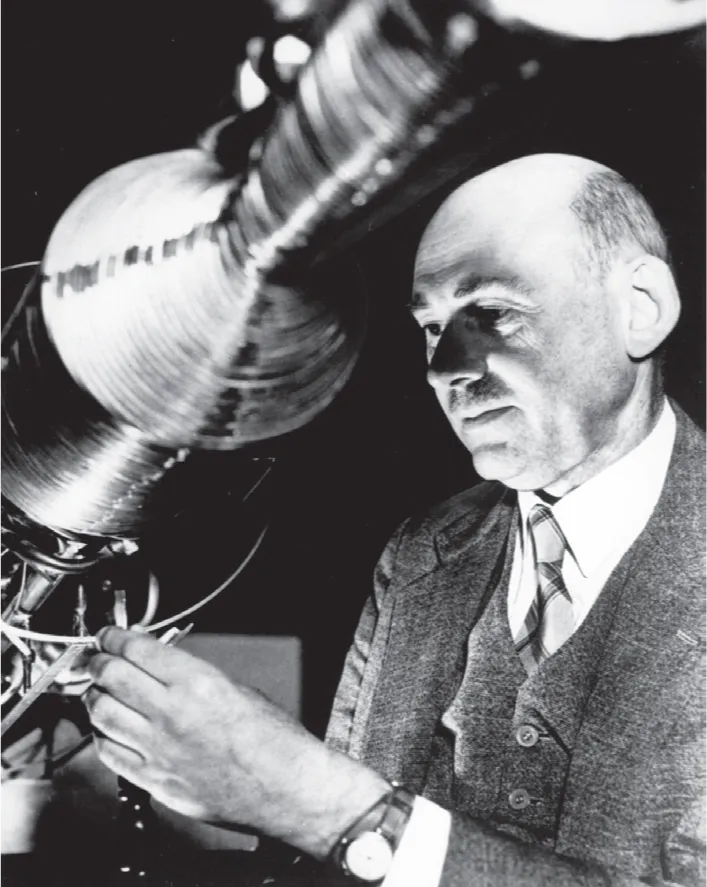
© Smithsonian National Air and Space Museum (NASM 87-5770)
Hermann Oberth photographed in his workshop while assisting on the production of the German science-fiction feature film Woman in the Moon. When he was ten years old, the telephone and the automobile first appeared in his rural hometown. In his later years he witnessed the launches of Apollo 11 and the space shuttle Challenger.
Undeterred, Oberth obstinately continued to pursue his studies independently, dismissing his instructors as unworthy to judge his work. For this gifted mathematician, formulating the necessary calculations for space travel was a diverting intellectual exercise that gave him a sense of ownership and agency. “This was nothing but a hobby for me,” he said, “like catching butterflies or collecting stamps for other people, with the only difference that I was engaged in rocket development.”
He asked himself a series of questions that would need to be answered if humans were to enter outer space: Which propellant should be used—liquid or solid? Is interplanetary travel possible? Can humans adapt to weightlessness? How might humans nourish themselves in space? Can humans wearing space suits venture outside vehicles? In contrast to Goddard’s more cautious approach, Oberth embraced the unknown by posing imaginative questions prompted by his reading of science fiction. He then devised practical solutions founded on his mathematical and engineering expertise.
In 1923 he published a short technical version of his dissertation, Die Rakete zu den Planetenräumen (The Rocket into Interplanetary Space), personally paying the expense of the book’s entire printing. Fortunately, his vanity-publishing project was a wise decision. By issuing the book in German, which in the early twentieth century was the dominant language of the scientific community, Oberth established himself as the world’s leading theorist of human spaceflight, overshadowing the more reclusive Goddard. When he read the German monograph, Goddard believed Oberth had borrowed his ideas without proper attribution, though there is little evidence to support his suspicions.
The Rocket into Interplanetary Space appeared at a moment when many Germans were hungry for something bold, dynamic, and modern to restore the nation’s pride, following the defeat in World War I. The 1920s were a time of experimentation in art, film, and architecture and the arrival of new consumer technologies like radio, air travel, and neon lighting. The speed, power, and streamlined design of rockets became associated with a future of exciting possibilites. Less than four years after the publication of Oberth’s book, the Verein für Raumschiffahrt—or Society for Space Travel—was formed in Germany, and it soon became the world’s leading rocketry organization. It published a journal, held conferences, and conducted research experiments. But the stunts of Max Valier, one of the society’s founders, were what drew the greatest media attention: He strapped himself into a rocket-powered car and hurtled down a racetrack, trailing a cloud of smoke and flame. Such daredevil exploits proved to be an effective way of generating publicity but did little to boost the society’s scientific reputation.
Not long after the society’s founding, the noted Austrian-German filmmaker Fritz Lang approached it for technical assistance in connection with his forthcoming science-fiction space epic, Frau im Mond (Woman in the Moon), a follow-up to his international hit Metropolis. Lang hired Oberth, the society’s figurehead president, to be the film’s technical adviser. The film’s studio also engaged Oberth to build a functioning liquid-fuel rocket to promote the movie’s premiere, a project that, despite providing the society needed research-and-development money, was unsuccessful.
Albert Einstein and other scientists were among the celebrities who attended the film’s opening, but the only rocket to be seen that night was the one that appeared on the screen, created by the studio’s special-effects department. Although Frau im Mond wasn’t a critical hit, it was historically important for introducing the world’s first rocket countdown. Fritz Lang created it as a dramatic device to instill suspense in the final moments before the blastoff. It was such an effective way to focus attention and convey the sequence of procedures prior to liftoff that rocket engineers around the world immediately adopted it.
Meanwhile, in the Soviet Union, reports of Goddard’s moon rocket and Oberth’s scientific monograph prompted Russian space enthusiasts to stake their country’s claim by recognizing that Konstantin Tsiolkovsky had been the first to mathematically publish the rocket equation. Tsiolkovsky was in his mid-sixties when he received his vindication, and it coincided with a brief and bizarre moment of space-travel mania. After the First World War, revolution, and a civil war, Russia was in the throes of change, as audacious and provocative new ideas permeated the culture; among them was a renewed interest in utopian Russian cosmism, and a desire to explore new worlds. One of Tsiolkovsky’s leading Soviet advocates rallied followers with the slogan “Forward to Mars!”
In 1924, Russian magazines and newspapers reported that Goddard was about to shoot his rocket to the Moon or, in fact, may have already done so. Many Russian readers assumed that colonizing the planets was imminent. At space-advocacy lectures and public programs—including one with a crowd so keyed up that a riot nearly took place—curious attendees demanded to know when flights to the Moon and planets would commence and where to volunteer to be among the first settlers. But after learning that trips to the planets were at least a few decades away, the crowd dispersed in disappointment. In Moscow, an international space exhibition attracted twelve thousand visitors, and a Russian Society for Studies of Interplanetary Travel was founded. But Stalin’s rise to power and the beginning of the Five-Year Plan brought an end to Russia’s short experimental post-revolutionary sojourn. Despite his new fame at home, Tsiolkovsky received little recognition abroad.
Goddard’s reticence for publicity...