- English
- ePUB (mobile friendly)
- Available on iOS & Android
eBook - ePub
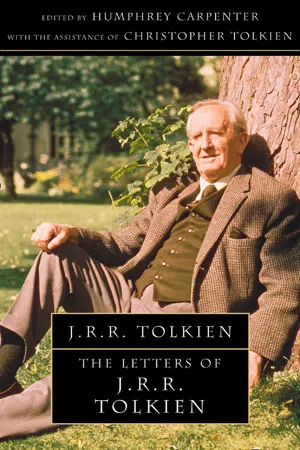
The Letters of J. R. R. Tolkien
Information
LETTERS
1 To Edith Bratt
[Tolkien became engaged to Edith Bratt, whom he had met during his adolescence in Birmingham, in January 1913, when he was twenty-one. The following letter was written during his final year as an undergraduate at Oxford, when he was studying English Language & Literature, and at the same time was drilling in the University Officers’ Training Corps as a preparation for joining the army.]
[Not dated; October 1914]
Exeter College, Oxford
My Edith darling:
Yes I was rather surprised by your card of Sat. morning and rather sorry because I knew my letter would have to wander after you. You do write splendid letters to me, little one; I am such a pig to you though. It seems age[s] since I wrote. I have had a busy (and very wet!) week end.
Friday was completely uneventful and Sat too though we had a drill all afternoon and got soaked several times and our rifles got all filthy and took ages to clean afterwards.
I spent most of the rest of those days indoors reading: I had an essay, as I told you, but I didn’t get it finished as Shakespeare came up and then (Lieutenant) Thompson1 (very healthy and well in his new uniform) and prevented me doing work on the Sabbath, as I had proposed to do. . . . . I went to St Aloysius for High Mass – and I rather enjoyed it – it is such ages since I heard one for Fr. F.2 wouldn’t let me go when I was at the Oratory last week.
I had to pay a duty call to the Rector3 in the afternoon which was very boring. His wife really is appalling! I got away as soon as possible and fled back in the rain to my books. Then I went and saw Mr Sisam4 and told him I could not finish my essay till Wed: and stayed and talked with him for some time, then I went and had an interesting talk with that quaint man Earp5 I have told you of and introduced him (to his great delight) to the ‘Kālevalā’ the Finnish ballads.
Amongst other work I am trying to turn one of the stories – which is really a very great story and most tragic – into a short story somewhat on the lines of Morris’ romances with chunks of poetry in between. . . . . 6
I have got to go to the college library now and get filthy amongst dusty books – and then hang about and see the Bursar. . . . .
R.7
2 From a letter to Edith Bratt
27 November 1914
I did about 4 hrs. [work] 9.20–1 or so in the morning: drilled all afternoon went to a lecture 5–6 and after dinner (with a man called Earp) had to go to a meeting of the Essay Club – an informal kind of last gasp [?]. There was a bad paper but an interesting discussion. It was also composition meeting and I read ‘Earendel’ which was well criticised.1
3 From a letter to Edith Bratt
26 November 1915
[After graduating at Oxford with a First Class in English, Tolkien was commissioned in the Lancashire Fusiliers. This letter was written from Rugeley Camp in Staffordshire, where he was training. Meanwhile he was working on a poem, ‘Kortirion among the Trees’, suggested by Warwick, where Edith Bratt was living. The poem describes a ‘fading town upon a little hill’, where ‘linger yet the Lonely Companies. . . . The holy fairies and immortal elves.’ For ‘the T.C.B.S.’ see no. 5.]
The usual kind of morning standing about and freezing and then trotting to get warmer so as to freeze again. We ended up by an hour’s bomb-throwing with dummies. Lunch and a freezing afternoon. All the hot days of summer we doubled about at full speed and perspiration, and now we stand in icy groups in the open being talked at! Tea and another scramble – I fought for a place at the stove and made a piece of toast on the end of a knife: what days! I have written out a pencil copy of ‘Kortirion’. I hope you won’t mind my sending it to the T.C.B.S. I want to send them something: I owe them all long letters. I will start on a careful ink copy for little you now and send it tomorrow night, as I don’t think I shall get more than one copy typed (it is so long). No on second thoughts I am sending you the pencil copy (which is very neat) and shall keep the T.C.B.S. waiting till I can make another.
4 From a letter to Edith Bratt
2 March 1916
This miserable drizzling afternoon I have been reading up old military lecture-notes again:— and getting bored with them after an hour and a half. I have done some touches to my nonsense fairy language – to its improvement.1
I often long to work at it and don’t let myself ‘cause though I love it so it does seem such a mad hobby!
5 To G. B. Smith
[While they were at King Edward’s School, Birmingham, in 1911, Tolkien and three friends, Rob Gilson, Geoffrey Smith and Christopher Wiseman, formed themselves into an unofficial and semi-secret society which they called ‘the T.C.B.S.’, initials standing for ‘Tea Club and Barrovian Society’, an allusion to their fondness for having tea in the school library, illicitly, and in Barrow’s Stores near the school. Since leaving King Edward’s, the T.C.B.S. had kept in close touch with each other, and in December 1914 had held a ‘Council’ at Wiseman’s London home, following which Tolkien had begun to devote much energy to writing poetry – the result, he believed, of the shared ideals and mutual encouragement of the T.C.B.S. Wiseman was now serving in the Navy, Gilson and Smith were sent out to the Somme, and Tolkien arrived on that battlefield, as Battalion Signalling Officer to the 11th Lancashire Fusiliers, just as the Allied offensive of 1 July was beginning. On that day, Rob Gilson was killed in action, but news of his death did not reach the other members of the T.C.B.S. for some weeks. Geoffrey Smith sent Tolkien a note about it, and later passed him a letter from Christopher Wiseman.]
12 August 1916
11th Lancashire Fusiliers, B.E.F., France
My dear old Geoffrey,
Thank you indeed for Christopher’s letter. I have thought much of things since – most of them incommunicable thoughts until God brings us together again if it be only for a space.
I don’t agree with Chris – although of course he does not say much. I agree most heartily of course with the part you underlined – but strangely enough not in the least now with the part I marked and commented. I went out into the wood – we are out in camp again from our second bout of trenches still in the same old area as when I saw you – last night and also the night before and sat and thought.
I cannot get away from the conclusion that it is wrong to confound the greatness which Rob has won with the greatness which he himself doubted. He himself will know that I am only being perfectly sincere and I am in no way unfaithful to my love for him – which I only realise now, more and more daily, that he has gone from the four – when I say that I now believe that if the greatness which we three certainly meant (and meant as more than holiness or nobility alone) is really the lot of the TCBS, then the death of any of its members is but a bitter winnowing of those who were not meant to be great – at least directly. God grant that this does not sound arrogant – I feel humbler enough in truth and immeasurably weaker and poorer now. The greatness I meant was that of a great instrument in God’s hands – a mover, a doer, even an achiever of great things, a beginner at the very least of large things.
The greatness which Rob has found is in no way smaller – for the greatness I meant and tremblingly hoped for as ours is valueless unless steeped with the same holiness of courage suffering and sacrifice – but is of a different kind. His greatness is in other words now a personal matter with us – of a kind to make us keep July 1st as a special day for all the years God may grant to any of us – but only touches the TCBS on that precise side which perhaps – it is possible – was the only one that Rob really felt – ‘Friendship to the Nth power’. What I meant, and thought Chris meant, and am almost sure you meant, was that the TCBS had been granted some spark of fire – certainly as a body if not singly – that was destined to kindle a new light, or, what is the same thing, rekindle an old light in the world; that the TCBS was destined to testify for God and Truth in a more direct way even than by laying down its several lives in this war (which is for all the evil of our own side with large view good against evil).
So far my chief impression is that something has gone crack. I feel just the same to both of you – nearer if anything and very much in need of you – I am hungry and lonely of course – but I don’t feel a member of a little complete body now. I honestly feel that the TCBS has ended – but I am not at all sure that it is not an unreliable feeling that will vanish – like magic perhaps when we come together again. Still I feel a mere individual at present – with intense feelings more than ideas but very powerless.
Of course the TCBS may have been all we dreamt – and its work in the end be done by three or two or one survivor and the part of the others be trusted by God to that of the inspiration which we do know we all got and get from one another. To this I now pin my hopes, and pray God that the people chosen to carry on the TCBS may be no fewer than we three. . . . .
I do however dread and grieve about it – apart from my own personal longings – because I cannot abandon yet the hope and ambitions (inchoate and cloudy I know) that first became conscious at the Council of London. That Council was as you know followed in my own case with my finding a voice for all kinds of pent up things and a tremendous opening up of everything for me:— I have always laid that to the credit of the inspiration that even a few hours with the four always brought to all of us.
There you are – I have sat solemnly down and tried to tell you drily just what I think. I have made it sound very cold and distant – and if it is incoherent that is due to its being written at different sittings amongst the noise of a very boring Company mess.
Send it on to Chris if you think it worth while. I do not know what is to be our move next or what is in store. Rumour is as busy as the universal weariness of all this war allows it to be. I wish I could know where you are. I make a guess of course.
I could write a huge letter but I have lots of jobs on. The Bde. Sig. Offr. is after me for a confabulation, and I have two rows to have with the QM and a detestable 6.30 parade – 6.30 pm of a sunny Sabbath.
Write to me when you get the ghost of a chance.
Yours
John Ronald.
6 To Mrs E. M. Wright
[In 1920 Tolkien was appointed Reader in English Language at Leeds University, a post that was later converted into a Professorship; see no. 46 for an account of the interview leading to his appointment. Tolkien was now married to Edith Bratt; by 1923 he had two children, John and Michael. In 1922 he published a glossary to a Middle English Reader edited by his former tutor, Kenneth Sisam. He also began work with E. V. Gordon on an edition of Sir Gawain and the Green Knight. The following letter, acknowledging receipt of an article about that poem, is addressed to the wife of Joseph Wright, editor of the English Dialect Dictionary (‘E.D.D.’). Tolkien had studied philology with Wright at Oxford.]
13 February 1923
The University, Leeds
Dear Mrs Wright,
I am very grateful to you for the offprint – and also for your kind remarks about the glossary. I certainly lavished an amount of time on it which is terrible to recall, and long delayed the Reader bringing curses on my head; but it was instructive.
I need hardly say that I am quite convinced by your article and am delighted to feel confident that another rough patch in ‘Sir G.’ is now smoothed out finally by you.
We have just passed through a somewhat disastrous Christmas, as the children chose that time to sicken for measles – by the beginning of January I was the only one in the house left up, the patients including the wife & nursemaid. The vacation work lay in ruins; but they (not the work) are all better now and not much the worse. I escaped. I hope you are well, and that Professor Wright is well – I have not heard any news of him lately, which I have interpreted favourably.
Middle English is an exciting field – almost uncharted I begin to think, because as soon as one turns detailed personal attention on to any little corner of it the received notions and ideas seem to crumple up and fall to pieces – as far as language goes at any rate. E.D.D. is certainly indispensable, or ‘unentbehrlich’ as really comes more natural to the philological mind, and I encourage people to browze in it.
My wife wishes to be remembered to you both and joins her greetings to mine.
Yours sincerely
J. R. R. Tolkien.
Philology is making headway here. The proportion of ‘language’ students is very high, and there is no trace of the press-gang! JRRT.
7 To the Electors of the Rawlinson and Bosworth Professorship of Anglo-Saxon, University of Oxford
[In the summer of 1925 the Professorship of Anglo-Saxon at Oxford was advertised, following the resignation of W. A. Craigie. Tolkien decided to apply, though he was only thirty-three. This is his formal letter of application, dated 27 June 1925.]
Gentlemen,
I desire to offer myself as a candidate for the Rawlinson and Bosworth Professorship of Anglo-Saxon.
A Chair which affords such opportunity of expressing and communicating an instructed enthusiasm for Anglo-Saxon studies and for the study of the other Old Germanic languages is naturally attractive to me, nor could I desire anything better than to be reassociated in this way with the Oxford English School. I was a member of that School both as undergraduate and as tutor, and during my five years’ absence in Leeds am happy to have remained in touch with it, more especially, in the last two years, as an Examiner in the Final Schools.
I entered Exeter College as Stapledon Exhibitioner in 1911. After taking Classical Moderations in 1913 (in which I specialized in Greek philology), I graduated with first class honours in English in 1915, my special subject being Old Icelandic. Until the end of 1918 I held ...
Table of contents
- Cover
- Title Page
- Copyright
- Contents
- Introduction
- Letters of J.R.R. Tolkien
- Notes
- Footnotes
- About the Author
- Works by J.R.R. Tolkien
- About the Publisher
Trusted by 375,005 students
Access to over 1.5 million titles for a fair monthly price.
Study more efficiently using our study tools.
Frequently asked questions
Yes, you can cancel anytime from the Subscription tab in your account settings on the Perlego website. Your subscription will stay active until the end of your current billing period. Learn how to cancel your subscription
No, books cannot be downloaded as external files, such as PDFs, for use outside of Perlego. However, you can download books within the Perlego app for offline reading on mobile or tablet. Learn how to download books offline
Perlego offers two plans: Essential and Complete
- Essential is ideal for learners and professionals who enjoy exploring a wide range of subjects. Access the Essential Library with 800,000+ trusted titles and best-sellers across business, personal growth, and the humanities. Includes unlimited reading time and Standard Read Aloud voice.
- Complete: Perfect for advanced learners and researchers needing full, unrestricted access. Unlock 1.5M+ books across hundreds of subjects, including academic and specialized titles. The Complete Plan also includes advanced features like Premium Read Aloud and Research Assistant.
We are an online textbook subscription service, where you can get access to an entire online library for less than the price of a single book per month. With over 1.5 million books across 990+ topics, we’ve got you covered! Learn about our mission
Look out for the read-aloud symbol on your next book to see if you can listen to it. The read-aloud tool reads text aloud for you, highlighting the text as it is being read. You can pause it, speed it up and slow it down. Learn more about Read Aloud
Yes! You can use the Perlego app on both iOS and Android devices to read anytime, anywhere — even offline. Perfect for commutes or when you’re on the go.
Please note we cannot support devices running on iOS 13 and Android 7 or earlier. Learn more about using the app
Please note we cannot support devices running on iOS 13 and Android 7 or earlier. Learn more about using the app
Yes, you can access The Letters of J. R. R. Tolkien by Humphrey Carpenter, Christopher Tolkien in PDF and/or ePUB format, as well as other popular books in Literature & Literary Criticism in Science Fiction. We have over 1.5 million books available in our catalogue for you to explore.