![]()
ANIMALS
Painting animals is not difficult if you break down the shapes into something manageable, such as a geometric shape. Of course, no animals will stand patiently while you paint them into the scene, so it is helpful to work from sketches or even photographs.
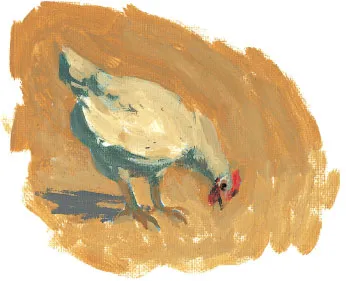
Hen
Birds come from eggs – and when painting them, that is a very good place to start. An egg is a good shape on which to base a bird. All you need to do is work out which angle the egg is positioned at. In chickens the shape is slightly tilted. Add some triangles for the head and tail feathers, another small triangle for the head, and you will be able to capture the shape and pose.
1 Mark out the hen using the egg shape, with a thin solution of blue and a hog bristle bright.
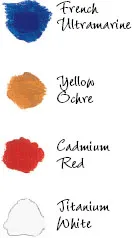
2 Paint in the darks on the bird: blue with red and a little white. This colour is also used for the bird’s shadow (below).
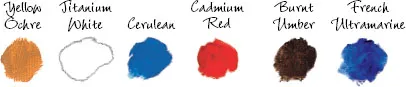
3 Using a small, soft brush, mix white with a little yellow for the light parts of the body. Legs are yellow with a little grey from the body shadow. Add red with a little white for the wattles, and mix yellow with a little white for the background.
Ducks
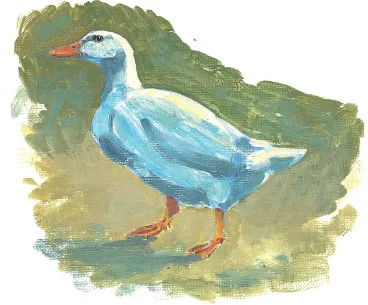
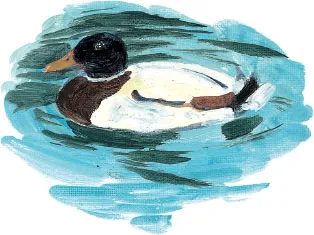
Ducks are found in the wild, in farmyards and in most public parks, anywhere where there is water. One of the important things to notice is that when the birds are swimming, they displace the water in a curved shape around their bodies, not a straight line.
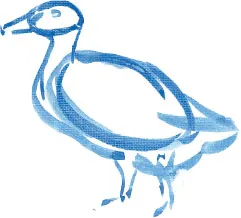
1 Construct the duck in the same way as the hen, using the egg shape. The shape tilts slightly to point downwards, and ducks have more sinuous necks than chickens.
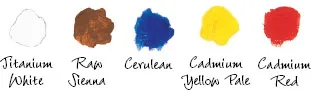
2 Paint the bird with cream made from white and yellow. The feather shadows are Cerulean, red and white. Beak and feet are a mix of red and yellow with white. The ground is yellow with Cerulean and white, and the shadows cast by the bird are Cerulean, red and white with a small amount of yellow.
Paint the drake in the water with yellow and white for the light parts, and brown, red and French Ultramarine for the dark head and neck. The beak is yellow with a touch of red and white. The water is Cerulean and white over the whole area first, then yellow mixed with French Ultramarine and a little white for the ripples.
Sheep
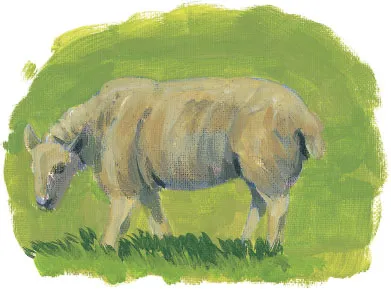
Sheep are features of many landscapes that are farmed, and add an air of peaceful tranquillity to a scene. However, they are almost never in the right spot to paint, or else they move on just as you are about to start painting. It’s a good idea to sketch them whenever you get the chance.
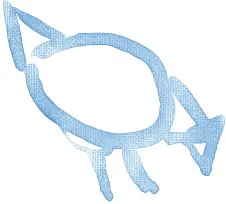
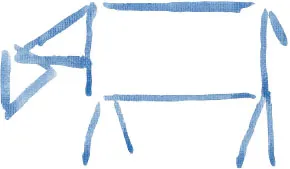
1 Using a hog bristle bright, draw out the simplified shape with a thin solution of blue.
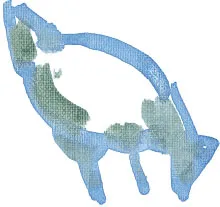
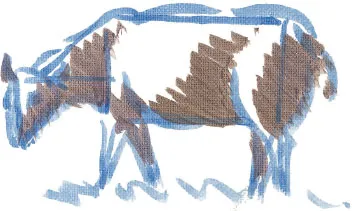
2 Fill out the profile of the sheep over the framework. Add shadows of blue mixed with red and a little white.
3 Mix Raw Sienna with white and a touch of blue to make the light parts of the sheep. Add details (eyes, nose, creases in the wool etc.) with blue and red and a small, soft brush. Paint the grass with yellow, blue and some white. The shadow is the same mix with more blue.
Cow
Cows, like sheep, add interest and atmosphere to a landscape. They are more striking than sheep, especially the Friesian breeds with their black and white markings. Use these markings to help you to construct their...