![]()
1
August: Endings and Beginnings
The universe is built on a plan the profound symmetry of which is somehow present in the inner structure of our intellect.
PAUL VALÉRY
Midday, 26 August, the Sinai Desert
It’s my 40th birthday. It’s 40 degrees. I’m covered in factor 40 sun cream, hiding in the shade of a reed shack on one side of the Red Sea. Saudi Arabia shimmers across the blue water. Out to sea, waves break where the coral cliff descends to the sea floor. The mountains of Sinai tower behind me.
I’m not usually terribly bothered by birthdays, but for a mathematician 40 is significant – not because of arcane and fantastical numerology, but because there is a generally held belief that by 40 you have done your best work. Mathematics, it is said, is a young man’s game. Now that I have spent 40 years roaming the mathematical gardens, is Sinai an ominous place to find myself, in a barren desert where an exiled nation wandered for 40 years? The Fields Medal, which is mathematics’ highest accolade, is awarded only to mathematicians under the age of 40. They are distributed every four years. This time next year, the latest batch will be announced in Madrid, but I am now too old to aspire to be on the list.
As a child, I hadn’t wanted to be a mathematician at all. I’d decided at an early age that I was going to study languages at university. This, I realized, was the secret to fulfilling my ultimate dream: to become a spy. My mum had been in the Foreign Office before she got married. The Diplomatic Corps in the 1960s didn’t believe that motherhood was compatible with being a diplomat, so she left the Service. But according to her, they’d let her keep the little black gun that every member of the Foreign Office was required to carry. ‘You never know when you might be recalled for some secret assignment overseas,’ she said, enigmatically. The gun, she claimed, was hidden somewhere in our house.
I searched high and low for the weapon, but they’d obviously been very thorough when they taught my mum the art of concealment. The only way to get my own gun was to join the Foreign Office myself and become a spy. And if I was going to look useful, I’d better be able to speak Russian.
At school I signed up for every language possible: French, German and Latin. The BBC started running a Russian course on television. My French teacher, Mr Brown, tried to help me with it. But I could never get my mouth around saying ‘hello’ – zdravstvuyte – and even after eight weeks of following the course I still couldn’t pronounce it. I began to despair. I was also becoming increasingly frustrated by the fact that there was no logic behind why certain foreign verbs behaved the way they did, and why certain nouns were masculine or feminine. Latin did hold out some hope, its strict grammar appealing to my emerging desire for things which were part of some consistent, logical scheme and not just apparently random associations. Or perhaps it was because the teacher always used my name for second-declension nouns: Marcus, Marce, Marcum, …
One day, when I was 12, my mathematics teacher pointed at me during a class and said, ‘du Sautoy, see me at the end of the lesson.’ I thought I must be in trouble. I followed him outside, and when we reached the back of the maths block he took a cigar from his pocket. He explained that this is where he came to smoke at break-time. The other teachers didn’t like the smoke in the common room. He lit the cigar slowly and said to me, ‘I think you should find out what mathematics is really about.’
I don’t quite know even now why he singled me out from all the others in the class for this revelation. I was far from being a maths prodigy, and lots of my friends seemed just as good at the subject. But something obviously made Mr Bailson think that I might have an appetite for finding out what lay beyond the arithmetic of the classroom.
He told me that I should read Martin Gardener’s column in Scientific American. He gave me the names of a couple of books which he thought I might enjoy, including one called The Language of Mathematics, by Frank Land. The simple fact of a teacher taking a personal interest in me was enough to spur me on to investigate what it was that he found so intriguing about the subject.
That weekend my dad and I took a trip up to Oxford, the nearest academic city to our home. A little shopfront on The Broad bore the name Blackwell’s. It didn’t look terribly promising, but someone had told my dad that this was the Mecca of academic bookshops. Entering the shop you realized why. Like Doctor Who’s Tardis, the shop was huge once you had entered the tiny front door. Mathematics books, we were told, were down in the Norrington Room, as the basement was known.
As we went downstairs a vast cavernous room opened up before us, stuffed full of what looked to me like every possible science book that could ever have been published. It was an Aladdin’s cave of science books. We found the shelves dedicated to mathematics. While my dad searched for the books my teacher had recommended, I started pulling books off the shelves and peering inside. For some reason there seemed to be a high concentration of yellow books. But it was what I found within the yellow covers that grabbed my attention. The contents looked extraordinary. I recognized strings of Greek letters from my brief foray into learning Greek. There were storms of tiny little numbers and letters adorning x’s and y’s. On every page there were words in bold like Lemma and Proof.
It was completely meaningless to me. There were a few students leaning against the bookshelves who seemed to be reading the books as though they were novels. Clearly, they understood this language. It was simply code for something. From that moment I decided that I was going to learn how to decode these mathematical hieroglyphics. As we were paying at the till, I saw a table full of yellow paperbacks. ‘They’re mathematical journals,’ explained the shop assistant. ‘The publishers are offering free copies to entice academics to take out a subscription.’
I picked up a copy of something called Inventiones Mathematica and put it in the bag with the books we’d just bought. Here was my challenge. Could I decode the mathematical inventions in this yellow book? Some of the articles were in German, one was in French and the rest were in English. But it was the mathematical language that I was now determined to crack. What did ‘Hilbert space’ and ‘isomorphism problem’ mean? What message was hidden in these lines of sigmas and deltas and symbols that I couldn’t even name?
When I got home I started looking at the books we’d bought. The Language of Mathematics particularly intrigued me. Before our expedition to Oxford, I’d never thought of mathematics as a language. At school it seemed to be just numbers that you could multiply or divide, add or subtract, with varying degrees of difficulty. But as I looked through this book I could see why my teacher had told me to ‘find out what maths is really about’.
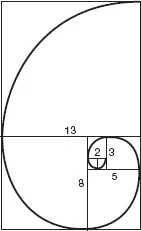
In this book there was no long division to lots of decimal places or anything like that. Instead there were, for example, important number sequences like the Fibonacci numbers. Apparently, the book said, these numbers explain how flowers and shells grow. You get any number in the sequence by adding the two previous numbers together. The sequence starts 1, 1, 2, 3, 5, 8, 13, 21, … The book explained how these numbers are like a code that tells a shell what to do next as it grows. A tiny snail starts off with a little 1 × 1 square house. Then, each time it outgrows its shell, it adds another room to the house. But since it doesn’t have much to go on, it simply adds a room whose dimensions are the sum of the dimensions of the two previous rooms. The result of this growth is a spiral (Figure 1). It was beautiful and simple. These numbers are fundamental, said the book, to the way nature grows things.
Fig. 1 How the snail uses the Fibonacci numbers to grow its shell.
Fibonacci’s spiral © Raymond Turvey
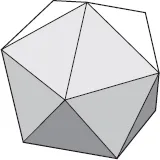
Other pages depicted interesting three-dimensional objects that I’d never seen before, built from pentagons and triangles. One was called an icosahedron and had 20 triangular faces (Figure 2). Apparently, if you took one of these objects (what the book called polyhedra) and counted the number of faces and points (what the book called vertices), and then subtracted the number of edges, you always got 2. For example, a cube has 6 faces, 8 vertices and 12 edges: 6 + 8 − 12 = 2. The book claimed that this trick would work for any polyhedron. That seemed like a bit of magic. I tried it on the one made out of 20 triangles.
Fig. 2 The icosahedron with its 20 triangular faces.
Icosahedron © Raymond Turvey
The trouble was that it was quite hard to envisage the whole object clearly enough to count everything. Even if I built one from card, keeping track of all those edges seemed a bit daunting. But then my dad showed me a short cut. ‘How many triangles are there?’ Well, the book said that there were 20. ‘So that’s 60 edges on 20 triangles, but each edge is shared by two triangles. That makes 30 edges.’ Now, that really was magic. Without looking at the icosahedron, you could work out how many edges it had. The same trick worked for the vertices. Again, 20 triangles have 60 vertices. But this time I could see from the picture that every vertex was shared by five triangles. So the icosahedron had 20 faces, 12 vertices and 30 edges. And sure enough, 20 + 12 − 30 = 2. But why did the formula work whatever polyhedron you took?
In another book there was a whole section on the symmetry of objects like these polyhedra made out of triangles. I had a vague idea of what ‘symmetry’ meant. I knew that I was symmetrical, at least on the outside. Whatever I had on the left side of my body, there was a mirror image of it on the right side. But a triangle, it seemed, had much more symmetry than just the simple mirror symmetry. You could spin it round as well, and the triangle still looked the same. I began to realize that I wasn’t actually sure what it meant to say that something was symmetrical.
The book stated that the equilateral triangle had six symmetries. As I read on, I began to see that the triangle’s symmetry was captured by the things I could do to it that would leave it looking the same. I traced an outline around a triangular piece of card and then counted the number of ways I could pick the triangle up and put it down so that it fitted back exactly inside its outline on the paper. Each of these moves, the book said, was ‘a symmetry’ of the triangle. So a symmetry was something active, not passive. The book was pushing me to think of a symmetry as an action that I could perform on the triangle to replace it inside its outline, rather than some innate property of the triangle itself. I started to count the symmetries of the triangle, thinking of them as the various different things I could do to it. I could flip the triangle over in three ways. Each time two corners swapped places. I could also spin the triangle by a third of a full rotation, either clockwise or anticlockwise. That made five symmetries. What was the sixth?
I searched desperately for what I’d missed. I tried combining actions to see whether I could get a new one. After all, performing two of these moves one after the other was effectively the same as making a single move. If a symmetry was a move that put the triangle back inside its outline, then perhaps I would get a new move or a new symmetry. What if I flipped the triangle then turned it? No, that was just like one of the other flips. What about flipping, rotating and then flipping back again? No, that just created the spin in the other direction, which I’d counted already. I’d got five things, but whatever combination I took of these moves I couldn’t get anything new. So I went back to the book.
What I found was that they’d included as a symmetry just leaving the triangle where it was. Curious … But I soon saw that if symmetry meant anything you could do to the triangle that kept it inside its outline, then not touching it at all – or, equivalently, picking it up and putting it back in exactly the same place – was also an action that had to be included.
I liked this idea of symmetry. The symmetries of an object seemed to be a bit like all the magic trick moves. The mathematician shows you the triangle, then tells you to turn away. While you are not looking, the mathematician does something to the triangle. But when you turn back it looks exactly as it did before. You could think of the total symmetry of an object as all the moves that the mathematician could make to trick you into thinking that he hadn’t touched it at all.
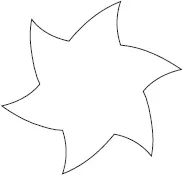
I tried out this new magic on some other shapes. Here was an interesting one, looking like a six-pointed starfish (Figure 3). I couldn’t flip it over without making it look different: it seemed to be spinning in one direction, which destroyed its reflectional mirror symmetry. But I could still spin it. With its six tentacles, there were five spins I could do, together with just leaving it where it was. Six symmetries. The same number as the triangle.
Fig. 3 A six-pointed starfish with no reflectional symmetry.
Six-pointed starfish © Raymond Turvey
Each object had the same number of symmetries. But the book talked about a language that could articulate and give meaning to the statement ‘These two objects have different symmetries.’ It would reveal why these objects represented two different species in the world of symmetry. This language could also expose, the book promised, when two objects that looked physically different actually had the same symmetries. This was the journey I was about to embark on: to discover what symmetry really is.
As I read on, the shapes and pictures gave way to symbols. Here was the language that the title of the other book was referring to. There seemed to be a way to translate the pictures into a language. I came across some of the symbols that I’d seen in the yellow journal I’d picked up. Everything was starting to get rather abstract, but it seemed that this language was trying to capture the discovery I’d made when playing with the six symmetries of the triangle. If you took two symmetries, or magic trick moves, and did them one after the other, for example a reflection followed by a rotation, it gave you a third symmetry. The language describing these interactions had a name: group theory.
This language provided an insight into why the six symmetries of the six-pointed starfish were different to the six symmetries of the triangle. A symmetry was one of these magic trick moves, so I could perform two symmetries of an object one after the other to get a third symmetry. The group of symmetries of the starfish interact with one another very differently to the interaction between the group of symmetries of the triangle. It was the interactions among the group of symmetries of an object that distinguished the group of symmetries of the triangle from the group of symmetries of the six-pointed starfish.
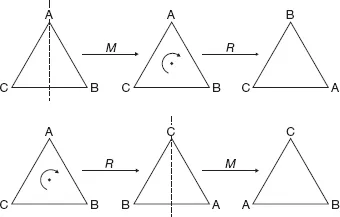
In the starfish, for example, one rotation followed by another gave me a third rotation. But it didn’t matter in what order I made the two rotations. For example, spinning the starfish 180° clockwise then anticlockwise 60° left the starfish in the same position as first doing the 60° anticlockwise spin and then the 180° clockwise spin. In contrast, if I took two symmetries of the triangle and combined the two magic trick moves corresponding to these symmetries, it made a big difference what order I did them in. A mirror symmetry move followed by a rotation was not the same as the rotation followed by the mirror symmetry move. The language of my book had translated the pictures into the sentence M·R ≠ R·M, where M was the mirror symmetry move and R the rotation (Figure 4). The physical world of symmetry could be translated into an abstract algebraic language.
As my school years progressed, I came to see what my maths teacher had done. The arithmetic of the classroom is a bit like scales and arpeggios for a musician. My teacher had played me some of the exciting music that was waiting for me out there if I could master the technical part of the subject. I certainly didn’t understand everything I read, but I did now want to know more.
Fig. 4 A mirror symmetry followed by a rotation is different from a rotation followed by a mirror symmetry.
Swapping symmetries © Raymond Turvey
Most budding musicians would abandon their instruments if all they were allowed to play and listen to were scales and arpeggios. A child starting out on an instrument will have no idea how Bach composed the Goldberg Variations or how to improvise a blues lick, yet they can still get a kick out of hearing someone else do it. Books such as The Language of Mathematics made me realize that you could do the same with maths. I didn’t have a clue what ‘a group’ really was, but I grasped that it was part of a secret language that could be used to unlock the science of symmetry.
This was the language I would try to learn. It might not get me into the Foreign Office, and I might have to give up the dream of being a spy, but here was a secret code that looked as intriguing as anything the world of espio...