- English
- ePUB (mobile friendly)
- Available on iOS & Android
eBook - ePub
About this book
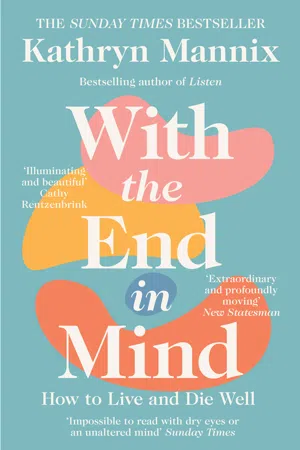
THE SUNDAY TIMES BESTSELLER
'Impossible to read with dry eyes or an unaltered mindset' Sunday Times
'Illuminating and beautiful' Cathy Rentzenbrink
What if everything you thought you knew about death was wrong?
How should we prepare for the facts of dying and saying our goodbyes?
And what if understanding death improved your life?
By turns touching and tragic, funny and wise, With the End in Mind brings together Kathryn Mannix ' s lifetime of medical experience to tell powerful stories of life and death.
Trusted by 375,005 students
Access to over 1 million titles for a fair monthly price.
Study more efficiently using our study tools.
Information
Topic
MedicineSubtopic
Medicine BiographiesNaming Death
It has become taboo to mention dying. This has been a gradual transition, and since we have lost familiarity with the process, we are now also losing the vocabulary that describes it. Euphemisms like ‘passed’ or ‘lost’ have replaced ‘died’ and ‘dead’. Illness has become a ‘battle’, and sick people, treatments and outcomes are described in metaphors of warfare. No matter that a life was well-lived, that an individual was contented with their achievements and satisfied by their lifetime’s tally of rich experiences: at the end of their life they will be described as having ‘lost their battle’, rather than simply having died.
Reclaiming the language of illness and dying enables us to have simple, unambiguous conversations about death. Allowing each other to discuss dying, rather than treating the D-words as magic ciphers that may cause harm merely by being spoken aloud, can support a dying person in anticipating the last part of their living, in planning ahead in order to prepare their loved ones for bereavement, and can bring the notion of death as the thing that happens at the end of every life back into the realm of the normal. Open discussion reduces superstition and fear, and allows us to be honest with each other at a time when pretence and well-intentioned lies can separate us, wasting time that is very precious.
Second-Hand News
Communication through conversation between two people is such an intrinsic part of life that we often take it for granted, yet we are all aware of occasions when friends and family get hold of the wrong end of the stick. What they thought they heard us say is not, in fact, what we thought we meant. Now multiply the possibilities of mis-hearing, misunderstanding and getting lost in translation when a person gets important news from their doctor, and then tries to report it back to their family afterwards. It’s a recipe for disaster.
Early in my career, I had the good fortune to be offered a twelve-month contract as a cancer research fellow, working in an academic cancer centre with a prestigious and groundbreaking team. My role was to see patients in clinics and on the wards who had agreed to take part in trials of new drugs; sometimes these were anti-cancer drugs, and sometimes other medications intended to reduce the side-effects of treatment. Over the year, I was mainly dealing with patients for whom no possible options for cure remained, and who knew that their only treatment options were aimed at improving their quality of life or possibly extending it by a short time. Some of these patients bravely offered to test new anti-cancer drugs, aware that they were unlikely to experience any personal benefit yet willing to help our research in order to contribute knowledge that might help future patients. For some it was a personal anti-cancer crusade; for others it was making sense of their impossible situation by using their misfortune to improve other people’s fortunes in the future; for some it was a form of bargaining with God or the Fates, in the hope that their reward would be an unexpected improvement in their own health.
I saw most of these patients very regularly. In addition to their admission for two or three days’ treatment with new chemotherapy agents every three weeks, I saw them weekly to take blood tests that monitored the impact of the drugs on their body, and to ask them about any side-effects they were experiencing. We talked about other things too, of course: how they were managing, what their families were up to, what plans they were making for Passover or Eid, the progress of a daughter’s pregnancy or a grandson’s apprenticeship application. They probably spoke to me more often than to their friends and neighbours, and I certainly saw more of them than I did of my own family.
In this way I got to know Fergus. He was a stocky, gruff-voiced Scotsman who had worked as a shepherd on his uncle’s farm from the age of eighteen. He loved the hills, the wide sky and the endless vistas. He was a quiet, shy man who confessed that he had been too timid to talk to girls as a youth, and had anticipated that he would be ‘married to the farm’. He was completely unprepared for the shock of falling in love at forty-three with the woman who managed the stock pens in his local meat market. He was captivated, and too mesmerised even to remember to be bashful. Within eighteen months they were married and parents to a son. Five years later Fergus was my patient, gently turning yellow as an aggressive cancer relentlessly replaced his liver.
Fergus joined in a study of a new drug for his type of cancer. ‘I have tae beat the bastard thing,’ he said. ‘I have too much to live fer. My Maggie, my lovely girl, how can I leave her when I’ve only just found her? And the Boy …’ His eyes would lock onto my face, searching for some sign that I had good news, that I might be offering recovery, some respite, some extra time for his unlooked for, unexpected, joyous family life. He always called his son ‘the Boy’. He said it reverently, as though he was talking about something too sacred to be named.
His fourth course of the treatment was due in mid-February, just before the Boy’s sixth birthday, which fell on Valentine’s Day. Fergus would be home in time for the big day, but the treatment always left him wretched, gagging and puking for five days before he could fall into a sweaty, forty-eight-hour sleep that restored his ability to talk to his family again. He came for his blood test the week before. He had been into town, and he showed me a beautiful locket he had bought for Maggie as a Valentine’s gift. ‘I’m going tae put a photo of the Boy on this side,’ he said, ‘so he’ll be at the front. And she likes this old photo of me, see’ – producing a snap taken at a family wedding in which he is young, broad and strong, with a mop of dark curls, and strong legs below his smart dress kilt, laughing and raising his dark brows above eyes creased from the weathered horizon-searching of his trade – ‘so I’ll cut the head oot and put it in the back. That way, I’ll always be right close tae her skin. Always. Whatever happens.’
I asked about their plans for the birthday. They would be at home, he told me, just the three of them together. ‘We’ve bought the Boy a bike, just wee with stabilisers. It’s blue. He has no idea. He’ll be so tickled …’ Fergus’s eyes lit up at the thought. I knew that his liver scan was not improving, and that postponing his treatment for a week, to avoid the birthday being wrecked by his resulting nausea and exhaustion, would make no difference to his overall outlook. He was losing ground; gradually more yellow, starting to look gaunt.
‘Fergus, how will you be over the birthday if we go ahead with the treatment next week?’ I asked. ‘Will you be able to enjoy the bike, the cake, the event?’
‘Och, I’ll prob’ly feel crap, I always dae, you know, fer a few days at least. But I cannae give up!’ Defiant lift of the chin.
‘What if we delay the treatment by one week? That won’t be giving up. It would let you enjoy the birthday, and Valentine’s Day. And then you can come back for the next treatment afterwards. A few days off won’t make a difference. What do you think?’
He considers, knitting his deep, thoughtful brow. ‘It wouldnae do nae harm to put it off fer a few days?’ he asks tentatively.
‘I don’t think so. Do you want to talk it over with your wife?’ I ask. I know she is in the waiting room, but he had left her there and come into the clinic room alone. ‘I can talk to her now, with you, if you like.’
‘No, nae need to bother wi’ that,’ he says. ‘I can explain. Aye, let’s bide a wee bit. I might be able to help wi’ the bike that way.’ He smiles. ‘Important family time, birthdays, eh? I have great memories o’ mine when I was wee. I want that fer the Boy.’ He picks up his jacket. ‘So, back to the ward on 19th then, is it? Or dae you need a blood test next week?’ I tell him the 19th will be fine. ‘Thanks then, doc,’ he says. ‘See you after, for the next bout.’ It sounds as if we are discussing a boxing match. He swings his jacket over his shoulder and heads for the door.
‘Are you sure you don’t want me to see if your wife has any questions?’ I ask.
‘Nae need. Nowt tae explain!’ he says, and disappears around the corner.
On the Monday after Valentine’s Day, a GP rang the cancer centre to say that Fergus had a swollen, red right calf. ‘Looks like a DVT,’ said the doctor. ‘Do you have a bed?’ Fergus’s admission was agreed, and an ambulance was despatched to collect him from home. He arrived within the hour, in a pyjama top and shorts. ‘Couldnae get the troosers over ma fat leg.’
Yes, this looks like a DVT: a deep-vein thrombosis, one of the over-clotting complications of cancer. Over the next few hours Fergus has a vein scan to confirm the diagnosis, and begins drugs to thin his blood and prevent the clot from getting any bigger. He tells me about the birthday: about the Boy’s joy over his bike, his daredevil pedalling up and down the pavement outside their house on his birthday, and every day since; about Maggie’s tears when she saw the locket, and her kissing the photos before hanging it around her neck; about the wonderful dinner she cooked, and the bicycle-wheel birthday cake; about how glad he was to have those special days, without sickness and post-treatment misery. His eyes are shining. Delaying this treatment was the right call, I think, as I leave his room to check my other patients.
The ‘cardiac arrest’ bleep takes me by surprise. I run to the ward, to find a hubbub outside Fergus’s room: a nurse running with the crash trolley, an anaesthetist dashing up the stairs towards us; the patients’ tea trolley deserted mid-ward. In Fergus’s room he is pale, semi-conscious, panting. His lips are blue. His eyes are wide, surprised-looking. I explain the DVT to the anaesthetist: the likelihood is that the clot in Fergus’s leg has broken up and travelled around his veins, and is now blocking the blood supply to his lungs. We give oxygen by face mask: its hissing drowns out the sound of his panting. I ask a nurse to call his wife. The anaesthetist tells me that because of his extensive cancer, and his failing liver, heart and lungs, Fergus is not a candidate for an intensive care unit bed, and I know that this is right – if he is dying, he should do it here, amongst people who know him and with his wife beside him. The crash team withdraws. We wait for Maggie. I give Fergus a small dose of a drug that will take the edge off his breathlessness, and his panting becomes less urgent. I sit beside the bed, wailing inside my head for his loss.
‘Am I dying?’ he asks me, between deep breaths from his mask.
‘You might be,’ I answer cautiously, ‘but we don’t know yet. Maggie is on her way. We’re going to stay very close, and if you have any pain I want to know.’
‘Bugger!’ he says. ‘It’s too soon tae die. Too much to live fer. My Maggie. Oor Boy …’ He can only manage one word for each breath he takes.
‘Fergus, I can give you some more of that medicine for breathlessness any time you want it. It might make you sleepy, though. Do you want to be awake for Maggie? Or would you rather be asleep, and less breathless?’
Before he can answer, Fergus’s breathing changes again: slower, grunting, laboured. His pupils begin to dilate. He is unconscious, unresponsive, unaware, dying. The clot has moved deeper. He is not getting any circulation through his lungs, his brain is not getting any oxygen. Within five minutes, his breathing ceases completely.
Maggie is shown straight into Sister’s office when she arrives ten minutes later. Sister takes me in and introduces me. I have heard so much about Maggie, yet never met her. I have to tell her that Fergus is dead. I have to say those words slowly, carefully, so she can understand. I sit beside her and explain about the clot in Fergus’s leg moving to his lungs, stopping him from getting oxygen. I explain that we managed his breathlessness so that he was calm and comfortable. I tell her about his joyful recounting of their son’s birthday. I repeat his last words, ‘My Maggie. Our Boy …’
Together, we walk to his room, where the nurses have removed the drips and oxygen pipes and he lies quiet, pale, fragile in his bed. I show Maggie where to sit so she can touch him, hold him, talk to him. I tell her she can sit here as long as she likes.
Later, back in Sister’s office, she sips a cup of NHS tea-with-sympathy with Sister while I write out a medical certificate of death for her to take away. I ask if there is anything else she would like to know.
‘No,’ she says, slowly. ‘I only want to say how glad I am that it was you in here today, looking after him, and not that cow that he saw in the clinic last time.’
I am thunderstruck. What can she mean? I ask what happened in the clinic.
‘That doctor told him that there was no hope. He might as well miss a week. It wouldn’t make any difference. He didn’t tell me until we got home. That cow took all his hope away.’
Sister looks at me. I can hear the blood rushing in my head. Breathe! Breathe! What did I say? How did he hear that? I cannot imagine how our clinic conversation could have been reconstituted in this way. I remember asking if I should talk to her. I remember him declining. I wonder what he thought he heard me say.
‘That was me, Maggie,’ I say. ‘I saw Fergus every time he came. I remember seeing him before the birthday.’ I recount, as best I can, the conversation we had, the decision to avoid treatment-related misery over Valentine’s Day, Fergus’s hopes for making happy birthday memories for their son. I watch as she tries to reconcile the image she has of the cow in the clinic with the woman before her, who has talked her through the death of her husband. I can see the struggle to comprehend in her eyes.
‘I am so very sorry, Maggie,’ I say. ‘I don’t know what to say to you. Maybe I said it wrong. Maybe he heard it differently from how I intended.’
‘Actually,’ she says after a long silence, ‘I think he said what you just said to me. But I knew that if it was really working well, you wouldn’t have given him a week off. He was always hopeful, and I was always expecting disaster. He did have a lovely time. I saw it, he was just so happy. You would never think he knew it was his last chance to celebrate our boy’s birthday. Our last Valentine’s Day. And maybe he didn’t. But I did.’
She sips the tea and strokes the locket hanging at her throat. In the silence, I contemplate the horrible harm I have caused. If I had voiced my concerns with Fergus in the clinic, he might have shared that lonely understanding of the approach of death with his wife. If I had only walked around the corner to where she was sitting, she might have had a chance to ask her own questions, to follow her own, hopeless hunch. They might have been able to say the important things that a couple needs to say on the brink of death. Instead, for this lonely woman, there was no goodbye.
And yet, she is prepared to pardon this inexcusable offence. She understands that her husband preferred to say little, and to know even less, and that I allowed that to happen.
‘Sorry I called you a cow,’ she says.
‘It wasn’t you, it was the situation,’ I reply.
I don’t start to cry until she has set off for home, to tell the Boy. There can be no worse conversation for a mother to have.
Slipping Through My Fingers
The emergency department is a sorting-house where very sick people must be helped quickly so that the opportunity to save life is not lost, while the unavoidably dying must also be rapidly identified and supported to make the best of their final moments. Amongst the people coming to the ED who may not leave alive are those still hoping to be made well, those who never previously suspected they were ill, and those who have lived with ill-health and increasing frailty for some time. Only our honesty about the probable outcomes of the treatments we can offer can enable patients and families to make wise choices about when to accept that life is drawing to its close.
Not all dying is neat and well-prepared. Although the final moments of life follow a reasonably consistent pattern of waning consciousness and automatic breathing, the journey to that point may take a less predictable path. Possibly 25 per cent of all deaths are sudden and unexpected, taking place too rapidly to allow time for any treatment. Yet even in such deaths there is often a known underlying condition, such as heart disease, or simply extreme age, that may make the timing of death unpredictable but that nevertheless foreshadows its approach.
So, if most deaths are at the end of a period of escalating ill-health, and if even the majority of sudden deaths are as a result of acknowledged significant illness, why are we still so often unready?
Kathleen, one of our nurse specialists, and I were making our recommendations to staff about a patient well known to the city’s palliative care services, who had been brought to the emergency department by her anxious daughter, when a familiar, pink-faced junior doctor ran past us shouting, ‘Cardiac arrest Bay 2! I think we’ll need you, Pallies!’
When I qualified as a doctor, the specialty of palliative medicine had not yet been established, and palliative care was a concept confined to a few charitably funded hospices. Now I am a consultant in the discipline, and trainee doctors come on placements in our hospital palliative care team. How times have changed. Each year we take three newly qualified doctors for a four-month placement.
Eighteen months ago Lisl arrived in our office, timid and daunted by the idea of working in palliative care. Four months later she had learned new communication skills, could offer a comprehensive pain and symptom assessment, had begun to elaborate her own script for the ‘explaining what dying is like’ conversations, and had taken to referring to our team members as the Pallies. We love watching each trainee grow in confidence and understanding, becoming ready to take a better understanding of palliative care back out into the rest of their medical practice. Lisl was now a trainee in trauma surgery; palliative care skills are useful i...
Table of contents
- Cover
- Title Page
- Copyright
- Dedication
- Contents
- Introduction
- Reading the Label
- Patterns
- My Way
- Naming Death
- Looking Beyond the Now
- Legacy
- Transcendence
- Last Words
- Glossary
- Resources and Helpful Information
- Letter Template
- Acknowledgements
- About the Publisher
Frequently asked questions
Yes, you can cancel anytime from the Subscription tab in your account settings on the Perlego website. Your subscription will stay active until the end of your current billing period. Learn how to cancel your subscription
No, books cannot be downloaded as external files, such as PDFs, for use outside of Perlego. However, you can download books within the Perlego app for offline reading on mobile or tablet. Learn how to download books offline
Perlego offers two plans: Essential and Complete
- Essential is ideal for learners and professionals who enjoy exploring a wide range of subjects. Access the Essential Library with 800,000+ trusted titles and best-sellers across business, personal growth, and the humanities. Includes unlimited reading time and Standard Read Aloud voice.
- Complete: Perfect for advanced learners and researchers needing full, unrestricted access. Unlock 1.4M+ books across hundreds of subjects, including academic and specialized titles. The Complete Plan also includes advanced features like Premium Read Aloud and Research Assistant.
We are an online textbook subscription service, where you can get access to an entire online library for less than the price of a single book per month. With over 1 million books across 990+ topics, we’ve got you covered! Learn about our mission
Look out for the read-aloud symbol on your next book to see if you can listen to it. The read-aloud tool reads text aloud for you, highlighting the text as it is being read. You can pause it, speed it up and slow it down. Learn more about Read Aloud
Yes! You can use the Perlego app on both iOS and Android devices to read anytime, anywhere — even offline. Perfect for commutes or when you’re on the go.
Please note we cannot support devices running on iOS 13 and Android 7 or earlier. Learn more about using the app
Please note we cannot support devices running on iOS 13 and Android 7 or earlier. Learn more about using the app
Yes, you can access With the End in Mind by Kathryn Mannix in PDF and/or ePUB format, as well as other popular books in Medicine & Medicine Biographies. We have over one million books available in our catalogue for you to explore.