SECRET VICE EB
  1. English
  2. ePUB (mobile friendly)
  3. Available on iOS & Android
eBook - ePub

About this book

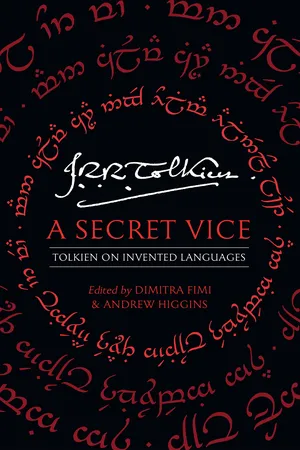
First ever critical study of Tolkien's little-known essay, which reveals how language invention shaped the creation of Middle-earth and beyond, to George R R Martin's Game of Thrones.

J.R.R. Tolkien's linguistic invention was a fundamental part of his artistic output, to the extent that later on in life he attributed the existence of his mythology to the desire to give his languages a home and peoples to speak them. As Tolkien puts it in 'A Secret Vice', 'the making of language and mythology are related functions'.

In the 1930s, Tolkien composed and delivered two lectures, in which he explored these two key elements of his sub-creative methodology. The second of these, the seminal Andrew Lang Lecture for 1938–9, 'On Fairy-Stories', which he delivered at the University of St Andrews in Scotland, is well known. But many years before, in 1931, Tolkien gave a talk to a literary society entitled 'A Hobby for the Home', where he unveiled for the first time to a listening public the art that he had both himself encountered and been involved with since his earliest childhood: 'the construction of imaginary languages in full or outline for amusement'.

This talk would be edited by Christopher Tolkien for inclusion as 'A Secret Vice' in The Monsters and the Critics and Other Essays and serves as the principal exposition of Tolkien's art of inventing languages. This new critical edition, which includes previously unpublished notes and drafts by Tolkien connected with the essay, including his 'Essay on Phonetic Symbolism', goes some way towards re-opening the debate on the importance of linguistic invention in Tolkien's mythology and the role of imaginary languages in fantasy literature.

Frequently asked questions

Yes, you can cancel anytime from the Subscription tab in your account settings on the Perlego website. Your subscription will stay active until the end of your current billing period. Learn how to cancel your subscription.
No, books cannot be downloaded as external files, such as PDFs, for use outside of Perlego. However, you can download books within the Perlego app for offline reading on mobile or tablet. Learn more here.
Perlego offers two plans: Essential and Complete
  • Essential is ideal for learners and professionals who enjoy exploring a wide range of subjects. Access the Essential Library with 800,000+ trusted titles and best-sellers across business, personal growth, and the humanities. Includes unlimited reading time and Standard Read Aloud voice.
  • Complete: Perfect for advanced learners and researchers needing full, unrestricted access. Unlock 1.4M+ books across hundreds of subjects, including academic and specialized titles. The Complete Plan also includes advanced features like Premium Read Aloud and Research Assistant.
Both plans are available with monthly, semester, or annual billing cycles.
We are an online textbook subscription service, where you can get access to an entire online library for less than the price of a single book per month. With over 1 million books across 1000+ topics, we’ve got you covered! Learn more here.
Look out for the read-aloud symbol on your next book to see if you can listen to it. The read-aloud tool reads text aloud for you, highlighting the text as it is being read. You can pause it, speed it up and slow it down. Learn more here.
Yes! You can use the Perlego app on both iOS or Android devices to read anytime, anywhere — even offline. Perfect for commutes or when you’re on the go.
Please note we cannot support devices running on iOS 13 and Android 7 or earlier. Learn more about using the app.
Yes, you can access SECRET VICE EB by J. R. R. Tolkien, Dimitra Fimi,Andrew Higgins, Dimitra Fimi, Andrew Higgins in PDF and/or ePUB format, as well as other popular books in Literatura & Lingüística. We have over one million books available in our catalogue for you to explore.

Information

PART I

‘A Secret Vice’

The essay (MS Tolkien 24, folios 10–24, 26–36, 38–42) is written in black ink on ‘Oxford paper’fn1 using two examination booklets (of 14 and 26 pages, respectively), as well as loose pages torn out of examination booklets. Folios 35 and 39, which contain translations of two Elvish poems, are typescripts on much flimsier, brownish paper. There are numerous pencil and ink emendations throughout the essay, as well as longer additional sections in pencil with indications of where they should be inserted. Most of these emendations and additions seem contemporary, apart from three instances (see Introduction, p. xxxiv) that may indicate a later delivery of this paper.
The title of the essay in the manuscript is ‘A Hobby for the Home’. In his 1983 edition of the essay Christopher Tolkien wrote:
The ironic title in the manuscript itself is A Hobby for the Home … but my father referred to it in 1967 by a different title: ‘The amusement of making up languages is very common among children (I once wrote a paper on it, called A Secret Vice)’ (The Letters of J.R.R. Tolkien, p. 374). The words ‘a secret vice’ occur in the essay; and I have adopted this title. (Monsters, pp. 3–4)
The Johnson Society minutes (see pp. xxxii–xxxiii) show that Tolkien did indeed use ‘A Secret Vice’ as his title when he first delivered the paper and we have, therefore, kept the title in this edition.
We have presented all the material included in the folios above, including pencil emendations and additions, in an attempt to reconstruct the essay as close as possible to the form it was in when first delivered. For example, folios 24r and 24v on the Fonwegian language, written in pencil and inserted as a loose leaf inside one of the examination booklets, were not included in the original edition of the essay. However, the minutes of the Johnson Society show that Tolkien did read those inserted pages (see above, pp. xxxii–xxxiii) so we have included them where Tolkien indicates.
A Hobby for the Home1
Some of you2 may have heard that there was recently a year or more ago a {illeg} Congress in Oxford, an Esperanto3 Congress4; or you may not have heard.In other words home-made or Invented languages8

Esperanto. La Onklino de Charlie
I heard – because I was invited to it by a certain Mr McCallum or Macallumo5 to see a performance of La Onklino de Charlie6.
Personally I am a believer in an “artificial” language, at any rate for Europe – a believer that is in its desirability, as the one thing antecedently necessary for uniting Europe, before it is swallowed by America7/non-Europe; as well as for many other good reasons – a believer in its possibility because the history of the world seems to exhibit, as far as I know it, both an increase in human control (or infl uence upon) the uncontrollable, and a progressive widening of the range of more or less uniform languages. Also I particularly like Esperanto, not least because it is the creation ultimately of one man, not a philologist, and is therefore something like a “human language bereft of the inconveniences due to too many successive cooks” – which is as good a description of the ideal artificial language (in a particular sense) as I can give.
In other words home-made or Invented languages8
Now I believe in the possibility of an artificial language – I am no longer so sure that it would be a good thing. But at least it is possible, and perhaps probable. For the general trend has been towards an increase of human control over (or deliberate interference at with at any rate) the what was previously ‘instinct’ or traditional.

Anyway I think that Esperanto per se has much to be said for it – it is likeable. Largely because it was in the main the creation or artifact of one man (not a philologist) but something of an artist.)
“A human language bereft of the inconveniences of one to too many successive cooks.”

At present I think we should be likely to get an inhumane language without any cooks at all – their place being taken by nutrition experts and dehydrators.
No doubt the Esperantist propaganda touched on all these points. I wasn’t there, so I cannot say. But it is not important, because my concern is not with that kind of artificial language at all. You must tolerate the stealthy approach. It is habitual. But in any case my real subject tonight is a stealthy subject. Rather a bashful matter. Indeed nothing less embarrassing than the revealing/unveiling in public of a secret vice. Had I boldly and brazenly begun right on my theme I might have called my paper a plea for a New Art, or at any rate a New Game or at least/perhaps the public reception of an ancient one.9 I might have done so, with a disgusting arrogance not justified by the possible advertisement value of such a title, if occasional and painful confidences had not given me grave cause to suspect that the vice, though secret, is not unique common, and the art (or game), if new at all, has at least been discovered by a good many other people independently.
The practitioners are all so shy and ashamed bashful however, that they never hardly ever show their works to one another, so none of us them know who are the geniuses at the game, or who are the splendid “primitives” whose neglected works, found in old drawers10, may possibly be purchased at great price (not from the authors, or their heirs and assigns!) for American museums, in after days when the ‘art’ has become acknowledged. I won’t say ‘general’! – it is too arduous and slow: I doubt if any devotee could produce more than one real masterpiece, plus at most a few brilliant sketches or outlines, in a life-time.
I shall never forget a little man – smaller than myself – whose name I have forgotten11, revealing himself by accident as a devotee, in a moment of extreme ennui, in a dirty wet marquee filled with trestle tables smelling of stale mutton fat, crowded with (mostly) depressed and wet creatures. We were listening to somebody lecturing on map-reading, or camp-hygiene, or the art of sticking a fellow through without (in defiance of Kipling12) bothering who God sent the bill to; rather we were trying to avoid listening, though the Guards’ English, and voice, is penetrating. The man next to me said suddenly in a dreamy voice: “Yes, I think I shall express the accusative case by a prefix!”13
A memorable remark! Of course by repeating it I have let the cat, so carefully hidden, out of its bag, or at least revealed the whiskers.14 But we won’t bother about that for a moment. Just consider the splendour of the words! “I shall express the accusative case.” Magnificent! Not “it is expressed”, nor even the more shambling “it is sometimes expressed”, nor the grim “you must learn how it is expressed”. What a pondering of alternatives within one’s choice before the final decision in favour of the daring and unusual prefix, so personal, so attractive; the final solution of some element in a design that had hitherto proved refractory. Here were no base considerations of the ‘practical’, the easiest for the ‘modern mind’, or for the million – only a question of taste, a satisfaction of a personal pleasure, a private sense of fitness.
As he said this word the little man’s smile was full of a great delight, as of a poet or painter seeing suddenly the solution of a hitherto clumsy passage. Yet he proved as close as an oyster. I never gathered any further details of his secret grammar; and military arrangements soon separated us never to meet again (up to now at any rate). But I gathered that this queer creature – ever afterwards a little bashful after inadvertently revealing his secret – cheered and comforted himself in the tedium and squalors of ‘training under canvas’ by composing a language, a personal system and symphony that no one else was to study or to hear. Whether he did this in his head (as only the great masters can), or on paper, I never knew. It is incidentally one of the attractions of this hobby that it needs so little apparatus! How far he ever proceeded in his composition, I never heard. Probably he was blown to bits in the very moment of deciding upon some ravishing method of indicating the subjunctive. The Great War was/Wars are not favourable to delicate pleasures.
But he was not the only one of his kind.15 I would venture to assert that, even if I did not know it from direct evidence. It is inevitable, if you “educate” most people, many of them more or less artistic or creative, not solely receptive, by teaching them languages. Few philologists even are devoid of the making instinct – but they often know but one thing well; they must build with the bricks they have.16 There must be a secret hierarchy of such folk. Where the little man stood in this, I do not know. High I should guess. What range of accomplishment there is among these hidden craftsmen, I can only surmise – and I surmise the range runs, if one only knew, from the crude chalk-scrawl of the village schoolboy to the heights of palaeolithic or bushman art (or beyond). Its development to perfection must none the less certainly be prevented by its solitariness, the lack of interchange, open rivalry, study or imitation of other’s technique.
I give no names. I have made small efforts of research. I use as evidence merely some of...

Table of contents

  1. Cover
  2. Title Page
  3. Copyright
  4. Contents
  5. Foreword
  6. Introduction
  7. Part I
  8. Part II
  9. Part III
  10. Coda: The Reception and Legacy of Tolkien’s Invented Languages
  11. Footnotes
  12. Appendices
  13. Chronology
  14. Abbreviations
  15. Bibliography
  16. About the Authors
  17. Works by J.R.R. Tolkien
  18. About the Publisher