![]()
Appendix 1: Key Figures
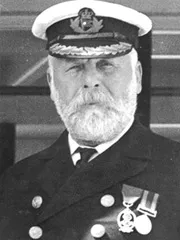
Captain Edward J. Smith
For a man who would spend most of his life conquering the ocean waves, Captain Edward John Smith, born 27 January 1850, began life in a place that was far removed from the sea – the landlocked town of Hanley in Stoke-on-Trent, in the heart of the North Staffordshire Potteries.
Smith’s father and grandfather worked as potters, and the younger Smith seemed destined to follow them into the family business. However, after leaving school at the tender age of twelve, the boy seemed intent on a sea-faring career. At thirteen, he was taken on as an apprentice with A. Gibson & Co. of Liverpool. Smith quickly gained the necessary qualifications, and by 1869, he was serving on board a clipper ship, the Senator Weber, an American-built vessel operated by his employers.
Captain Edward J. Smith
Having proved himself an able seaman, Smith joined the White Star Line in March 1880, and was immediately given the post of Fourth Officer on the SS Celtic. This was the beginning a dazzling career with Thomas Ismay’s shipping company. For seven years, Smith served on various White Star vessels, including freighters to Australia and passenger liners to New York. Finally, in 1887, he was given his first command as captain of the SS Republic. On 12 July of the same year, Smith married Sarah Eleanor Pennington. Their daughter, Helen Melville Smith, was born on 2 April 1898. The family lived a large, redbrick house called ‘Woodhead’ in Highfield, Southampton.
Captain Smith was widely regarded as the White Star Line’s safest pair of hands, having taken the helm of White Star’s Majestic, Coptic, Adriatic and the Olympic. By the time he took command of the Titanic in 1912, he was earning a salary of £1,250 per annum – a significant amount of money for the time. The success of his professional career was mirrored in his personal life.
Smith also served in the British Navy, gaining his Extra Master’s Certificate in 1888, thus qualifying as Lieutenant. This enabled him to join the Royal Naval Reserve, and later serve in the Boer War – with distinction – successfully completing two hazardous voyages to Cape Colony to transport troops. In 1903, he was awarded the Transport Medal by Edward VII for his efforts.
Captain Edward J. Smith, 1907
By the time Captain Smith took command of RMS Titanic, he was sixty-two years old, and this voyage was to be Smith’s last before retirement – a triumphant entry into New York Harbour on the world’s largest ship was to be a fitting end to the unblemished career of this master mariner. Fate, however, had other plans.
Edward John Smith did not survive the sinking of RMS Titanic – as was his duty as captain, he went down with his ship on that ill-fated night in April 1912. His body was never recovered.
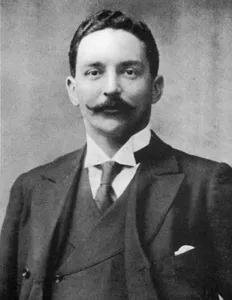
Joseph Bruce Ismay
Joseph Bruce Ismay was born in Crosby, near Liverpool, on 12 December 1862. He was the eldest of seven children born to Thomas Henry Ismay, an industrialist, and Margaret Ismay (née Bruce).
Ismay’s family had strong connections to England’s shipping industry. His paternal grandfather, Luke Bruce, was a prominent ship-owner and his father was partner in the shipping company, Ismay, Imrie & Company. When the younger Ismay was almost seven years old, his father established the White Star Line shipping company. As a young boy, Ismay attended Elstree preparatory school, before being sent to the well-respected public school, Harrow.
Joseph Bruce Ismay
Ismay’s relationship with his bullying father was fraught, and the impressionable boy became shy and withdrawn. This was a pattern which would be perpetuated into adulthood – Ismay had very few friends, and when he wasn’t working, lived a hermit-like existence. His difficulties with his father did not, however, dissuade him from entering the family business. He spent four years learning the ropes as an apprentice and after this, he travelled to America to take up the position of the company’s agent in New York City. In 1888, Ismay married the American heiress, Julia Florence Schieffelin, and they went on to have two sons and two daughters. Three years after the marriage, they returned to England, where Ismay took up a position as partner in Ismay, Imrie & Company.
Upon his father’s death in 1899, Ismay took over the running of the family firm. He displayed a considerable flair for the shipping business, and the company continued to thrive under his stewardship. Ismay’s acute business acumen was in evidence in 1901, when he thrashed out a deal to sell his firm to International Mercantile Marine, a shipping conglomerate owned by American financier, J. P. Morgan. Under the terms of the agreement, ownership of the company passed to Morgan, while Ismay remained at the helm of White Star Line as Chairman and Managing Director.
In his capacity as Chairman, Ismay travelled on the maiden voyages of White Star’s vessels, with RMS Titanic being no exception. On the night of the disaster, Ismay’s actions were commendable – at first. He patrolled the decks, giving orders, and helping to load the lifeboats with women and children. But when the ship was close about to go under, his sense of duty abandoned him. Faced with the prospect of an almost certain death when the ship foundered, Ismay made a split-second decision which would haunt him for the rest of his days – he decided to save himself by stepping into the last lifeboat as it was being lowered away.
The fact that the Chairman of White Star had survived the sinking when so many others had perished, meant that Ismay became a target for those looking for somebody to blame for the tragedy. His actions were widely pilloried, and in the court of public opinion, condemnation was swift and brutal. He was widely ridiculed in newspapers on both sides of the Atlantic, with cartoons lampooning his perceived cowardice. The American press were particularly unrestrained in their assessment of the White Star Line’s Chairman, bestowing on him such monikers as ‘The Coward of the Titanic’ and ‘J. Brute Ismay’. His reputation would never recover.
Joseph B. Ismay
Ismay left the White Star Line in 1913. He lived out the rest of days dividing his time between his homes in Ireland and London. He died of a blood clot in the brain in 1937 and is buried at Putney Vale Cemetery in London, England.
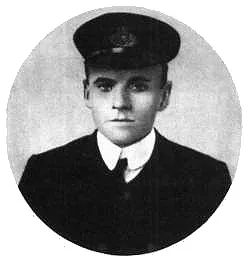
Charles Lightoller
Born on 30 March 1874, Charles Herbert Lightoller began life in the Lancashire town of Chorley. The young Lightoller was initially brought up by his father, his mother having died not long after his birth. But, by the time he was thirteen, his father had abandoned him, leaving the boy to fend for himself. In 1888, he began a four-year nautical apprenticeship on board the Primrose Hill.
Charles Lightoller
Lightoller’s early nautical career was adventurous, to say the least. On various voyages he survived a shipwreck, a cyclone, a severe bout of malaria, and a fire which had ignited a cargo of coal. After a brief stint prospecting for gold in the Yukon Territory of Canada, Lightoller joined the White Star Line in 1900, by which time he was well acquainted with the drama of the high seas. In 1903, on a voyage to Australia, Lightoller met his future wife, Sylvia Hawley-Wilson and they would go on to have five children.
Lightoller served as Second Officer on Titanic’s maiden voyage, and was one of the thirty men who survived the sinking by clinging onto an upturned Collapsible life raft. On the morning of 15 April, he was the last person to board the Carpathia, having first ensured that every other survivor reached the rescue ship safely. Testifying at both the American and British Inquiries in the disaster, Lightoller tried to protect his employers and the memory of Captain Smith by steadfastly refusing to lay blame on either party.
In 1913, Lightoller resumed his seafaring career, serving as First Officer on White Star’s Oceanic, a situation which continued after the outbreak of World War I, when the ship was commandeered by the Royal Navy. On 31 July 1916, Lightoller launched a gun attack on the German airship, Zeppelin L31, for which he received the Distinguished Service Cross.
Despite his distinguished war service, Lightoller discovered that his peacetime career opportunities were limited with the White Star Line. So, after more than twenty years loyal service, Lightoller resigned to write his bestselling autobiography, Titanic and Other Ships. This became the subject of a lawsuit by the Marconi Company. In 1929, he purchased an old steam yacht, re-fitted it with a new steam engine, and renamed it the Sundowner. Lightoller was destined to have one last wartime adventure – the Sundowner was one of the flotilla of small ships which took part in the evacuation of Dunkirk in 1940. In the latter years of his life, Lightoller suffered from chronic heart disease. He died on 8 December 1952, aged 78.
William Murdoch
William McMaster Murdoch was born in Dumfries and Galloway region of Scotland on 28 February 1873. After finishing his schooling in 1887, he signed on with William Joyce & Co shipping company as a trainee. He served his apprenticeship on board the Charles Cotesworth, making a number of voyages around the hazardous Cape Horn en route to, and from, San Francisco.
After only four years, Murdoch gained his Second Mate’s Certificate, and in 1893, he started work aboard the Iquique, which was under the command of his father. On gaining his Extra Master’s Certificate (...