- English
- ePUB (mobile friendly)
- Available on iOS & Android
eBook - ePub
CAVALIERS ROUNDHEADS EPU EB
About this book
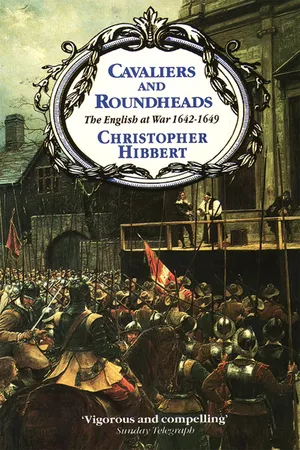
This social as well as a military history recreates the scenes of civil war in England, between 1642 and 1649.
The book is enlivened by character sketches not only of the leading participants (Charles I, Prince Rupert, Oliver Cromwell), but also of the numerous lesser characters, male and female, who took part in the desperate conflict. Families and friends were bitterly divided as men left home to fight for King or Parliament. Castles and towns were besieged and sacked. Houses were plundered, churches desecrated and some 200,000 lives were lost.
Trusted by 375,005 students
Access to over 1 million titles for a fair monthly price.
Study more efficiently using our study tools.
Information
PART ONE
1
THE GATHERING STORM
‘Lord, what work was here! What clattering of glasses! What beating down of walls! What tearing up of monuments! What tooting and piping on the destroyed organ pipes!’
Bishop Joseph Hall
The distant rumblings of the storm had first been heard in Scotland, where the King had offended not only the nobility by taking back into royal hands estates which had once belonged to the Crown and had since been alienated, but also the Presbyterian congregations of the Kirk by his evident determination to impose upon them the popish practices of the detested Englishman, William Laud. When a new prayer book designed upon Anglican lines was introduced there was a riot in St Giles’s Cathedral in Edinburgh, and a bishop suspected of concealing a crucifix beneath his vestments was chased through the streets by a mob of three hundred angry women. A representative of the King’s Government in Edinburgh, who ran to the bishop’s assistance and was himself attacked, reported to London that the King must choose between abandoning his prayer book and forcing it down the Presbyterians’ throats with the help of a well-equipped army of forty thousand men. The Marquess of Hamilton, the King’s Commissioner in Scotland, warned the King that his countrymen were ‘possessed by the Devil’, and that if his Majesty used his army in this way he would not only provoke rebellion in England but risk the Crown in his other two kingdoms of Scotland and Ireland as well.
In defiance of this prescient advice, an English army was raised; but, far from being the powerful force recommended, it was a tawdry array of discontented raw recruits, special levies, trained bands and militia, neither inspired by their cause nor encouraged by the prospects of good pay, whereas the army raised by the Scots, fired by patriotism and religious faith and commanded by a wily, though barely literate old professional soldier, Alexander Leslie, was largely composed of clansmen trained to battle and troops experienced in Continental warfare, backed up by hundreds of men and women ready to fight on the barricades with knives and pitchforks in defence of a National Covenant which, signed by all classes, pledged resistance to ‘papistry’.
The English army which the King in person led against the Scottish rebels in March 1639 was numerous enough, being over twenty thousand strong. Yet, apart from the regiments raised in those far northern areas where men were always ready to fight their traditional enemies across the border, the rank and file remained dispirited and their equipment so limited and primitive that many of the trained bands had to make do with bows and arrows until supplied with pikes which proved inadequate. ‘Our army is but weak,’ lamented Edmund Verney, Knight Marshal of the King’s Palace, ‘our purse is weaker; and if we fight with these forces…we shall have our throats cut.’ Sir Jacob Astley, the King’s Sergeant-Major recalled from retirement to command the infantry, felt obliged to concur. ‘Our men are very raw,’ he reported, ‘our arms of all sorts naught, our victuals scarce, and provisions for horses worse.’ The Earl of Essex, another veteran of Continental wars and for a time commander of the cavalry, was no more confident of success; nor was that charming courtier and ‘wooing ambassador’ Lord Kensington, recently created first Earl of Holland, whom the King was unwisely persuaded to put in Essex’s place by Holland’s friend, the Queen; nor were the regimental commanders, many of whom resented the King’s having resorted to an ancient and, for them, most inconvenient tradition by calling upon his tenants-in-chief to attend upon him with an appropriate number of men. ‘We have had a most cold, wet and long time of living in the field,’ wrote Thomas Windebank, one of the many sons of the King’s Secretary of State, Sir Francis Windebank, when the war was over, ‘but kept ourselves warm with the hope of rubbing, fubbing and scrubbing those scurvy, filthy, dirty, nasty, lousy, itchy, scabby, shitten, stinking, slovenly, snottynosed, logger-headed, foolish, insolent, proud, beggarly, impertinent, absurd, grout-headed [daft], villainous, barbarous, beastial, false, lying, roguish, devilish, long-eared, short-haired, damnable, atheistical, puritanical crew of the Scottish Covenant.’
As the Scottish rebel army advanced purposefully towards the border, the English forces began to crumble away; and at Berwick in June the King, who – always reluctant to recognize that his authority was limited by what it was possible to achieve – had declared that he would ‘rather dye than yield to these impertinent and damnable demands’ of the Scots, was now obliged to come to terms and to agree to a meeting of a General Assembly of the Church of Scotland and to the election of a Scottish Parliament to negotiate a peace. The differences between the two sides, however, particularly on the question of bishops, were too marked for settlement. The Scottish Parliament was adjourned and war seemed inevitable once more.
Thomas Wentworth, soon to be created Earl of Strafford, came over from Ireland to give his advice in 1639. The King’s principal Secretary of State at this time was Sir Henry Vane, an assiduous courtier of the Queen, a ‘busy and bustling man’, smooth, cunning, evasive and equivocal. His views, when he could be prevailed upon to express them, contrasted sharply with those of the Earl of Strafford, whom he much disliked and by whom he was much distrusted in turn. It was Strafford’s opinion that prompt, vigorous and if necessary ruthless action was essential. For far too long the government of the country had been drifting along indecisively, uncertainly directed by such incompetent and procrastinating ministers as Vane who told the King what he wanted to hear rather than what he ought to know. In pain, limping from gout and weakened by dysentery, Strafford was blunt and irritable, his ‘soure and haughty temper’ as Philip Warwick described it, much exacerbated. To resolve the country’s problems, he said, a very large sum of money would be needed; therefore a new Parliament must be called.
The King had always found it difficult to like Strafford. So had the Queen. But both recognized in him, as did William Laud, a man of forceful authority whose thoroughgoing policies had brought order and some measure of prosperity to Ireland and might extricate England from its present troubles. Strafford’s advice was accepted: in April 1640 the Members of what was to become known as the Short Parliament assembled in the chamber of the House which had remained empty and silent for so long.
Most of these Members, elected for the first time, were inexperienced in the ways and customs of the House. They gazed about the chamber, one of them said, wondering ‘who should begin’. Some looked towards John Hampden, Member for Buckinghamshire, who was described by Edward Hyde, Member for Wootton Bassett, as ‘the most popular man in the House’. The eldest son of a Buckinghamshire landowner of ample fortune, Hampden had first been elected to Parliament in 1621, and had since achieved national fame by undergoing a term of imprisonment for refusing to pay Ship Money. Respected as Hampden was, though, he was not much of an orator and had always shown more aptitude for committee work than for public debate.
It was left, therefore, to an older member who had first entered Parliament in 1614 to take the lead. This was John Pym, a thickset, scholarly-looking man, intense and studious, with a rough and shaggy appearance which gained him the nickname ‘Ox’. Like Eliot and Hampden and so many other Parliamentary leaders of his time, he came from an old country family. The son of a gentleman from Somerset, he had been at Oxford before entering the Middle Temple; and, though he was never called to the bar, his speeches were those of a clever lawyer, precise, considered, telling, quite without the frantic rhetoric of Sir John Eliot’s harangues.
He had earned the dislike of the King by his speaking against the Duke of Buckingham, and he now alienated his erstwhile friend the Earl of Strafford by advising his fellow Members of the Commons to refuse to vote any money for the King’s war against the Scots until the country’s grievances had been considered and satisfied. Strafford reacted characteristically to this provocation: he advised the dissolution of Parliament and, since an army strong enough to subdue the Scottish rebels could not be raised in England, the use against them of an army from Ireland. The situation, Strafford insisted, was getting out of hand: there was rioting in the City; south of the river a mob had surged towards Lambeth Palace, forcing the Archbishop to seek shelter in Whitehall; apprentices, dock hands and watermen were marching through the streets with drums, waving staves at passers-by and shopkeepers. ‘Unless you hang up some of them,’ Strafford warned the King, ‘you will do no good with them.’ Several rioters were accordingly imprisoned; two of the ringleaders were hanged; and the rack was brought out for the last time in England to torture one of them. Order for a time was restored. But the City Aldermen continued to refuse to contribute to the loan which was essential to a successful prosecution of the Scottish war.
The English army which marched north that summer against the Scottish rebels was consequently both underpaid and ill-supplied as well as ill-disciplined: two Roman Catholic officers were murdered by their men, who then deserted. Nor did it have the undivided support of the civilians it left behind. Before it marched two of its soldiers fell into conversation with two clothiers in the Green Dragon Tavern in Bishopsgate Street. The clothiers expressed sympathy for the Scots, whereupon one of the soldiers said they must be Puritans. One of the clothiers asked if ‘he could tell what a Puritan was, whereat [the soldier] flew into such a rage he threw a trencher, and hit him on the head’.
The English army, defeated at Newburn on 28 August, met the fate which all sensible men had predicted; and the terms to which the King was obliged to agree were deeply humiliating: the Scottish army was to be paid £850 a day until its claims were settled; and it was to be left in control of Northumberland and Durham. The Scottish provincial government was also to be paid its expenses. So yet another Parliament would have to be called in London, and it was not likely to accept dissolution as tamely as had its predecessor, nor to rest until the King’s ‘evil counsellors’ had been removed from office.
The Members of this new Parliament, which, summoned in November 1640, was to become known as the Long Parliament, directed their attack first against Strafford, whom they had arrested and taken away to the Tower. Then William Laud was impeached and sent to join him there. Several less courageous counsellors slunk abroad.
The Queen took it upon herself to stiffen her husband’s resolve. Distressed by the death of their little daughter Anne, frequently in tears, sleeping badly and feeling ill, she pleaded with the King to stand firm against the demands of Parliament, not to disband the Irish army, at one moment plotting to rescue Strafford from the Tower, at another trying to placate John Pym and his fellow Puritans by reducing the number of Roman Catholics in her household and by arranging for the marriage of her eldest daughter Mary to the Protestant Prince of Orange, whose requests for the hand of her second daughter Elizabeth had previously been rejected with scorn, constantly badgering the King not to give way to the Commons’ demands.
The King’s policy, such as it was in these alarming months, was to wait upon events, promising and prevaricating, standing his ground as long as possible, then reluctantly giving way, endeavouring to persuade the Commons that their revolutionary demands threatened to bring the whole country to disaster, and that, as he put it to them himself, a skilful watchmaker might improve the working of a watch by taking it to pieces and cleaning it, provided that, when he put it together again, he left ‘not one pin out of it’.
Yet the determination of Strafford, endorsed by the Queen, to remain in the Tower for ever rather than to advise the King to surrender to Parliament in exchange for his freedom made a reconciliation with the Commons difficult to achieve, while the need to pay the Scottish rebels to prevent them advancing south made a break with Parliament impossible to contemplate.
The King, therefore, felt unable to resist a whole series of measures which declared monopolies and taxes levied without Parliamentary consent illegal, required the calling of Parliament every three years, reversed the judgements in several Ship Money cases, abolished prerogative courts, settled the limits of the royal forests, roundly condemned Laudism, and, in March 1641, demanded that the Earl of Strafford should be brought to trial on a charge of High Treason.
The conduct of this trial in Westminster Hall demonstrated only too painfully to the King’s friends how far his Majesty had fallen in public esteem. Sitting in a small curtained room at the back of the throne, he was ‘little more regarded’ than the guards upon the doors. There was ‘loud clattering’, so a witness recorded, and ‘much public eating not only of confections but of flesh and bread, and bottles of beer and wine going from mouth to mouth without cups, and all this in the King’s eye’.
The accused looked tired and ill, his beard grey, his back bent, though he was not yet fifty. But he answered the questions that were put to him quickly, calmly, occasionally with contempt, gaining much support by his skill and courage, obliging his accusers to conclude that a charge of High Treason would not serve their purpose and that instead they should bring in a Bill of Attainder which, if Parliament would pass it and the King assent to it, would secure the prisoner’s execution on the grounds that it was necessary for the safety of the state.
Mobs paraded about the streets demanding Strafford’s death. Robert Baillie, the Scottish Presbyterian divine who was in London at the time, recorded that ‘on Monday some thousands of citizens and prentisses awaited all day at Westminster, cryed to every Lord as they went in and in a loud and hideous voyce for justice against Strafford and all traitors…On Wednesday a sudden bruite ran through the Citie that the Papists had set the Lower House on fyre and had besett it with armies; in a clapp all the Citie is in alarum: shops closed, a world of people in armes runnes down to Westminster.’
The Commons passed the Bill by a majority of 204; the Lords’ majority was seven. Strafford’s life now depended upon the King, who had given him his word that he would never let his minister suffer ‘in life, honour or fortune’. With the mob shouting for the traitor’s death beneath the windows of Whitehall Palace and threatening to break down the doors, Strafford wrote to the King to release him from his promise, urging him, ‘for the prevention of evils’ which might result from his refusal, to give his assent to the Bill. For two days the King hesitated, listening to conflicting advice. But, warned that the lives of the Queen and their children might be endangered by his stand, and advised by the Bishop of Lincoln that a monarch had two consciences, one public and one private, and that while the private conscience might find the condemnation of Strafford abhorrent, the public conscience must be concerned with the danger of further bloodshed, the King eventually persuaded himself that it was his duty to submit. He signed the commission with tears in his eyes.
On 12 May Strafford walked with firm step to the scaffold on Tower Hill, passing beneath a window where his old friend Archbishop Laud looked down piteously upon him through the bars. Strafford bowed to him. ‘My Lord,’ he asked, ‘your prayers and blessings.’ Laud raised his hand in benediction and murmured a prayer, before falling back fainting from the window. ‘Farewell, my Lord,’ said Strafford, marching on. ‘God protect your innocency.’
‘I sinned against my conscience,’ the King told the Queen after the axe had fallen. ‘It was a base, sinful concession.’ He believed that he would never forgive himself for what had happened that day, and he never did. Yet he also came to believe that Strafford’s death was due not to his having made concessions too late but to his ever having made any concessions at all.
The execution of Strafford seemed to excite the appetite for revolutionary measures of those Members of the Long Parliament who were eager for further reform, who were determined upon what the nonconformist preacher Edmund Calamy described as a ‘second Reformation’. According to one observer, ‘reformation [went on] as hot as toast’, while noncomformist sects proliferated and the extreme amongst them grew ever more outlandish, though few so outré as the Muggletonians, who condemned both prayer and preaching, and the Adamites, peculiarly hysterical descendants of the Brethren and Sisters of the Free Spirit, who conceived themselves as being in that state of innocence obtaining in the Garden of Eden before the Fall and believed it appropriate to worship God in Adam and Eve’s condition of nakedness. Inspired by preachers and pamphleteers, by female preachers leading congregations in extempore prayers, and by Puritan writers like John Milton who castigated the clergy of the Church of England for stumbling into ‘new-vomited paganisme’, their prayer book for being ‘the skeleton of a Mass-book’ and their communion table for being ‘pageanted about like a dreadful idol’, apprentices chased Anglican parsons down the streets, calling them ‘Abbeylubbers’ and ‘Canterbury Whelps’ and tearing the gowns from their backs.
From all over the country, now and later, there came reports of altar rails being torn down and altars overturned, of prayer books being thrown about churches and graveyards, of vestments being stripped from the backs of Laudian clergy, of attacks upon those opponents of Calvinist doctrines known as Arminians, and of bishops menaced by gangs of women who threatened to hang them with their lawn sleeves. In one church some wild sectaries, provoked by the curate’s kneeling as he administered the sacrament to his parishioners, kicked the communion bread up and down the chancel; in others candles were trampled underfoot, crucifixes and organs broken and stained glass windows smashed. At the Church of the Holy Sepulchre without Newgate, a woman encouraged her child to urinate on the communion table; in Newcastle women were said to be tearing up surplices as well as prayer books; in Kidderminster there was a riot when some members of the parish objected to the churchwardens’ removal of a crucifix from their churchyard cross. The sectaries ‘make such havoc in our churches,’ wrote one observer, ‘by pulling down ancient monuments, glass windows and rails, that their madness is intolerable.’
At Norwich the Bishop, Joseph Hall, was driven out of his palace which was left without ‘so much as a dozen of trenchers or the children’s pictures’, and his chapel and the cathedral were desecrated and wrecked:
Lord, what work was here! What clattering of glasses! What beating down of walls! What tearing up of monuments! What pulling down of seats! What wresting out of iron and brass from the windows and graves! What defacing of arms! What demolishing of curious stonework!…What tooting and piping on the destroyed organ pipes! And what a hideous triumph on the market day before all the county, when in a kind of sacrilegious procession all the organ pipes, vestments, copes and surplices, together with the leaden cross which had been newly sawn down from the Green Yard pulpit, and the service books and singing books were carried to the fire in the public market place, a lewd wretch walking before the train in a cope trailing in the dirt, with a service-book in his hand, imitating in impious scorn the tune, and usurping the words of the Litany.
Later there were similar scenes at Canterbury, where a Puritan clergyman made use of a guide book to the cathedral to demolish ‘many window-images’, ‘many idols of stone’, ‘seven large pictures of the Virgin Mary’ and a window dedicated to ‘their prime cathedral saint, archbishop Becket with cope, rochet, mitre, crozier…Now it is more defaced than any window in that cathedral. Whilst judgement was executing on the idols in that window, the cathedralists cried out…“Hold your hands, holt, holt, heer’s Sir, etc.” The minister [carrying out the desecration] being then on top of the city ladder, near 60 steps high, with a whole pike in his hand rattling down proud Becket’s glassy bones…to him it was said, “’Tis a shame for a minister to be seen there”…Some wished he might break his neck, others said it should cost blood.’
By the time the work of desecration in Canterbury was finished, a catalogue of the damage done there made sorry reading:
The windows, famous both for strength and beauty, so generally battered and broken down as they lay exposed to the injury of all weathers; the whole roof with that of the steeples, the chapter-houses and cloister extremely impaired and ruined, both in the timber work and lead; the water tables, pipes and much other of the lead in almost all places cut off…The choir stripped an...
Table of contents
- Cover Page
- Title Page
- Table of Contents
- TABLE OF PRINCIPAL EVENTS
- AUTHOR’S NOTE AND ACKNOWLEDGEMENTS
- PROLOGUE
- PART ONE
- PART TWO
- EPILOGUE
- The Fate of Characters Whose End is Not Recorded in the Text
- Some of the Principal Civil War Sites, Buildings, Memorials and Museums in England
- BIBLIOGRAPHY
- INDEX
- About the Author
- Praise
- By the same author
- The English A Social History 1066-1945
- Copyright
- About the Publisher
Frequently asked questions
Yes, you can cancel anytime from the Subscription tab in your account settings on the Perlego website. Your subscription will stay active until the end of your current billing period. Learn how to cancel your subscription
No, books cannot be downloaded as external files, such as PDFs, for use outside of Perlego. However, you can download books within the Perlego app for offline reading on mobile or tablet. Learn how to download books offline
Perlego offers two plans: Essential and Complete
- Essential is ideal for learners and professionals who enjoy exploring a wide range of subjects. Access the Essential Library with 800,000+ trusted titles and best-sellers across business, personal growth, and the humanities. Includes unlimited reading time and Standard Read Aloud voice.
- Complete: Perfect for advanced learners and researchers needing full, unrestricted access. Unlock 1.4M+ books across hundreds of subjects, including academic and specialized titles. The Complete Plan also includes advanced features like Premium Read Aloud and Research Assistant.
We are an online textbook subscription service, where you can get access to an entire online library for less than the price of a single book per month. With over 1 million books across 990+ topics, we’ve got you covered! Learn about our mission
Look out for the read-aloud symbol on your next book to see if you can listen to it. The read-aloud tool reads text aloud for you, highlighting the text as it is being read. You can pause it, speed it up and slow it down. Learn more about Read Aloud
Yes! You can use the Perlego app on both iOS and Android devices to read anytime, anywhere — even offline. Perfect for commutes or when you’re on the go.
Please note we cannot support devices running on iOS 13 and Android 7 or earlier. Learn more about using the app
Please note we cannot support devices running on iOS 13 and Android 7 or earlier. Learn more about using the app
Yes, you can access CAVALIERS ROUNDHEADS EPU EB by Christopher Hibbert in PDF and/or ePUB format, as well as other popular books in History & Historical Biographies. We have over one million books available in our catalogue for you to explore.