![]()
APPENDIX 1
![]()
Transactional Analysis: An Overview
Throughout this book we have been drawing on the theory of Transactional Analysis (TA). So here we give a brief overview.
Transactional Analysis was developed by psychiatrist Eric Berne in the Sixties and is one of the most accessible forms of modern psychology; TA explores and attempts to quantify what underpins human relationships.
Berne devised the idea that a transaction is a unit of social intercourse. So when two or more people encounter each other, sooner or later one of them will speak or give some indication of acknowledging the presence of the other. This is called a transactional stimulus.
The other person will then say or do something which is in some way related to the first stimulus and that is called the transactional response. (Think of those standard British greeting/response lines: ‘How are you?’ and ‘I’m Fine’.) In order to understand ourselves and our relationships it can really help to understand why we think and behave as we do; what’s driving our responses.
In TA we start with the idea of ‘self’ and, depending on what we are doing and who we are with, this ‘self’ is not just one fixed way of being. We are made up of different ways of being, thinking and feeling. These are called ‘Ego States’. Everybody moves between different Ego States – whether awake or asleep. Clearly, the more we can understand them, the more we understand ourselves.
When we introduced the idea of your debating table (see page 21) we were introducing you to TA and Ego States, so here is the theory behind this concept.
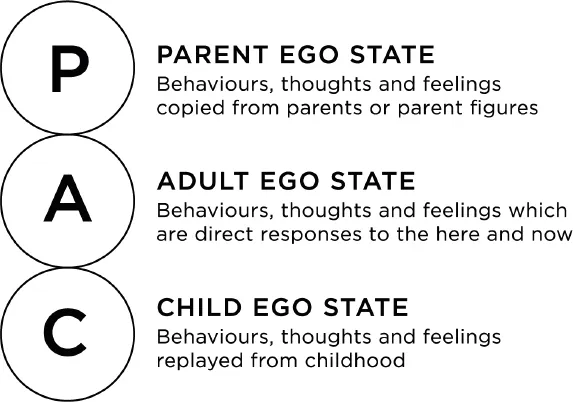
Parent Ego State (P)
When we are in our Parent Ego State we may behave in a Parental manner – drawn to nurture others (as a Parent might) or we may want to tell them off. This is the behavioural side of the model. Both have a positive and negative side. For example, the nurturing side can become overly nurturing of others – even if it isn’t wanted and it is at a cost to the giver. Remember the Rescuer? Equally, the controlling side might be viewed as negative, but again the reverse can be true – as children we needed the firmer boundaries at times. Think of a child refusing to go to school: as a parent you know they are not poorly and if you acquiesce it will make the next day even harder for them. To be firm but kind will be more beneficial to the child than overly nurturing and giving them a day off.
But we have a deeper structural side to Ego States. This is where we have been influenced by those who raised us: parents, grandparents, foster parents – indeed any older people of influence.
TA is not an excuse to lay your problems or frustrations at your parents’ door though. It’s simply acknowledging that our parents have a role to play in creating our beliefs, and that we have a role in choosing which messages we take on. So this is not about looking for excuses, it is about taking responsibility for yourself.
Turning into our parents
In our Parent Ego State we may share or reject cultural views, political views, religion, work ethic, ideas on how to parent and how to fit into society. And there are times, especially as you get older, that you have a thought or say something which reminds you of your parents and their views, even if it is unwelcome. Yet, out it pops.
We mentioned messages we have chosen; this is an important point. Each child in a family will take on different messages – that is because we are all individuals. Each of us growing up decides how to be, in order to fit in with our surroundings.
Here in the Parent Ego State we learn how well to look after ourselves and others. It is also where we can be critical and controlling of others – it’s a broad brush but if you hear yourself saying ‘You should have tried harder’ to yourself or another, this is your Parent Ego State talking. A ‘should’ or ‘ought’ is a Parental order.
Child Ego State (C)
The Child Ego State contains the thinking, feelings and behaviour of our childhood. It can be rebellious – wanting to stomp out of a room or slamming the door. Or we may be drawn to be pleasing and to try to make others happy. This is called an ‘Adaptive Child’ response (we are adapting to the other). Or we may be walking down the beach on a sunny day and feel so full of joie de vivre that we dive into the sea – this is the action of our ‘Free Child’.
There is also a deeper structure to our behaviour in the Child Ego State. This is created by our actual childhood. So a smell or a tone in another’s voice can ping us back to feeling 6 years old again. People sometimes say they have a lot of blanks in their childhood. Don’t worry about this. Trust what you remember and trust what you feel when you get triggered into a past memory.
Our Child Ego State is a product of our past and how we chose to be; as well as how we were influenced by others, even how child-like we were allowed to be.
Sometimes circumstances take over. A child has to deal with grown-up problems suddenly – death or serious illness in a parent. How often have you heard it said: ‘When that happened, I grew up overnight’?
For someone with that experience they may not know their Child Ego State very well, yet somewhere there may still be a yearning to be carefree, to be looked after and to have fun.
You may be feeling happier or more positive when we talk about the Child. Or perhaps you found more instinctive connection when we were discussing the Parent: ‘That sounds like me’. Perhaps you were already setting one against the other – ‘Oh, how could anyone behave like that’ or ‘I could never behave like that’. But be aware whatever you feel now – or where you instinctively identify or recognise yourself most – neither Parent nor Child state is preferable; they all serve a purpose and we need to draw on them all at different times.
Adult Ego State (A)
The fundamental difference between this and the Parent and Child Ego States is that these are both archaic positions. The Adult is here and now. This is the state we wish to get to. But before we can function fully from this state, we need to understand our past and the contents of our other Ego States.
This is why we placed the Adult Ego at the head of the debating table; we need to understand our many selves and learn to listen to them. It is from this place that we can take the healthiest, wisest decisions.
A Question of Transactions
Remember what we said about transactions – those moments between humans when we interact with each other – be it conversation, face-to-face, e-mail, phone or text?
If you are in your Parent state when that transaction occurs, you are inviting either a Parental or a Child response from the other.
If you are in a Child Ego State, you are expecting a Child or Parental Ego State reply from the other. Yet if you are in your Adult Ego State, it invites the other into Adult and keeps both in the here and now. That transaction (or conversation) handled with empathy can then be the most honest way forward as neither party is slipping into their archaic selves.
However, there are occasions when you may be in your Adult Ego State, but the people you are transacting with will stay resolutely in Parent or Child. This is called a crossed transaction and leads to a breakdown in communication or the other party shifting Ego to complement the transactions and keep the contact.
This doesn’t necessarily mean the healthiest response though. Maybe you are talking to your boss about holiday leave and you start in Adult knowing that you are entitled to leave, but your boss could respond with a Parental tone of ‘You know we are stretched at the moment – do you really have to take leave now?’
They have crossed the transaction and you may feel pulled to be ‘good’ and respond with a child-like pleasing response of, ‘OK, I’ll leave it for now.’ This may make the transactions feel easier but where is your healthy self-boundary? Who is caring for you?
By staying in Adult and responding that you are aware it is a difficult time but you will be putting in for your leave nonetheless, which will in the long run be better for all – yes, even the boss – you will not end up an overtired and resentful employee or start looking for another job.
E is for empathy
How often have you heard or uttered the phrase: ‘I know just how you feel’? But how rarely is that true. We all think we know what empathy is and how to use it, but do we?
Often we mistake feeling sorry for another’s misfortune as empathy – but that is sympathy. Instead, empathy is an awareness of what the other person is feeling even when you cannot relate to that feeling directly – and being aware that our actions/speech have an effect on the other.
For example, when we see footage on television of a young woman who is a refugee, sympathetic you say ‘Poor her’, which is a very Parental reaction. You may have a more judgemental response: ‘Not another one’. This is also sparked from your Parental Ego State. You might even think ‘That looks tough but my life is worse’ – a classic Child response.
Empathetic you – in your Adult Ego State – says: ‘What an awful thing to experience. I wonder how she is coping? How would I cope? What can I do?’ So empathy isn’t about saying ‘Poor you’ or ‘Poor me (I have it worse)’, but ‘I care about you and I care about me’.
Empathy used in boundary-making says: ‘I’m aware of my boundary and how it may have an effect on you’. It has great power.
![]()
APPENDIX 2:
![]()
Strokes
‘You can stroke people with words’
F. SCOTT FITZGERALD
You may have heard the word ‘stroke’ used in the context of a reward; you may even have used it colloquially, too – ‘I’m getting my strokes from this’. But what does it mean in TA theory and how does it fit into a book on boundaries?
The classic definition of a stroke is ‘a unit of recognition’ (Berne, 1972), be it positive or negative. This stems from the importance of a baby to be in contact with their primary caregiver. Babies may be fed and watered and warm and dry, but if they don’t have visual and physical contact it’s been shown that their health will deteriorate as scientists who studied the Romanian orphans of the 1980s discovered. Hence the word ‘stroke’ – think cuddling or physically comforting an infant.
Imagine a child on a fairly typical trajectory through their life. They receive cuddles and visual contact from their caregiver, which progresses to the first stages of oral communication (their ‘coo’s and ‘da’s get responded to). In this happening, the child knows they exist. As they progress they begin to hear the words ‘I love you’, which are the ultimate unconditional stroke. Strokes come in different packages from the unconditional through to the conditional – such as being told, ‘He’s such a good little boy when he eats his food.’
As strokes are such an important part of our wellbeing, if a child is in a place with access to few positive strokes, they will invite negative strokes through bad behaviour because in that moment when the parent turns and shouts at them, it is more than their parent...