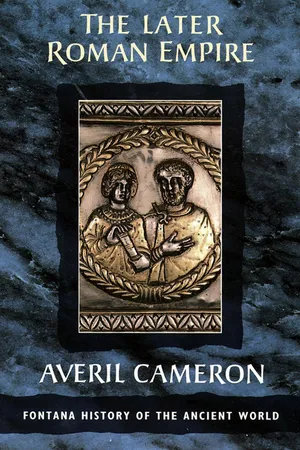
The Later Roman Empire (Text Only)
eBook - ePub

The Later Roman Empire (Text Only)

  1. English
  2. ePUB (mobile friendly)
  3. Available on iOS & Android
eBook - ePub

The Later Roman Empire (Text Only)

About this book

A comprehensive study - recently updated for the eBook edition - which introduces the reader to the vigour and variety of the fourth century AD.

Frequently asked questions

Yes, you can cancel anytime from the Subscription tab in your account settings on the Perlego website. Your subscription will stay active until the end of your current billing period. Learn how to cancel your subscription.
At the moment all of our mobile-responsive ePub books are available to download via the app. Most of our PDFs are also available to download and we're working on making the final remaining ones downloadable now. Learn more here.
Perlego offers two plans: Essential and Complete
  • Essential is ideal for learners and professionals who enjoy exploring a wide range of subjects. Access the Essential Library with 800,000+ trusted titles and best-sellers across business, personal growth, and the humanities. Includes unlimited reading time and Standard Read Aloud voice.
  • Complete: Perfect for advanced learners and researchers needing full, unrestricted access. Unlock 1.4M+ books across hundreds of subjects, including academic and specialized titles. The Complete Plan also includes advanced features like Premium Read Aloud and Research Assistant.
Both plans are available with monthly, semester, or annual billing cycles.
We are an online textbook subscription service, where you can get access to an entire online library for less than the price of a single book per month. With over 1 million books across 1000+ topics, we’ve got you covered! Learn more here.
Look out for the read-aloud symbol on your next book to see if you can listen to it. The read-aloud tool reads text aloud for you, highlighting the text as it is being read. You can pause it, speed it up and slow it down. Learn more here.
Yes! You can use the Perlego app on both iOS or Android devices to read anytime, anywhere — even offline. Perfect for commutes or when you’re on the go.
Please note we cannot support devices running on iOS 13 and Android 7 or earlier. Learn more about using the app.
Yes, you can access The Later Roman Empire (Text Only) by Averil Cameron in PDF and/or ePUB format, as well as other popular books in History & European History. We have over one million books available in our catalogue for you to explore.

Information

Publisher
HarperPress
Year
2013
Print ISBN
9780006861720
eBook ISBN
9780007391844

Index

The pagination of this electronic edition does not match the edition from which it was created. To locate a specific passage, please use the search feature of your e-book reader’s tools.

Ablabius, 55, 77
Acacius, Bishop of Beroea, 128
Adrianople, Battle of (AD 378), 85, 116, 136–7, 173
Aedesius of Pergamum, 89, 95
Agathias, 34, 147
Alamanni, 30, 90, 134, 136
Alaric the Visigoth, 22, 83, 138–9, 149–50, 188
Alexander Severus, 3
Alexandria (Egypt), 75, 182
Serapaeum, 75, 87
Allectus, usurper, 32
Alypius, 155
Ambrose, Bishop of Milan: writings, 13, 25, 78
on dedication of Church of Holy Sepulchre, 62
building, 72
and Gratian’s removal of altar from senate, 73
refuses communion to Theodosius I, 75
on conversion, 78, 153
influence, 102
Milan basilica, 126
influence on imperial policy, 156, education, 166
negotiates freeing of captives, 177
Amiens, 9
Ammianus Marcellinus: on army, 35
style, 46, 106
and Constantine, 64
on Constantius II, 65
and religion, 73–4; on Serapaeum, 75
on Roman aristocracy, 79
on nuns; 83
on Julian, 20, 64, 86, 89, 91, 93, 95, 97
on Valentinian and Valens, 99
praises Theodosius I, 101
and decline, 108
on rich landowners, 115
on military campaigns against barbarians, 133–7, 145
on Arabia, 142
on ‘Saracens’, 143
on class conflicts and education in Rome, 156–9
on treason trials, 163–4
on Antioch, 173; Res Gestae, 13, 19–21, 85–7, 194
Amphilochius of Iconium, 128
angareia (military transport), 6, 147
Anicii (Roman family), 159
annona militaris (army supplies), 6, 7, 36–7, 116, 122, 146–7
Antes (mythical giant), 170
Antioch: status, 8, 174
damaged, 9, 173–4
Julian in, 91–2, 95–6
population, 123
welfare, charity, 126, 177
captured by Shapur I, 141
trials for magic, 164
development, 173–5
entertainments, 175–6; ‘school’ of, 182
Antiochus, Bishop of Ptolemais, 128
Antony (Egyptian hermit), 23, 25, 82, 184
Apamea (Syria), 131, 173, 183
Aper (praetorian prefect), 31
Aphrodisias (Caria), 75, 176
Apiones (Egyptian family), 185
Apollonius of Tyana, 22
Aproniani (Roman family), 159
Apronianus, literary patron, 158
Aquileia, 43, 90
Arabs, 142–4, 188, 192
Arcadius, Emperor, 1, 74, 76, 99, 102, 149, 172
archaeology: as evidence, 28–9
Arianism, 69–71, 182
Arius, 59–60, 69–70
Aries, Council of (AD 314), 67
army (Roman): reforms, 5, 7, 33–6, 146
payments ...

Table of contents

  1. Cover
  2. Title Page
  3. Contents
  4. Introduction to the Fontana History of the Ancient World
  5. Preface
  6. Maps
  7. I: Introduction: The Third-Century Background
  8. II: The Sources
  9. III: The New Empire: Diocletian
  10. IV: The New Empire: Constantine
  11. V: Church and State: The Legacy of Constantine
  12. VI: The Reign of Julian
  13. VII: The Late Roman State: Constantius to Theodosius
  14. VIII: Late Roman Economy and Society
  15. IX: Military Affairs, Barbarians and the Late Roman Army
  16. X: Culture in the Late Fourth Century
  17. XI: Constantinople and the East
  18. XII: Conclusion
  19. Date Chart
  20. List of Emperors
  21. Primary Sources
  22. Further Reading
  23. Appendix
  24. Index
  25. About the Author
  26. Fontana History of the Ancient World Series
  27. Copyright
  28. About the Publisher