![]()
Appendix 1: Key People
Victor Emmanuel III 1869–1947
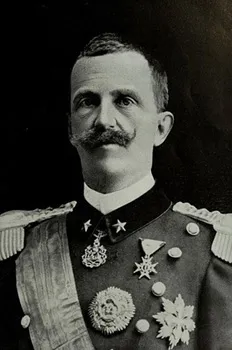
King Victor Emmanuel III.
On 29 July 1900, the king of Italy, Umberto I, was assassinated. The throne passed to his 30-year-old son, who, as Victor Emmanuel III, would reign until 1946.
Born in Naples on 11 November 1869, the future king was so short, the German kaiser, Wilhelm II, nicknamed him ‘the dwarf’ and, in private, Mussolini called him the ‘little sardine’. He ruled over an Italy that had been in existence as a unified nation only since 1861. As a figurehead king, Victor Emmanuel chose to ignore the affairs of state, preferring instead to focus on his vast collection of coins.
With the outbreak of hostilities in July 1914, Victor Emmanuel favoured participation in the war, partly as a means of enhancing Italy’s reputation on the international stage. Italy duly entered the war in May 1915, not as ally of Germany and Austria-Hungary, but on the side of the Triple Entente allies – France, Russia and Great Britain.
After 1918, Victor Emmanuel again retired to the sidelines as Italy struggled, with limited success, to cope with the post-war instabilities of demobilization, unemployment and inflation.
In October 1922, with the country on the verge of civil war, Benito Mussolini led the fascist March on Rome, demanding to form a new government. At first, Victor Emmanuel resisted but then, fearing outright anarchy, bowed to Mussolini’s persistence.
The murder of a leading socialist politician and outspoken critic of the fascists, Giacomo Matteotti, in June 1924 almost caused Mussolini’s downfall. Many suspected Mussolini’s involvement and demanded that the king remove Mussolini from power. Ignoring the national outcry, Victor Emmanuel, more fearful of a socialist takeover, threw his support behind the fascists. Mussolini had survived.
For the next two decades, Victor Emmanuel watched without undue concern as Mussolini ruled the country. Following Italy’s successful invasions of Ethiopia (1935–6) and Albania (1939), Victor Emmanuel was made emperor of the former and the king of the latter. On hearing he was to be made emperor of Ethiopia, the king wept. Having never visited either country, he renounced both titles in 1943.
Victor Emmanuel opposed Italy’s entry into the Second World War but was unable to prevent Mussolini from declaring war on France and Great Britain in June 1940. Three years later, on 24/25 July 1943, with Italy staring defeat in the face, the Italian Fascist Grand Council voted in favour of a resolution to have Mussolini removed from power.
The following day, Victor Emmanuel dismissed the Duce. With Mussolini now arrested and held in captivity, Victor Emmanuel signed the armistice with the Allies on 8 September. A month later, having fled to the town of Brindisi, he declared war on his former ally, Germany.
On 9 May 1946, a year after the end of the war, Victor Emmanuel was forced to abdicate and leave Italy. He moved to Egypt. He named his son as his successor, Umberto II, three weeks ahead of a national referendum to decide on whether Italy should maintain its monarchy. On 2 June, the nation voted 54.3 per cent in favour of becoming a republic. After 85 years, the Kingdom of Italy was at an end.
The king’s daughter, Princess Mafalda, married a prominent Nazi. When her husband fell out with the Nazi regime, they were both arrested. Malfalda was interned in Buchenwald concentration camp where she died on 27 August 1944.
Victor Emmanuel III died in exile in Egypt on 28 December 1947, aged 78.
Galeazzo Ciano 1903–1944
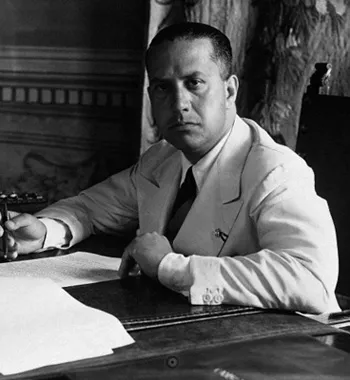
Galeazzo Ciano.
Galeazzo Ciano’s father had made a name for himself as an admiral during the First World War. An early supporter of Benito Mussolini, he built his fortune through some unethical business deals. Thus, Galeazzo, was born on 18 March 1903, into wealth and luxury, and father and son developed a love for fascism. Both father and son took part in Mussolini’s 1922 ‘March on Rome’.
Ciano studied law before embarking on a diplomatic career which took him to South America and China. On 24 April 1930, he married Edda Mussolini, hence becoming Mussolini’s son-in-law – facilitating a rapid rise up the promotional ladder. The couple were to have three children although Ciano, like his father-in-law, had numerous affairs.
In 1935, Mussolini made Ciano his minister for propaganda. The same year, Ciano volunteered for action in Italy’s invasion of Ethiopia, serving in a bomber squadron and reaching the rank of captain. He returned to a hero’s welcome and in June 1936, aged only 33, he was appointed by Mussolini as minister of foreign affairs, replacing Mussolini himself.
As minister, Ciano began to keep a diary, maintaining it up to the last weeks of his life, recording his meetings with Mussolini, Hitler and various foreign ministers.
In 1939, Ciano helped Mussolini plan Italy’s successful invasion of Albania. The Albanian port of Saranda was renamed Port Edda in his wife’s honour. The name change didn’t last long.
In the summer of 1939, with Hitler gearing up for his invasion of Poland, and knowing Italy was far from prepared to commit to war, Ciano tried to persuade Mussolini not to be drawn in. ‘The Duce’s reactions are varied,’ wrote Ciano in his diary. ‘At first he agrees with me [not to commit to war]. Then he says that honour compels him to march with Germany.’ When, on 10 June 1940, Mussolini declared war on Britain and France, Ciano wrote, ‘I am sad, very sad. The adventure begins. May God help Italy!’ Despite his reservations, Ciano again took to the skies, flying sorties during Italy’s ill-fated attack on Greece.
In February 1943, having failed to persuade Mussolini to seek terms with the Allies, Ciano was sacked. In his diary, Ciano wrote, ‘Our leave-taking was cordial, for which I am very glad, because I like Mussolini, like him very much, and what I shall miss the most will be my contact with him.’ Ciano took up a post as ambassador to the Vatican.
At the meeting of the Grand Fascist Council on 24/25 July 1943, to discuss whether Mussolini should be allowed to continue as commander, Ciano was one of those who voted against his father-in-law. The following day, King Victor Emmanuel III dismissed Mussolini from his post and had him arrested.
On 28 August, Ciano, fearing arrest in Italy, fled with Edda and their children to Germany. The Germans, however, sent Ciano back to Mussolini’s new republic where he was promptly arrested for treason, namely for having voted against Mussolini.
Under pressure from the Germans, and despite his daughter’s desperate pleas, Mussolini had Ciano tried, found guilty and sentenced to be shot. Ciano and Edda tried to use his diaries to bargain for his life. The Germans knew it would contain sensitive information that could be damaging to the regime. SS chief, Heinrich Himmler, certainly considered a deal but was overruled by Hitler.
The night before the execution, Mussolini had a crisis of heart over whether he could go through with it. After all, as well as being his son-in-law, he had always liked Ciano, and Ciano had served him well. In the end, the prospect of being regarded as weak by Hitler overrode any familial loyalty and hence, on 11 January 1944, Galeazzo Ciano, along with four others found guilty of treason against Mussolini, went to his death. Aged only 40, Ciano collapsed on the way to the place of execution and had to be carried. To add to the humiliation, they were tied to chairs and shot in the back. Ciano’s last words were ‘Long live Italy!’
(Two days before her husband’s execution, Edda escaped to Switzerland, taking the diaries with her. Edda never forgave her father: ‘The Italian people must avenge the death of my husband. If they do not, I’ll do it with my own hands.’ Indeed, Mussolini was executed by his own people but certainly not out of any revenge or nostalgia for Ciano. The diaries were published in 1946 and were used by the prosecution against Hitler’s foreign minister, Joachim von Ribbentrop, at the post-war Nuremberg Trials. Edda’s son, Fabrizio, later wrote a book entitled, When Grandpa Had Daddy Shot.)
Ida Dalser 1880–1937
In Milan during 1914, Benito Mussolini married Ida Dalser, a 34-year-old beautician who soon bore him a child, Benito Albino Mussolini. Dalser sold her business to help her husband fund his new newspaper, Il Popolo d’Italia (The People of Italy).
The marriage did not last and shortly after the birth of Benito Jr, Mussolini had married Rachele Guidi, his long-term mistress and mother to his first child, Edda, who had been born in 1910.
Unsurprisingly, Ida, left penniless, was furious with the way Mussolini had treated her. Following the end of the First World War, she claimed she had proof that in early 1915 Mussolini had taken bribes from the French government to use his influence to commit neutral Italy to declare war against Austria-Hungary. (Italy did, indeed, declare war in May 1915.) Had this allegation come to light it would have ruined Mussolini’s fledgling career.
Mussolini ordered the destruction of the marriage records and stopped paying his first wife’s maintenance as previously ordered by the courts.
With Dalser still a threat, Mussolini had her abducted. Beaten and forced into a straitjacket, she was declared insane and interned against her will in an asylum. Dalser and her son were, according to the doctor’s report, a ‘danger to themselves and others’. Benito Jr, separated from his mother, was placed in various boarding schools and, as he grew up, was told that his mother had died. He was ordered to stop referring to Mussolini as his father and had his surname changed to Bernardi.
In 1935, Benito, like his mother, was forcibly incarcerated in a psychiatric hospital. Both remained detained until their deaths – Dalser on 3 December 1937 of a ‘brain haemorrhage’, and Benito killed on 26 August 1942, aged 26, following a series of injections designed to induce coma.
Rachele Mussolini 1890–1979
Rachele Guidi and Mussolini had their first child, Edda, in 1910. In 1914, Mussolini married and in 1915 had a child with Ida Dalser. But Mussolini returned to Guidi and on 17 December 1915, they married in a civil ceremony.
Mussolini and Rachele Guidi shared the same place of birth – the town of Predappio in the area of Forlì in northern Italy. Rachele, born on 11 April 1890, was seven years younger than her future husband. She and Mussolini first met when Mussolini appeared at her school as a stand-in teacher. Rachele’s father had warned her against marrying the penniless Mussolini: ‘That young man will starve you to death,’ he warned. After the death of her father, Rachele’s mother began a relationship with Mussolini’s widowed father.
In December 1925, ten years after their civil marriage, Rachele and Mussolini were married in a Catholic church. It was less a romantic gesture than an attempt by Mussolini to ingratiate himself with the Pope, Pius XI. The Mussolinis were to have five children.
Rachele knew about her husband’s many indiscretions. In an interview with Life magazine in February 1966, Rachele said, ‘My husband had a fascination for women. They all wanted him. Sometimes he showed me their letters – from women who wanted to sleep with him or have a baby with him. It always made me laugh.’
In 1923, Rachele took on a lover of her own – according to Edda in an interview in 1995, shortly before her death. Rachele, according to Edda, told Mussolini, ‘You have many women. There is a person who loves me a lot, a beautiful companion.’ Mussolini may have been shocked but he did nothing to stop the affair, which, apparently, lasted several years.
In fact, it was less Mussolini’s dalliances that worried Rachele, than his career in politics: ‘You can’t be happy in politics … one day things go well,’ she said, ‘another day things go badly.’ She admitted that she had been at her happiest when they were poor.
Mussolini was, by all accounts, fearful of his wife. Once, following an argument, she kicked him out of the house and made him have his dinner on the front steps. One friend remembered, ‘The Duce was more afraid of her than he was of the Germans.’
In his later years, while running the Italian Social Republic, Mussolini had his mistress, Claretta Petacci, a woman two years younger than his daughter, Edda, set up home nearby – much to Rachele Mussolini’s disgust. Wife and mistress frequently argued while Mu...