![]()
1
INTRODUCTION
… the Discovery whereof I doe here attempt (for want of written Record) to work-out and restore after a kind of Algebraical method, by comparing those that I have seen one with another; and reducing them to a kind of Aequation: so (being but an ill Orator my selfe) to make the Stones give Evidence for themselves.
John Aubrey, Monumenta Britannica, ed. J. Fowles and R. Legg (1980), p. 32
The People
MOST of the achievements recorded in this book were those of people who lived between three and six thousand years ago—a relatively short period by comparison with the quarter of a million years that Britain has been inhabited. During that long earlier period, following the arrival of the first hunters in these northern latitudes, there had been gradual but massive fluctuations in climate, and long glacial periods during which it would have been necessary to retreat southwards. Much of what is known about the general pattern of existence of early peoples derives from evidence as to their diet, for example from middens, and hunters are in this regard by their very lifestyle elusive. The few hunter-gatherers who were cave dwellers—and especially those from temperate regions in the same period—tell us that there were other dimensions to their lives than subsistence alone, for they have left us carved and modelled figurines in stone and clay, including those notorious ‘Venuses’ who look as though they were meant as wives for Michelin man. Even from a time as early as the Leptolithic period (say 35,000 to 10,000 BC) there have been found in France not only many specialized tools and weapons, but spectacular cave art. Among surviving artefacts are bones scratched in ways suggesting that some sort of counting was taking place, and on the basis of the grouping of incisions into sets of around thirty, claims have been made that some of the counting was of the days of the Moon.
It is from the Leptolithic period that the first clear indication of ritualized burial in Britain has been found, that of the ‘Red Lady’ (or was it a young man?) found in a cave at Paviland on the Gower Peninsula in Wales. The body had been covered in red ochre—presumably to give it a semblance of life in death—and had been dressed in ornaments of ivory and shell. Radiocarbon dating puts this at well over twenty thousand years ago, when there was still a land bridge to the continent of Europe.1 Both shells and ochre have been found with similar Middle Palaeolithic burials in France and southeastern Europe, and indeed red ochre was to be used in the same way throughout Europe for many millennia thereafter.
The last of the long periods of glaciation lasted for about sixty thousand years, and drew to a close about eleven thousand years ago, even though there are signs of intelligent activity with stone implements from an earlier date. As the climate changed, and temperatures rose to levels more or less those of the present, northern Europe was drastically affected. Much is known of the environment of the time from the evidence of pollen and molluscs. The most striking changes were to the forests. First birch and pine made a recovery, and then hazel, elm, oak and lime moved into the older forests, with ash and alder following later. The population began to expand again after hunting and collecting methods were adapted to the new flora and fauna. Habits did not develop in the same way in all northern centres, but speaking generally, man tried to live near to large stretches of water at least in winter and early spring. Britain was linked to the continent by land until about 8000 BC. It is to this (Mesolithic) period that the first known human activity in the immediate neighbourhood of Stonehenge belongs. A series of pits was dug then a few hundred metres to the north of the stones, and they appear to have held massive upright posts of pine, for reasons that are entirely a matter for speculation.
As the forests developed, deer, elk, ox and boar moved northwards into them, and were hunted for food, but also for clothing, weapons, and implements that could be made from antler and horn. Long afterwards, ditches at places like Stonehenge were still being dug with antler picks. There are signs that the hunting way of life in Britain was giving way to farming by 4400 BC or thereabouts. It was long supposed that this change was a consequence of immigration by an alien people, but the matter is likely to have been more complicated. Hunter-gatherers had actually been opting for a relatively settled existence long before this new phase, a fact that would have made them more receptive to farming techniques than if they had been nomadic. It has even been claimed that they had previously indulged in a form of agriculture, namely the cultivation of the hazel for its nuts, but this is unproven. They had by this time certainly developed simple but efficient stone tools—unpolished axes and adzes, for example—and had proved themselves capable of sculpting animal figures and of decorating antler and bone tools, but the farming economy, which typically involved the cultivation of grain and the raising of such animals as sheep, cattle, swine, and goats, had much earlier beginnings, and those far away from Britain. Radiocarbon dating methods have pushed back the origins of settled agricultural communities in southwest Asia to well before 8000 BC, and similar communities may be as old in southeast Asia. Farming soon spread into the Mediterranean: it was practised in Thessaly, Crete and Cyprus even before the development of pottery there. It also made its way westwards along the Mediterranean coast, and again the domestication of sheep and goat evidently preceded pottery-making. By the sixth millennium BC, farming villages where pottery was made were present over the entire Aegean area, from whence farming made its way into the Balkan peninsula and the Hungarian plain, mostly following river valleys. The most important phase in the spread of farming to northern latitudes, however, took place early in the fifth millennium, when it moved northwards from the Hungarian plain, westwards along the Mediterranean coast, and in all directions along the Atlantic and Baltic coasts, where the population had become relatively stable. Finally it was carried inland to other parts of Europe by small groups, in particular lake-dwellers.
The main movement northwards is associated with a characteristic type of pottery, decorated with linear patterns, and usually known by its German name, Bandkeramik. The explosion of the Bandkeramik culture from the general area of the Hungarian plain is also characterized by its remarkable settlements, each with ten or twenty long wooden buildings, dwellings five or six metres wide and roughly eight times as long, with a roof supported by three rows of posts. A typical house was divided into three sections: the living quarters were in the middle, there was a granary at one end, and at the other there was a section of uncertain purpose that might have been a house temple for cult purposes. There is no clear evidence for animal stalls. In each village, one of the buildings was usually notably larger than the rest. As this culture spread westwards and northwards it finally made contact at length with settled communities along the Mediterranean and Atlantic coasts of western Europe, including Britain and Ireland. These coastal communities already had a certain cultural homogeneity, and the new farming habits did not exclude the old but supplemented them. Baltic peoples, for example, now learned how to grow grain and raise cattle, but they did so on a limited scale and continued to fish, to collect shellfish, and to hunt along the coast and inland as they had done before. Their contacts with the distant Danubian tradition are nevertheless evident from their pottery, from copper imports, and the style of their long houses.
By what route farming eventually reached southern Britain is not entirely clear. On one view it arrived through a migration of peoples from perhaps two or three directions, in particular from western France and from the northern and southern Netherlands. It has been suggested that some immigrant groups might have settled in Britain and coexisted for centuries alongside the older hunting population, the two merging only by slow degrees. Another hypothesis, at least as plausible as the first, is based on the fact that early dates for food production have been found from along the Irish Sea, in the neighbourhood of important centres of polished stone axe production that later sent their wares at least as far afield as Wessex. It is possible, therefore, that agriculture was brought to Britain by an Irish Sea population that had learned of it and acquired stock and skill through coastal contacts. Whatever the answer, by 4000 BC farming was established to some degree in places across the length and breadth of Britain and Ireland. Although the population was then still very small, it was growing steadily. There were of course important differences between forms of agriculture developed in different centres, differences that depended on history and environment, but there are such strong affinities between Britain and the continent of Europe from this time onwards that whether or not we are to believe in the migration of peoples in appreciable numbers it is impossible to doubt a continuing interchange of ideas.
The narrower focus of these pages is southern Britain, roughly south of a line from the Wash to the Bristol Channel, and the Neolithic ‘Windmill Hill’ culture and its successors down to the Bronze Age. (That culture takes its name from a hilltop site near Winterbourne Monkton and Avebury in Wiltshire, where it was first given archaeological recognition as a characteristic form.) (See Fig. 3.) The people concerned seem to have had a liking for chalk downlands, which were then covered in a dense forest, largely of oak and elm. The claiming of land from forest has been traced though the analysis of pollens that show, for instance, a decline in the numbers of elms and the corresponding advance of small light-seeking flora. It is possible that land clearance was at first only for animal fodder. The soil at least was light, and easy to cultivate with simple tools, such as those fashioned from antlers—it has even been suggested that deer were at times actually farmed for their antlers. The chalk also had the merit of yielding seams of flintstone, much used for cutting-tools. The farming communities of the region certainly left their mark on the land.
They left other marks on the landscape, in the form of ditches, enclosures of various sorts, defensive earthworks, tombs of various sorts, stone circles, carvings on stone, and so forth—but stones, earthworks, flints, antler picks, pots, even bronze and golden ornaments, are only the husks of human existence. Had these people left behind them even a rudimentary literature, we should no doubt think of them in a very different way. The intelligence and intensity of feeling that is evident from so many of their tangible remains, together with what is known of other non-literate cultures, makes it virtually certain that they had a rich and imaginative oral tradition, even though there is clearly no hope of our ever recovering it.
One of the theses of this book is that various astronomically guided rituals were in use by the time of the very earliest farming communities in Britain. This does not mean that such rituals necessarily followed the same routes as agricultural practices, or that either remained constant over long periods of time. There was a slow evolution in both, with many local variations in tradition. Problems of diffusion of influence are among the most difficult to solve, and once again, a movement of ideas does not necessarily mean a significant movement of populations. While it would be unwise to hazard many general conclusions on astronomical grounds alone, the evidence from this quarter is that the exchange of ideas between adjacent peoples was much greater than is usually recognized.
Alignments and Orientations
The overall aim of this book is to discover certain patterns of intellectual and religious behaviour through a study of archaeological remains that seem to have been deliberately directed in some way towards phenomena in the heavens. Much use will be made of a handful of words and ideas that are certainly not a part of everyday discourse but that are, even so, essentially simple. One of these, the notion of an astronomical alignment, is easily explained by reference first to the stars and then to the Sun and Moon (see also Glossary).
Each day, from a given place, if I can see an identifiable star rising, it will always seem to rise over the same point on the distant horizon. (This will be on its eastern half. It will culminate due south of the pole for anyone living in the northern hemisphere. And in view of the context, this qualification need not be repeated.) If it can be seen setting, the star will similarly always seem to set over a fixed point on the western horizon. If the star is sufficiently important to me, I might choose to remind myself of those points of rising and setting, perhaps by such irregularities as hill-tops or isolated trees; or I might choose to mark the directions in which they lie by setting up pairs of posts or other markers relatively near at hand. I should not have to revise the alignments of such markers materially during my lifetime, unless I wanted extreme accuracy of a sort that need not be considered here. (The word ‘alignment’ will usually be used here to refer to two or more terrestrial objects lined up on a celestial object, and not exclusively to sets of three or more terrestrial objects in line, which is an unnecessarily narrow archaeological usage.)
I might choose to direct my buildings—say the main axis of my church—in the same way. Reversing the order of discussion, however, is a hazardous undertaking: the fact that the orientation of someone else’s church happens to produce an alignment with an astronomically interesting event does not necessarily imply that the orientation was deliberate. Deciding between deliberate and accidental alignments is one of the central problems of this book.
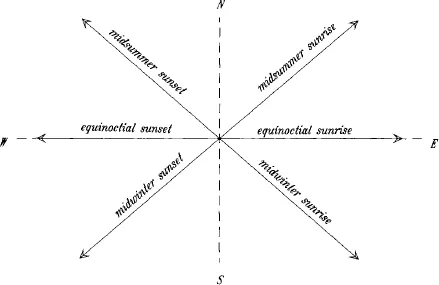
Just as with the stars, I may notice the Sun rising at a recognizable place on the horizon, but in this case, as the days go by, that place will seem to change. In midsummer, the Sun in the eastern half of the sky will rise over its most northerly point of the horizon. It will attain its most northerly point of setting on the horizon’s western half at the same season. I could mark these directions as I did those of the rising and setting star; and as the year progressed and the days shortened, I should notice that those distant points of the Sun’s rising and setting move southwards, and that in midwinter they reach to their furthest points south. Again I could mark those southern extremes in one way or another. The markers (both near at hand, or one near and one distant) would then be aligned on four critical phenomena, namely midsummer and midwinter risings and settings of the Sun.
FIG. 1. The directions of the rising and setting Sun at Stonehenge, around 2000 BC, at the times of summer and winter solstice. The directions for the equinoxes are also marked, but are barely distinguishable from the (broken) east–west line. In all cases it is supposed that the upper limb of the Sun (first or last glint of the Sun) is seen on the distant natural horizon.
Approximately halfway between the directions of sunrise at precise midsummer and midwinter (that is, at the solstices), is the true direction of east; and true west is similarly more or less mid-way between the extreme directions of setting. The actual sizes of the angles depend on v...