![]()
1
The Falling Dream
1
My own falling dream began at a village fête in Norfolk. I was four years old. My uncle, a tall and usually silent RAF pilot, had bought a red party balloon from a charity stall, and tied it to the top button of my aertex shirt. This was my first balloon, and it seemed to have a mind of its own. It was inflated with helium, which is a gas fourteen times lighter than air, though I did not understand this at the time. It pulled mysteriously and insistently at my button. ‘Maybe you will fly,’ my uncle remarked. He led me up a grassy bank so we could look over the whole fête. Below me stretched the little tents, the stalls, the show ring with its bales of straw and small dancing horses. Above me bobbed the big red balloon, gleaming and beautiful, blotting out the sun. It bounced off the top of my head, making a strange springy sound, full of distance. It tugged me impatiently towards the sky, and I began to feel unsteady on my feet. I felt that I was falling – upwards. Then my uncle let go of my hand, and my dream began.
2
Throughout history, dreamlike stories and romantic adventures have always attached themselves to balloons. Some are factual, some are pure fantasy, many (the most interesting) are a provoking mixture of the two. But some kind of narrative basket always seems to come tantalisingly suspended beneath them. Show me a balloon and I’ll show you a story; quite often a tall one. And very frequently it is a story of courage in the face of imminent catastrophe.
What’s more, all balloon flights are naturally three-act dramas. The First Act is the launch: the human drama of plans, hopes, expectations. The Second Act is the flight itself: the realities, the visions, the possible discoveries. The Final Act is the landing, the least predictable, most perilous part of any ascent, which may bring triumph or disaster or (quite often) farce. The ultimate nature of any particular balloon ascent – a pastoral, a tragedy, a comedy, a melodrama, even a sitcom – is never clear until the balloon is safely back on earth. Sometimes it is not clear even then.
Even the well-known fable of the Cretan engineer Daedalus and his young son Icarus, so often retold as the Genesis myth of flying, is curiously ambiguous in its outcome. It appears originally in Book VIII of Ovid’s long poem Metamorphoses, ‘The Transformations’, completed two thousand years ago, around 8 AD. Having constructed wings for both of them, Daedalus and son launch into the empyrean together, but famously the impetuous Icarus flies too high; the wax joints of his feathered wings melt ‘in the scorching heat of the sun’, and he tumbles down into the sea. Yet this primal legend of flight is more complex than it might appear.
It is often forgotten that in the same Book VIII of Ovid’s poem, Daedalus also has a twelve-year-old nephew (the son of his sister) called Perdix. Perdix is a brilliant and precocious child inventor, loved by all in Crete. But Daedalus, in a crazed fit of grief and jealousy after the death of Icarus, hurls Perdix ‘headlong down from the sacred hill of Minerva’. Yet unlike Icarus, Perdix does not crash to earth and die. Instead, he takes to the air and flies with divine aid: ‘Pallas Athene, the goddess who fosters all talent in art and craft, caught him and turned him, still in mid-air, to a fluttering bird and covered his body with feathers, so the strength of his quick intelligence sprang into his wings and feet.’ He becomes Perdix, the partridge (perdrix in French), a child who has indeed learned to fly successfully – although unlike Icarus he always remains close to the ground, ‘and does not build his nest in mountain crags’.1
What may happen while actually aloft is equally mysterious. Balloons have always given a remarkable bird’s-eye or angel’s-eye view of the world. They are unusual instruments of contemplation, and even speculation. They provide unexpected visions of the earth beneath. To the earliest aeronauts they displayed great natural features like rivers, mountains, forests, lakes, waterfalls, and even polar regions, in an utterly new light. But they also showed human features: the growth of the new industrial cities, the speed and violence of modern warfare, or the expansion of imperial exploration.
Long before the arrival of the aeroplane in the twentieth century, balloons gave the first physical glimpse of a planetary overview. Balloons contributed to the sciences and the arts that first suggested that we are all guests aboard a unified, living world. The nature of the upper air, the forecasting of weather, the evolutions of geology, the development of international communications, the power of propaganda, the creations of science fiction, even the development of extra-terrestrial travel itself, are an integral part of balloon history.
But there are also stranger, existential elements, far less easy to define. The mental release, the physical heart-lift, the calm perilous delight of ballooning – an early aeronaut described it as ‘hilarity’ – is an absolute revelation, but one not easily or convincingly described. I have tried to capture its spirit indirectly, by tying together this cluster of true balloon stories and colourful tales, from the vast ‘history and lore of aerostation’, in the hope that they will bear us aloft for a little while.
While airborne, they may also provide a new perspective. The vulnerable globe of balloon fabric is itself symbolically related to the vulnerable globe of the whole earth. There is some haunting analogy between the silken skin of a balloon, the thin ‘onion skin’ of safety, and the thin atmospheric skin of our whole, beautiful planet as it floats in space. This thin breathable layer of air is not much more than seven miles thick – as balloonists were the first to discover. In every way, balloons make you catch your breath.
3
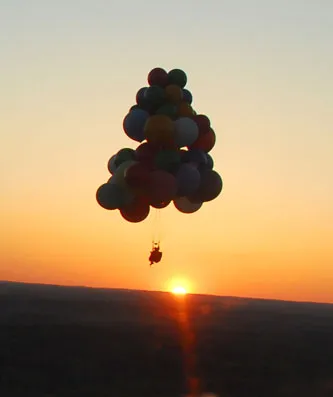
Falling upwards by helium party balloon may sound unlikely. But on Sunday, 20 April 2008 a forty-one-year-old Catholic priest, Father Adelir Antonio de Carli, made a heroic ascent using a very similar method. Father de Carli was known locally as Padre Baloneiro – ‘The Balloon Priest’ – and he flew for charity. He took off from the port city of Paranaguá, in Brazil, strapped into a buoyancy chair suspended beneath a thousand small multicoloured helium balloons. They were grouped into five vivid clusters of pink, green, red, white and yellow. His aim was to raise money for a truckers’ rest stop and spiritual centre. He was known for his human rights campaigns, and that January had made a successful four-hour charity ascent suspended beneath six hundred helium party balloons.
On this second flight, armed with a thermal flying suit, GPS system and satellite phone, he rose successfully to some nineteen thousand feet, near to the edge of the sustainable atmosphere, where the sky becomes dark blue, and human breath forms glittering ice crystals in the ever-thinning air. Here, close to heaven, he cheerfully reported back by phone to his flight control. He also gave a phone interview to the Brazilian TV channel Globo, in which he said he was ‘fine, but very cold’, and was having trouble operating his GPS device. But he was also being carried out to sea, and was now thirty miles off the coast. At 8.45 that Sunday evening, he lost contact with the coastguards. An air-sea rescue search was mounted early the following Monday morning, but without success. A surviving cluster of fifty balloons was found floating in the sea late on Tuesday, but without Padre Baloneiro attached. The Brazilian naval search was called off on 29 April. But his parishioners continued to believe in his miraculous survival, and prayed daily for him.
Three months later, on 4 July 2008, an oil-rig support vessel found the remains of his body (lower torso and legs only) floating about sixty miles off the Brazilian coast, still attached to his buoyancy chair. It seems that part of the helium balloon rig must have separated or failed in some way during the first twenty-four hours of his flight. Possibly some of the balloons began bursting at high altitude, but this of course would have automatically reduced his lift, much as planned, and brought him back comparatively gently to earth. Except that now there was no earth beneath him. It seems that Padre Baloneiro must have spent some time meditating in the sea. Finally, he was probably eaten by sharks. But he was a brave man, a daring balloonist, and possibly even a saint.fn1
4
The dash and eccentricity of so many of those who have flown balloons since the first Montgolfiers of 1783 is strangely mesmerising. I find it difficult not to admire such figures as Sophie Blanchard, Charles Green, Félix Nadar, James Glaisher, Thaddeus Lowe, Gaston Tissandier or Salomon Andrée. Indeed, I find it difficult not to fall for them. The word ‘intrepid’ is automatically used of balloonists; but almost always thoughtlessly. In my experience, balloonists come in every shape and personality type: meticulous, cautious, reckless, obsessive, sportive, saturnine, or devil-may-care. Equally they seem to have every kind of motivation: professional, commercial, scientific, philanthropic, escapist, aesthetic, or just plain publicity-seeking.
But the one thing they never quite seem to be is down-to-earth. All of them seem to have one enigmatic thing in common, besides physical courage and a head for heights. This is a romantic dream of flying, a strange – an almost unnatural – longing to be airborne. There is something both exotic and magnetic about such people. A biographer is drawn to their enigma.
The balloons themselves are mysterious, paradoxical objects. They are both beautiful and ephemeral. They are a mixture of power and fragility in constant flux. They offer a provoking combination of tranquillity and peril; of control and helplessness; of technology and terror. They make demands.
Consider an earlier balloon flight for charity, which took place on the afternoon of 22 July 1785, when a full-size hydrogen balloon was seen flying at three thousand feet over the Norfolk fishing village of Lowestoft. (Indeed, very close to my village fête.) The balloon was heading rapidly eastwards, directly out over the North Sea, and its pilot was clearly unable to bring it back to earth. There was nothing between the balloon and the distant shores of the Baltic.
The man in the basket was thirty-three-year-old John Money, a half-pay officer from the 15th Light Dragoons. Major Money had taken off earlier that afternoon from Ranelagh Gardens in Norwich, to raise cash for the new Norfolk and Norwich Hospital, founded in 1772. It was a cause supported by the Bishop of Norwich and the local Norwich MP, William Wyndham, a friend of Dr Johnson’s and also a balloon enthusiast. The Major knew a lot about horses, harness, and driving a coach and pair, but he had little practical experience of balloons. He was however a man of courage and resource, who enjoyed a gamble as well as supporting a good cause.
Money had originally joined the Norfolk Militia, then the 15th Light Dragoons, and subsequently went out to serve as a captain under General John Burgoyne for the British Crown in the American War of Independence. He was noted for his unfashionable objection to military flogging for desertion (often a lethal punishment), mildly suggesting that a neat tattooed ‘D’ on the upper right arm might prove more effective. He was captured in Canada after the Battle of Saratoga, but eventually bargained his way out of prison. It seems he was a cool customer in a tight situation.
He was now back home, riding his horses and kicking his heels on his small country estate at Crown Point, in the village of Trowse Newton, just south of Norwich. Balloons fascinated him, partly for their military possibilities, but also for their sheer if uncontrollable beauty. He regarded them as if they were a species of wild horse. Admittedly, he had only made one previous ascent, in London that spring, in what was known as the ‘British Balloon’. This had been constructed as a patriotic rival to the already celebrated Italian balloons of Vincenzo Lunardi and the wealthy eccentric Count Zambeccari. Characteristically, Money had somehow convinced the owners of the British balloon to let him transport it to Norwich, and to fly it solo for this philanthropic ascent.2
The launch went fine, according to the local Gazette, attended by ‘a large and brilliant assembly of the first and most distinguished personages in the city and county’.3 The balloon rose easily above the stately copper beeches on the northern boundary of the gardens (their leaves barely stirring), and was then carried on a gentle summer breeze across the river Yare, in a north-westwards direction towards distant Lincolnshire. But as it gained height, an ‘improper current’ arose, and a brisk wind blew it back across the city – to more enthusiastic cheers – and then south-eastwards, still gaining height, towards the Norfolk coast, a mere fifteen miles away. By 6 p.m. the balloon was spotted sailing high over Lowestoft, and heading out over the North Sea. It was supposed that some problem had arisen with the valve of his balloon, and that Money was unable to vent sufficient hydrogen gas to bring himself down. He disappeared rapidly out over the sea and into the softening eastern haze of the summer evening.
Among the ‘distinguished assembly’ who witnessed the launch at Ranelagh Gardens was the Earl of Orford. He wrote anxiously to William Wyndham the following morning. ‘I am sorry to inform you that a Major Money ascended alone under the British Balloon at 4 o’clock yesterday afternoon. The balloon rose to a great height and took a direction towards the sea. It was seen entering over the ocean about a league south of Lowestoft at a very great height at six o’clock. By which circumstance I am greatly apprehensive for his thus continuing in the air, but that by some accident perhaps the String which connects to the valve was broken …’4
Orford’s notion of a balloon controlled by a ‘string’ was a little...