![]()
IV
VESUVIUS to POMPEII
Vesuvio, Parco Nazionale del Vesuvio
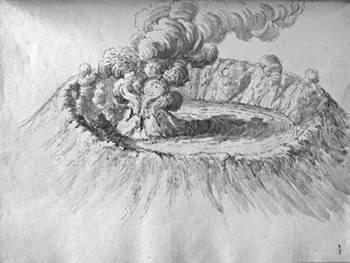
The ground beneath the gladiators’ feet became greyer and drier as they climbed. The lower slopes were thickly grassed, with rustlings of wild boar, of future food perhaps if the beasts ever ventured higher. After an hour among well-watered chestnut trees came a few minutes in sharp brush. Then suddenly the colours collapsed. Grey rock turned to black. A pockmarked path slipped like a shadow through high rock walls. Suddenly, down below was a wide, flat bowl, the size of fifty amphitheatres, with steep sides stitched about with broken fences of brown wire, the brittle stems of dried bindweed and wild moisture-seeking vines.
This was a place of fire with nothing left to burn. Weightless stones flew before every careless kick. There were bleached animal bones, and ditches which opened like clams in a cooking pan. There were cooler places too, and the protecting walls which mattered here most, the remains of a mountain which had many times lost its peak to the clouds. Vesuvius had not erupted for seven centuries, not since the earliest arrivals of the Greeks in Italy, hardly since the age of myth. But no gladiator knew that. To the Thracians and Germans of Capua, suddenly free from one alien Italian place, this must have been shockingly like another.
They made their camp. Military discipline does not leave the disciplined merely because their masters have been left behind. They chose the best site beneath the walls, distributing the food and water stolen from farmers below. Spartacus, Florus says, had served briefly as a soldier before his slaveries began. He may not have been the only one. He now had a circle of defensible space, natural towers to watch for pursuers from the highest ground for miles, time to wake and sleep. The gladiators could shout at the clouds from a path at the same level as the clouds. They could throw down rocks at the lower mists that rolled in from the sea. With a siege catapult of the kind that some of them had seen, they could dream of controlling the sea.
A chance to pause was also a chance to look at each other and to see who they were. Prisoners look different to each other when they are free. ‘On the outside’ means more than merely where they are. Prisoners see their fellow prison inmates from the inside in every sense: what is eating them up, what is wrong with their minds, their bodies or their luck. A fellow escaper is a different person and is to be treated in a different way. He has his weapons with him—not just for the hours of training and entertainment. He has his short sword and stabbing dagger by his side all the time. He may be calm and quiet and vigilant, as though he were back in his army unit in Germany, Gaul or Greece. He may be vicious and violent, randomly, as the farmers, wives and daughters of the lower slopes found when they disturbed the escapers’ hunt for food and wine.
He is a Gaul, a German or an Illyrian as well as a gladiator. In the arena he had an assigned role, Thracian fighter with horsehair griffin helmet or net-and-trident man. But his real origins need not have owed anything to these stage identities. Tombstones tell us of these professional roles, the Thracian whose gladiatorial persona was as a Samnite. In the schools a gladiator could be characterised by the colour of his hair, the place where he was captured, the port where he was sold or, most defining of all, the demands of the programme and the crowd. On the mountain he could instead think back—or try to think back—to what he had been before. In Gaul a healthy male slave and an amphora of average wine cost about the same. In Gaul he might have been a slave of other Gauls, or as free to drink his fill as he is now on the heights of Vesuvius.
He may find the thinking hard. He may be one of those who had survived his fights with fellow men and animals in the arena but not the feelings that followed afterwards. Psychological trauma is not a discovery of modern analysts alone. The Romans knew about it too. Anyone selling a slave who had fought a lion or bear had to declare that contest in the contract. Attempted suicides had to be declared, even escapes. Tattoos told his criminal record to anyone who cared to look. The fighter may know what is inscribed on his forehead only when he is fully away and free. Then he begins to see a wider range of futures, beyond the next meal or the next fight. He may begin slowly, but new openings in his skies do appear.
The gladiators had to make decisions about how they would live and who would command. The need to think such thoughts came sharp and suddenly to those with a long experience only of mines, chain-gangs and the arena. An acceptance of others’ leadership emerged, that of Spartacus and two men called Crixus and Oenomaus, a Thracian, a German and maybe a Gaul. There was still no sign of pursuit from Capua or Rome.
Osservatorio, Parco Nazionale del Vesuvio
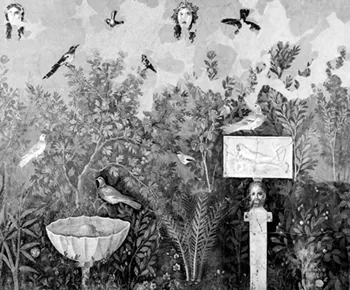
Down below at the foot of the mountain by the sea was some of the finest paradise known to Roman minds. There were fields—as there still are fields—of clipped and carefully nurtured grapes, distant cousins of the wild vines at the summit. There were gardens of medicinal herbs gathered from Asia and Africa and the shores and hillsides of all Italy. On the walls of the finest houses were paintings of these plants and flowers. Ever since that night, 150 years after the rebellion, when mountain rocks became towers of glowing gas, some of those images have survived, set hard in ash.
Today Vesuvius is an elegant cone. Two thousand years ago it looked like a castle, derelict or half built. Many of the places from which Spartacus watched out to sea and land have now to be imagined high up in the air where there no longer is a mountain. Stones on which Spartacus stood are pebbles around Pompeii or dust particles a hundred thousand miles away. Geography fails as a guide in this still explosive place, where the steam pours out after rain and the scientists of the Observatory are on constant watch from halfway up the slope. After each eruption—from that of 79, when Roman gods were the cause, to that of 1631 when sinful Christians brought the fate of Sodom upon themselves, to that of 1944, when the victims blamed the Germans—the simultaneous process of replanting and forgetting begins again.
The homes on which Spartacus looked down had never been burnt by molten rock. Their owners knew fires from a mile below the earth as legends alone. There were myrtle berries and strawberry trees, poppies, pomegranates and what we now call French roses. Absinthe in tiny quantities kept away the pain from any excesses of vermouth. Basil was good to flavour olives, as long as it was watered only at midday. Bee-balm plants brought honey bees. Camomile soothed stings. Dill delighted the eyes. The alphabet of the herb garden has remained much the same here for 2,000 years, while at the top of the mountain, every year in hidden ways, in some years openly, and in a few with the wildest explosive force, Vesuvius has moved back and forth in size and myth.
The men and women who knew most about Roman science and medicine were from the east. The painters of gardens, their weeders and grafters, the people who applied the potions and ointments were almost always slaves or former slaves. They were candidates to join the mountain rebels but not likely ones. Greek doctors could kill Romans more safely by staying at home: the Romans had for centuries turned to Athens and Epidaurus for the cures of pains and the banishment of plagues. Greek cooks too could poison as easily as they could please. As for the better classes of ‘speaking tools’, those who could speak the language of great Greek poets, suggesting quotations to make their masters look good at parties and quips for their mistresses: why should they choose cold nights on a hot mountain?
There were slaves working on these lower slopes who looked forward confidently to promised freedom. There were freed slaves whose job was to punish other slaves. Around the port of Puteoli, not many miles along the coast, there was a torture industry. Selected employees—none of them lame, blind, crippled or tattooed (that was the traditional rule)—would whip, crucify, rack and gibbet for agreed fees. The owner of the torture house had to provide at no extra charge the rope, nails, pitch and wax that the slave’s sentence, decided by his or her master, might require.
Not so very far from these houses with their menus of pain were the most sophisticated theatres and schools. The torturers were kept separate from society. They had to wear coloured caps like the medieval unclean or to live outside the city. But nothing in the pleasure places between Vesuvius and the sea, between Vesuvius and Capua, was very far from anything else. This was a tiny part of Italy, a few square miles of extraordinarily concentrated cruelty, luxury and Greek thought.
The thinkers of the area are the ones with whom we share many a modern anxiety. They thought in many and various ways about dying. Distinguished followers of Aristotle argued about how long was a man’s natural life. The philosopher Staseas of Naples, plying his peripatetic trade here in the first century BC, said that it was eighty-four, a figure twice that at which the poet Statius in the following century thought that he was old. Plato’s disciples preferred eighty-one, the number three multiplied by itself three times. Others thought carefully about dying because their aim was to stop thinking about it. The slopes of Mount Vesuvius were home to sellers of all sorts of ideas.
Among the most controversial were philosophers who argued that if you could just be free of the fear of death you would be free of every other sort of care too. Romans came to Campania to relax, to be rid of the business stress of Roman life. If you were looking for otium (that verbal opposite of the rich man’s unavoidable negotium), a philosophy course which offered a mental detox was an attractive prospect. Epicurus of Athens had founded a philosophy school more than two hundred years before—for slaves and women as well as for free men. Like all the best gurus, he had liked to attract his followers rather than seek them, and had himself claimed a fearless death, crushing the pain of kidney stones with memories of enjoyable conversations in his past.
The Epicureans of Naples followed the same precepts. They taught the science of life, death and sight. What made an object visible? What part was played by the eye and what part by the object? Every spectacular, anything that could be seen at all, was made of ‘spectres’, subtle emanations that survived in the mind as dreams. The poet Lucretius, beginning his career in Rome at the time of the break-out from Capua, had learnt to put Greek thoughts into pioneering Latin. His studies for On the Nature of the World: De rerum natura were the perfect accompaniment for the civilised man at his bath, at the dinner table and at the games. Cicero put the theories of Epicurus into Latin too, partly to explain their power, frequently and aggressively to challenge them.
Do not fear death, said Epicurus. The dead man is nothing. The dead cannot perceive harm; so the dead can have no harm. We have no fear of what happened before our own existence. Why worry what happens afterwards? Why fear that we are about to die? If death does not come in the morning contests of our days, it will come in the afternoon. At either time it is not to be feared. The Epicureans combined the modern skills of logician, psychoanalyst and colonic irrigator. They were the first pleasure-seeking materialists. In 73 BC, with Athens a provincial backwater, Campania was their natural home.
Nowhere in the world were there so many rich and anxious men, and so many amphitheatres. What better place was there than a gladiatorial arena to see those whose whole training was to show no fear of death, to die so well, to be remembered, albeit briefly, for their exit from life’s stage (in Act One or Act Three: why care?) rather than for their eager entrances or pointless running about upon it? The reward for a good gladiator was either a good end or the chance for an even better end in games to come. What a pity that so many of Lentulus Batiatus’ troop—once coming on so well, the experts said—would now end up in a miserable tortured death after defeat by the Roman legions now approaching Vesuvius.
Vesuvio, Parco Nazionale del Vesuvio
It was the same need for peace that, in the following century, brought Statius to the farms beneath Vesuvius, back to his home, back to his own Greek calm. He too needed otium. He had not wanted to leave Rome. But leaving Domitian’s Rome, however briefly, had been the right thing to do. He could not sleep in the capital for fear of his enemies. He could not write for fear of his critics. He was a man of literary business; he wrote for money, for his family, not for fun; and his business had suddenly turned bad.
Domitian’s moods were not mellowing with age. Any writer who seemed subversive might be strangled; a slave who copied out his master’s errors could be crucified. The virginity of a Vestal virgin was suddenly no longer a technical and antiquarian matter; live burial was restored as the rightful punishment for the woman, crucifixion accompanied by the smashing of arms and legs for the man.
The emperor’s passion for religious detail had been learnt in long lessons with Statius’ father. But that was not a connection upon which an anxious poet could rely. Suddenly his most obsequious subtlety was not enough. Even his most mannered excess and expressive skills could not buy security. The critics were hostile. Who could tell who was encouraging them? It seemed safer not to find out. He took the same road south as had both Spartacus the slave and those pursuing Spartacus the free man.
Statius’ wife Claudia was with him—even more reluctantly. In a rare poem about his own life he writes to her glowing words about Naples, its theatres and steaming beaches. It is not, he says, as though he were taking her off to some home town in the wild lands of Thrace. He describes their long marriage with gratitude and joy. She was always the first to hear his poems, to judge his rehearsals. She had nursed him through a near-fatal illness. They had shared the joy of his Alban prize and the frustration when the prizes stopped.
Claudia, even more than he, was unhappy to go south for ever. She was worried for the future in Rome of her unmarried daughter, a beautiful and gifted musician. The capital was the only place for the ambitious, but success did not come easily there to a young woman on her own. At the end of that journey Statius wrote what became his most famous poem, much translated over succeeding centuries, and its subject is insomnia.
This is a plea to the god of sleep, the young and gentle god who, while allowing peace to all of nature, denies his blessings to Statius. ‘Crimine quo merui?’ the poet begins. ‘By what crime have I deserved to lack what is given to herds and birds and wild beasts?’ No reason is given by the poet for this wakefulness. There is quiet all around. He is not composing, not kept sleepless by inner noise. He is not in love or in mourning. He seems both bold and terrified. He does not request the deepest sleep: only the happier multitude can pray for that. A tiny ...