![]()
1
The Darkest Places
This is the most beautiful place on earth. There are many such places. Every man, every woman, carries in heart and mind the image of the ideal place, the right place, the one true home, known or unknown, actual or visionary.
—EDWARD ABBEY (1968)
We’re going to be in a big black hole on the map,” says Dan Duriscoe, slowing his red Toyota Tundra so we can gaze down into Death Valley National Park. “There’s nothing between us and that mountain, and then there’s nothing for another hundred and fifty miles.” Duriscoe, who speaks in a low, gravelly voice and has a penchant for colorful language, has encyclopedic knowledge of the desert West. He’s full of dirt roads leading off into deserted valleys, and turnoffs no one else knows. As a founding member of the National Park Service’s Night Sky Team, Duriscoe has traveled all over the United States documenting levels of darkness. Death Valley holds some of the darkest places he’s seen. “I’ve been to probably two hundred different locations in the parks doing measurements,” he tells me, “and there’s only three I gave Class One. One of them was here.” Tonight, we are headed to one of his favorite spots, Eureka Valley, between the Last Chance Range and the Sylvania Mountains. “This time of year, fuck, there’s not going to be anybody out here,” he says. “This is about as isolated as you can get in California.”
We drop into Eureka Valley, hit washboard gravel for miles, turn and climb a hundred yards past a Road Closed sign, and park. Immediate stillness and quiet, no wind, no bugs, the scent of sagebrush and creosote, distant sand dunes sixty feet high. We set up chairs and a table and make a fire. “This is what I live for,” he says. “I can’t imagine life without this.” In the west, Venus is a brilliant white ball just above desert mountain silhouette, bright like a porch light or like a headlight coming over the ridge. But there is no house, and there is no car. A loose chain of flights bob toward San Francisco far to the north, a faint amber glows from Los Angeles southwest, but there is no one anywhere for miles around, and not a single individual artificial light in any direction. Already the sky feels ancient—big, darker each minute, and filling with light, as though the growing dark is sifting stars, spreading them on black fabric before us.
Primitive darkness. The desert before civilization, before settlement. The dark land with no light of its own, and stars coming all the way to the ground: the Big Dipper setting, revolving into the northern horizon, Orion rising from the southeast with Betelgeuse flashing its red-orange cape in the atmosphere. The zodiacal band, like a fainter Milky Way, twirls skyward from the western horizon. The valley so dark you see by night’s natural light—the zodiacal light and airglow, and maybe 10 percent from the stars. Duriscoe and I see each other faintly. With no trees or woods we see in all directions to where mountains saw jagged horizons from the bottom of the sky. That sky becomes brighter and darker the longer we stay out, in a way almost no one in America experiences now. Our eyes go dark-adapted, good at ten minutes, even more so at forty-five; but then, after two hours of wide-open eyes and the land with no lights, the sky shifts into focus, like an optometrist switching a lens and saying, “Better?” Before this there were stars, but now there are stars upon stars and a sense of stars you can’t yet see. “In the city you will never see like this,” Duriscoe says. “Even out here it takes patience, and we expect instant results. People drive out from Las Vegas because they hear there’s a star party and say, ‘Now show me the night sky. I got about five minutes.’”
We climb from Eureka and drop on winding washboard to Crankshaft Junction. “These are the last of the wild roads,” Duriscoe says, “and we’re in the blackest part of the map.” We are within a few miles of the Nevada border, the Los Angeles light dome blocked now by mountains, but not the faint dome from Las Vegas some 160 miles southeast. I have been at the center of that, and now I am at the center of this—from the brightest spot on the map to one of the darkest.
This dark land. The way I no longer expect to see any lights. The way the dark feels both comfortable and comforting as the night goes on. “Lots of amateur astronomers don’t care, as long as they can see the sky,” Duriscoe explains, “but to me, it’s the land and the sky together that makes this experience unique in the West—the wild land and the wild sky.” And then, speaking of the Night Sky Team, he adds, “That’s what we’re trying to preserve, the ability to see and appreciate the natural night landscape.”
At the crest between valleys I take out binoculars, and in turn they take my breath, multiplying the number of visible stars tenfold. I feel as though I’m falling, and I have to pull away to find my balance in the dark. The ground on which I’m standing, the cloth of stars above. The great nebula in Orion’s belt, the Pleiades, Jupiter so bright and clear it makes me laugh. And then here comes Sirius. The brightest star we ever see, and—because it’s so low, the atmosphere a prism—flashing like a pinwheel sparkler, green and red and purple and blue. Then super-bright shooting stars, like green-yellow flares falling from the sky. And then for me, for the first time, the Andromeda Galaxy in clear detail—the most distant object we can see without a lens, at two million light-years away—the photons that have been traveling toward Earth all this time now touching the back of my eyes. For Duriscoe, it’s this kind of firsthand experience with the night sky that matters, rather than seeing it, as he says, on “these goddamn computers, fuck that, that’s just totally impersonal hogwash.”
He has spent several hundred nights outside. What are some of the best night skies he’s seen? “Mauna Kea was thrilling because of the overpowering brightness of the universe; it’s just raining down on you. Or Big Bend, where there’s not a trace of a light dome. Or after the winter storms in Sequoia National Park, I remember being up at seven thousand feet after two feet of snow and coming out at eleven p.m. with the stars just razor-sharp. Not a drop of moisture in the air. Ten below. Spectacular.” People are always asking him—as I have—where’s the best sky; where’s the best place to go to see a truly amazing starry night? “The best night sky,” he says, “is the place where you were when that happened. I can’t tell you where to go on any given night, at any given time of the year. I can tell you where to go where your probability of it happening is good, but that doesn’t mean it’s going to happen. But so be it. That’s life.”
The turning Earth, the presented universe—in the dry desert air the stars come down to the horizon, in the west blinking out as they fall from the world’s edge, and in the east blinking on, as though lit and set into the sky by some happy wild creatures just on the mountain’s other side.
When the first national parks were created in the late nineteenth century, conserving and protecting darkness wasn’t on anyone’s mind. It would be decades before electric lights were used in most of the parks, and even longer before the light from American cities and suburbs began to seriously concern astronomers, scientists, and everyday stargazers.
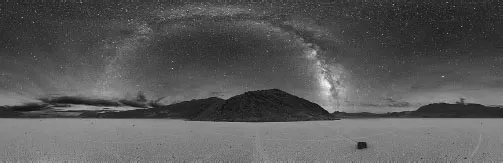
The Milky Way bends over the “Racetrack” section of Death Valley National Park. (Dan Duriscoe, NPS Night Sky Program)
Times have definitely changed. The lights from Las Vegas, for example, are visible on the horizons of at least eight national parks—and the National Park Service now includes darkness as one of the resources it is sworn to protect. In 2001, the NPS created its Night Sky Team to help raise park service employees’ and park visitors’ awareness of the importance of darkness, to measure the level of darkness in the parks, and to gauge how rapidly the resource was being lost.
If not for Chad Moore, there might not be a Night Sky Team. I first met Moore at the IDA conference in Tucson five years ago. He was based then in southern Utah’s Bryce Canyon National Park, working closely with Dan Duriscoe and two other National Park Service employees, Angie Richman and Kevin Poe. In 2009, the NPS created a new science division combining programs in natural sounds and night skies, and moved Moore to Fort Collins, Colorado. The Night Sky Team now has six full-time members and has documented the night sky in 88 NPS properties, with a target of 110. With more and more national parks adding their services and other parks needing to be rechecked, the Night Sky Team will have its hands full for years to come. And it all started with Moore realizing that the night sky over the park where he worked was growing brighter.
“In 1999, I was working at Pinnacles National Monument in central California,” he tells me, “and it seemed that in just the three years I’d been there the sky was getting brighter, particularly in one direction.” A new prison had been built near the park, plush with floodlights and wallpacks, and a new housing development had gone in as well. “I thought, Wow, if I can see this much change in three years, imagine what it will be like in thirty years.” Moore wondered if there were a way to measure the light pollution around the parks, and he began asking colleagues at other parks if they knew. “I literally got the same answer from a dozen different people: I don’t know, but I’m worried about it too. So, I thought, I’m going to figure out how to do this. Maybe it’s just my job.” Moore wrote a grant proposal to purchase equipment and contacted Duriscoe to see if he wanted to join in. The two of them decided to buy a CCD camera (a research-grade digital camera) and take pictures of the night sky over different parks, figuring it would take a few months to gather the data they would need. That was twelve years ago. Moore laughs. “Neither of us had any idea how much work it was going to be.”
Taking pictures of the night sky over the parks isn’t as easy as it may sound. For one thing, it’s something that can only be done during the dark nights around a new moon, when the moon’s monthly cycle keeps its light out of the sky. Next, the weather has to cooperate—meaning no clouds, and preferably no heavy wind; certainly no rain, thunderstorms, tornadoes, snowstorms, or hurricanes. Third, in order for the camera to give an accurate picture of the night sky darkness over each park, Moore and Duriscoe had to get away from any lights associated with the park. There would be no setting up of the camera in the visitors center parking lot and then sauntering back to the warmth of motel comfort. In park after park, the two men carried the heavy equipment out into the darkest location they could find, often spending hours hiking to their remote location, and often spending the entire night outside.
Moore says they were looking for numbers. “Our original purpose was simply to quantify the resource, which was important to understanding acceptable change. As humans we tend to only value things we can give a number to, and one of the tough things about managing darkness is that there’s no way to track it. Our contribution is that we have a sophisticated way to accurately do that.” At first, he and Duriscoe relied on quantifying the level of darkness wherever they went by using the 9-to-1 rubric of John Bortle’s scale. But as they continued their work, they gradually gained a deeper understanding of the different factors that contribute to the quality of a given night sky, eventually developing a new “sky quality index” using a 1–100 scale. Still, their ultimate goal remains the same: to accurately gauge the quality of night sky darkness in order to help the NPS value and protect its resource.
The challenge of measuring the quality—and thereby the value—of darkness remains. “It’s not like measuring arsenic in drinking water,” says Moore, “where you know there’s a certain threshold that you can’t cross before it gets dangerous.” Even so, having a way to talk about darkness in numerical terms can go far in helping people understand its value. “Humans, we don’t detect gradual change well at all,” Moore says. By measuring a park’s level of darkness repeatedly over time, Moore and the NPS will be able to tell park superintendents, “This is how much you’ve lost,” or “This is how much better the sky has become.” By doing so they hope to fight what Moore calls “the problem of us sort of forgetting how good it used to be, where we have this sliding bar of what’s an acceptable quality getting lower and lower.” It’s what psychologist Peter Kahn calls “environmental generational amnesia,” a situation where “the problem is that people don’t recognize there’s a problem” because they don’t know any better. In other words, if you have never known a night sky any darker than the one you have now, why would you think anything is wrong?
I am heading to the summit of Cadillac Mountain in Acadia National Park in Maine, first to watch the sun set, then to watch the night rise.
Most cars are coming down; my car is going up. At the top are tourists, but fewer and fewer as the light fades, as though there’s some cosmic balance that everywhere must be obliged—the more the darkness, the fewer the humans. There’s a parking lot, but no lights—except for those of fireflies, floating around the bushes. I find a good perch and survey the sky—in the west charcoal red, in the north rain-cloud blue, in the east the purple haze of dusk and the same in the south. The orange-pink of high-pressure sodium sprinkled here and there in the islands around the mountain. I know the ocean from the sky only by a darker shade of gray at the horizon. The last chickadee sings as the first stars arrive, and I eat my dinner looking east to open sea, writing by red headlamp and wearing both my jackets, rain and fleece.
By 10:00 p.m. I’m alone on top of this mountain in a national park, lying back on Cadillac rocks. In the southern sky, windows open periodically in the clouds, each time revealing a different constellation. First, Sagittarius, the teapot toward the center of our galaxy—then that’s gone, the window closed. Another window opens and Scorpius appears, shining bright, its time on the stage; then, its time gone.
When the rain starts to fall, I start to think that this is not smart, standing exposed on this rock. But for a moment I will, just to feel the rain on my face and legs and arms. Not so far from here, Henry Thoreau climbed Mt. Katahdin and wished for “Contact! Contact!” That desire to know the wild. When the rain first hit, my first thought was to flee, but then I have come a long way to see this night, and not every night has to be clear and starry—at least not for this one-man Night Sky Team. The rain, the wind, the storm clouds moving through, this busy tourist spot has become wild again, this flat rock a theater, only I am the audience and the actors are all around.
The native people here are called the Wabanaki, the People of the Dawnland: Cadillac Mountain is the first location in the United States to be struck by sun each fall and winter morning. Tonight it will be, I suspect, the last place to see the stars, at least around here. To the east the ocean and sky, their black shapes blended, the horizon gone. But to the south, open space remains where bright stars come down to ocean water. I am happy to have my red rain jacket, happy to be otherwise soaked. I stand on this rock in this park, watching until storm clouds move over this last open space, the sky closing down, the land going dark.
In the morning I meet John Muir at the visitors center, his words alive on a sign next to the stairs: “Everyone needs beauty as well as bread,” he argues, “places to play in and pray in where nature may heal and cheer and give strength to body and soul.” Farther along I find Sigurd Olson far from home, and he and I, two Minnesota boys, stand face to face. “If we can somehow retain places where we can always sense the mystery of the unknown,” he says, “our lives will be richer.” Beauty and mystery: intangible qualities we all know are valuable but don’t always know how to value.
This place gives me hope. On a weekend summer morning a constant stream of people come and go, volunteers directing traffic, rangers offering talks and advice. This place—this national park—gives me hope because of where it lies. Here in the east, not six hours from Boston, a place where for millions of people each year, the beauty and mystery of night can be brought within reach.
“Not a lot of people think to look up at night,” says Sonya Berger, an Acadia ranger. “They run around from one lit place to another lit place, flipping on artificial daytime whenever it gets dark. And then when you walk outside, usually there’s going to be a streetlight or you’re just going to walk to your car and flip your headlights on. It’s kind of like living in Phoenix where you hop from one air-conditioned place to another, and you never feel the heat—you never realize that it’s a really crazy place to live in during the summer. I think that for a lot of people that’s what happens with the night sky, too.”
In response, Berger and her fellow rangers offer a series of different programs geared to get park visitors to pay attention to the night, including Stars over Sand Beach, which on summer nights often has two hundred attendees or more. Knowing the Night, a night walk focused on sensory experiences, invites people to walk in the dark, testing their natural adaptations. It’s not something many visitors have done before, the rangers find. Berger says, “We tell them it’s okay, come with us.”
It’s a message Acadia National Park has been offering for decades, and a message the NPS as a whole is beginning to offer more and more. More than sixty national parks and monuments offer some form of night sky program, and the number continues to grow. In addition, the NPS as a whole has begun to take the conservation of darkness more seriously, adopting in 2006 a poli...