![]()
Ornamental Woody Plants
The following ornamental woody plant directory offers practical information on pruning and training the trees, shrubs and climbing plants most commonly found in our gardens.
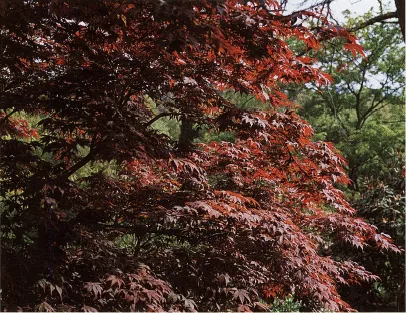
Acer palmatum
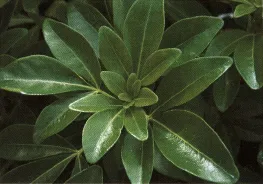
Choisya ternata
There is one sentence you will not see too often in this directory section, yet it is vitally important for the welfare of woody plants: when pruning, always cut out dead, diseased or damaged wood, when seen. This applies to every type of woody plant, regardless of the normal pruning season. If you leave unpruned any dead or diseased wood, healthy tissue will become infected; likewise, if a branch is damaged, then there are multiple entry points for air- and waterborne infections. So, even though this sentence is not repeated hundreds of times throughout the text, you should be aware that it applies to every plant entry appearing on the following pages.
EVERGREEN CONIFER
General: These conifers do not pose any significant pruning challenges for the gardener. From the moment a seedling of Abies is manageable, it is important that a single leader is selected. Once planted in its permanent quarters you should allow the leader, and all side branches, to grow unchecked. Any branches which are seen to be damaged, or are dying back, should be removed to the trunk. No other pruning is normally necessary.
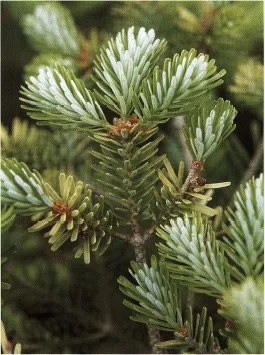
Abies koreana
EVERGREEN/DECIDUOUS SHRUB
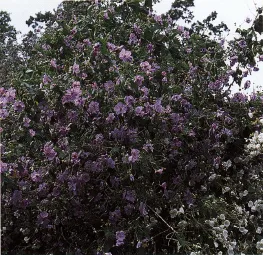
General: All species are tender, and if grown outdoors are best protected by a south-facing wall. Although these are short-lived plants, often exhausting themselves in three or four years, they do repay by flowering over a long period in summer. They flower on current season’s growth. Before growth starts in earnest in mid-spring, cut out any winter damage, and thin out crowded shoots.
Special requirements: Abutilon x suntense is a spectacular hardy hybrid which tends to blow over unless it is fairly hard pruned after flowering, in late spring or early summer.
A. vitifolium should be treated as a freestanding shrub; the only pruning needed is dead-heading, in mid-summer.
The trailing abutilon, A. megapotamicum, grows long, slender stems, and it is ideal for training against a wall. The form ‘Variegatum’ has yellow-mottled leaves. With a wall-trained specimen, cut away old wood in early to mid-spring, and tie in the strong young replacement shoots.
Abutilon x suntense
EVERGREEN SHRUB/TREE
General: Native of Australasia, acacias succeed only in mild districts, and are best grown in the shelter of a warm wall. The only pruning required to keep a mature specimen producing its masses of tiny yellow blooms each spring is to remove old, spent flower shoots, dead wood (of which there tends to be a large amount each year), and any frost-damaged tips. This is best carried out soon after flowering is over, during mid- to late spring, and ideally when you know there are no more prolonged frosts until autumn.
Special requirements: Most acacias resent hard pruning, and do not regenerate successfully. However two exceptions to this are Acacia dealbata and A. melanoxylon; both are suckering species. Vigorous species (such as A. dealbata and A. longifolia) can be cut back hard when young to encourage branching low down. Some forms, including A. cultiformis and A. verticillata can be clipped regularly, and make acceptable informal hedging.
DECIDUOUS SHRUB/TREE
General: There are a large number of acers, varying in height, habit and decorative value. It is the smaller Japanese maple (Acer palmatum) which is most commonly seen in gardens. These acers tend to branch low; if they do not, a little judicious pruning whilst they are young will encourage them.
There are dozens of Acer species that make wonderful specimen trees. Many are grown for their ornamental barks, whilst others have desirable shapes and leaf sty...