![]()
CHAPTER 1
The Home Front
There is nothing out of the ordinary about Joyce Voysey’s semi-detached house in New Malden or the quiet suburban street on which she lives. The garden is well kept, the house immaculate and neatly furnished. Joyce and her sister, Cynthia Maidment, are two white-haired ladies with kindly faces and easy smiles, eager to welcome their visitors, especially those who have come to talk about their beloved brother, Cyril Barton.
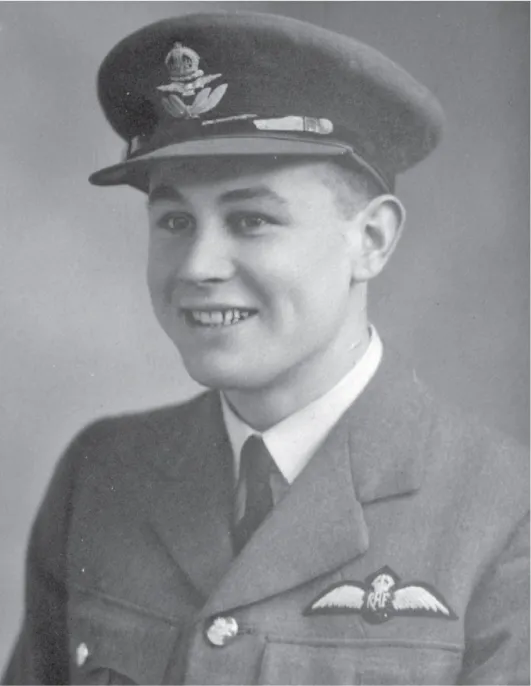
His portrait, an oil-painted copy of his official RAF photograph, gazes from the wall of the sitting room. His broad, boyish grin is equal parts innocence and mischief and his eyes shine with pride. While Cyril looks down, his sisters serve tea in china cups and saucers on a polished mahogany table. At one end is a large scrapbook, filled with papers and cuttings, and a stack of files, all of them focused on Cyril’s service in Bomber Command. The scrapbook is well thumbed, its pages now faded and yellowing. At first glance there is nothing to suggest that they contain one of the most extraordinary stories of the Second World War.
Cynthia, Joyce and their three brothers and sisters idolised Cyril. They always looked forward to the week when he made the long journey home from his RAF base in Burn, North Yorkshire. Cyril was the oldest, wisest and most confident of the six Barton children, and life at their semi-detached Edwardian house seemed more fun whenever he was there. He was mischievous and playful but also like ‘a little father to us’,1 Cynthia remembers, who often put them to bed at night when their dad, an electrical engineer, worked late shifts. He and their brother Ken, who was two years younger, had also taught the girls to sew, knit, draw and read.
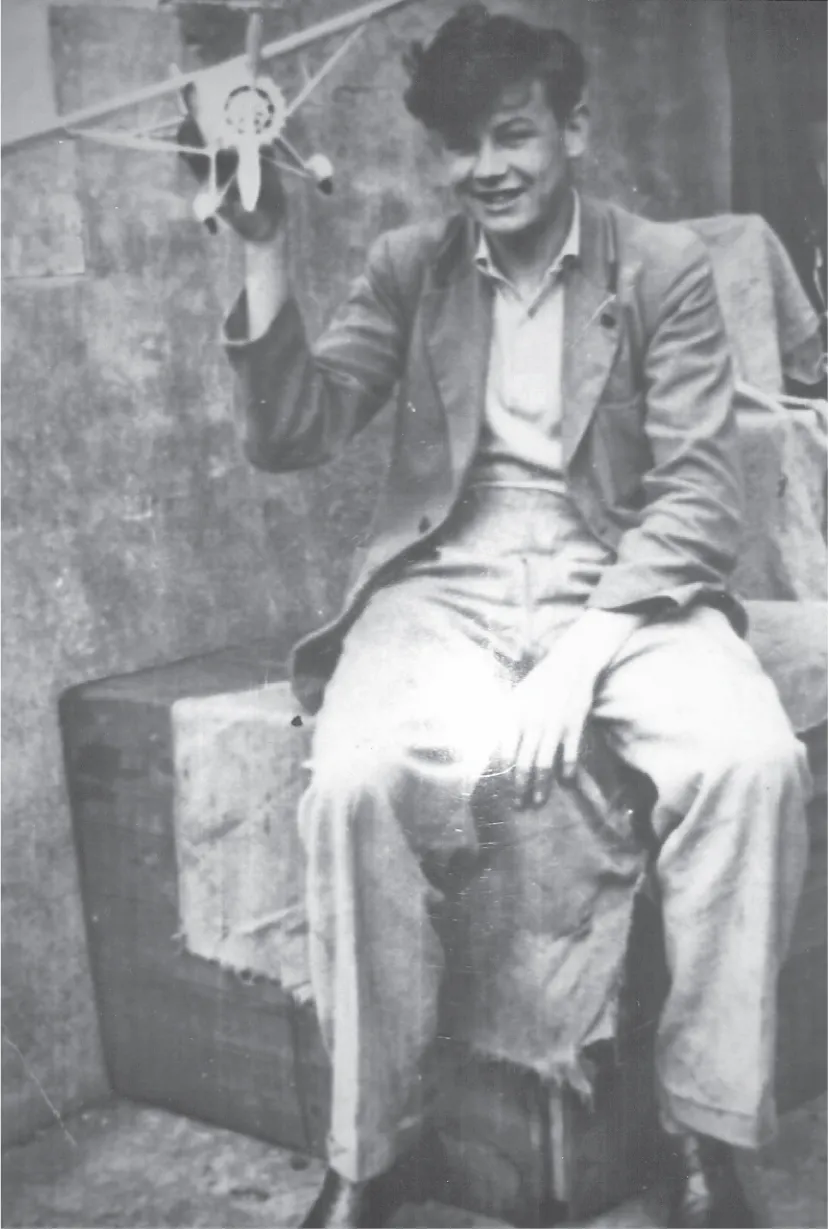
Cyril flew with 578 Squadron. He and his crew had been operational since August 1943. Becoming a pilot had been a lifetime’s ambition. As a five-year-old he had once stuffed feathers from a recently plucked chicken into the sleeves of his pullover and jumped off a wall, flapping furiously, determined to defy gravity. The family had little money, but whenever funds allowed he was bought model aeroplanes, which he would build assiduously. Sometimes he would even allow his little sisters to help finish off the wings with yellow tissue paper. He was always willing to give them a ride on the back of Ichabod, his trusty bicycle, named after the son of Phineas in the Book of Samuel, and loosely translated from the Hebrew as ‘The Glory has departed’.
When they were teenagers, Cyril and Ken had heard the distinctive rumble of a Vickers Wellesley in the night sky. They went out into their quiet suburban street for a closer look. The light bomber had lurched into an uncontrollable spin, and the pilot had parachuted out. Seconds later, there was a world-shaking bang. Cyril and Ken shoved Cynthia into their younger sister Pamela’s pushchair so they could get to the crash site quicker than Cynthia could run. A few streets away the tail section of the plane jutted from a tiled roof. No one had been injured, but the house’s pregnant inhabitant gave birth earlier than expected. Cyril’s only regret was the absence of debris which he could claim as a souvenir.
His dream of flying seemed to have been dashed when his late childhood was blighted by serious illness. Severe bouts of meningitis and peritonitis hospitalised him for months, interrupted his schooling and at times threatened his life. His parents were twice summoned to the hospital to see him for the last time.
Each time he recovered, he managed to catch up at school, and throughout his ordeal he remained typically selfless; a diary entry from his sickbed recorded his principal concern: ‘I don’t know what to get Dad for his birthday.’
His love of aviation never wavered. At the age of 14 he went to work at Parnall’s, a manufacturer of military and civil aircraft. They had recently taken over Nash & Thompson in Kingston, who designed gun turrets for RAF bombers, and it was here that Cyril started as an apprentice draughtsman, taking one day a week off to study at college for his National Certificate in Aeronautical Engineering. His early apprenticeship was as blighted by illness as his schooldays had been, but he managed to complete it, and when war broke out, though he might have claimed the protection of a reserved occupation, he knew his chance to fly had finally arrived.
The minute he reached enlistment age in 1941 he asked his father if he could volunteer for the RAF. The family had moved to the safety of the countryside, leaving Cyril lodging in Surrey with his Sunday school teacher, so parental permission had to be sought by letter.
Mr Barton couldn’t hide his reluctance to agree to Cyril’s request; he had survived the horror of the trenches in the Great War and was in no hurry to see his much-loved son follow in his footsteps. ‘Dear Cyril,’ he wrote,
After all these … forms, the phone calls and so on, I weighed up your position and feel that the matter should rest entirely with you. Naturally your mother and I are not too keen on your “joining up”, more especially as I know by experience what such a step entails, but in view of what you have said regarding your present state at Parnells [sic], I rather grudgingly give my consent …
I am writing as requested to both the Air Ministry and Parnells and in doing so I wish you every success and a happy ending to your enthusiasm. Stick to your principles and faith (this will be very hard in the RAF) and I am confident that you will win. We at home will be waiting and watching in all that the future may hold for you.
I’ll close now and may God bless you and help you in the days that lie ahead. That is my greatest wish and hope …
Goodbye and ‘happy landings’.
Dad
Unsurprisingly, Cynthia and Joyce’s parents worried constantly about Cyril’s frequent and serious ill health, and their concern made his homecoming even more precious. Most of those serving an operational tour with Bomber Command were given one week off in every six. Cynthia, Joyce and Pamela, then aged seven, would wait eagerly for him to return to New Malden – the family had grown bored with country life and moved back to Surrey by then – wondering what new skills he would pass on, what practical jokes he might pull and what words of wisdom he would impart.
Their house always reverberated with laughter during these visits, and even when he was away in the United States, completing his pilot training in Albany, Georgia, he wrote streams of letters, including one to his sisters in May 1942, enclosing photos of the young daughters of the family he was staying with, but promising, ‘I’m not going to stay and be their big brother … I’ll try and come home for Christmas!’
That February visit of 1944, the ground was still blanketed with snow. Without even changing out of his uniform, Cyril headed straight to the garden shed. He pulled out an old tea chest and attached some metal runners to it. His three sisters screeched with delight as he dragged them up and down the street on their makeshift sleigh.
But once the excitement had died down, Cynthia noticed a change in her brother’s usually gregarious nature. He still found time to teach Joyce how to conjure up a watercolour sunset by wetting the paper and then blending in the paints, but much of the time he was withdrawn and silent. Their mother told the girls that Cyril had ‘grown up’, but it concerned them to see him so distant and preoccupied. He had always possessed a serious side and a strong religious conviction, but the Cyril they knew best was a playful extrovert.
One morning, as he sat quietly on the sofa, staring into space, Cynthia was unable to contain herself for a minute longer. There had been talk of a girl he had met, and she felt a surge of jealousy that there was someone else on the scene who might share his leave. Was that bothering him?
‘What’s wrong?’ she asked.
Cyril remained silent for a few seconds. Then he nodded. ‘As you’re a young lady now, I’ll tell you.’ He patted the empty space on the sofa beside him. When she sat down, he turned to face her. ‘You know I’m having to bomb people in Germany?’
Cynthia did know, even if she didn’t fully understand. Cyril and his crew had completed more than a dozen ops. Their parents rarely mentioned the dangers he faced, especially in front of the younger children, but as they heard the drone of engines overhead and stood in the garden counting the bombers in their droves, his mother couldn’t help saying plaintively: ‘Oh, I hope Cyril’s not in one of them.’
It was the same story in thousands of other homes across the country; the worry was never voiced, but it hung in the air like mist. Most evenings the Barton family gathered in the kitchen and switched on their Consul Marconi wireless. Sitting around the table, warmed by a Triplex oven, they listened to their favourite programmes, whilst their mother and father waited anxiously for the latest news bulletins from the front.
‘Well, I don’t like doing it,’ Cyril said, ‘because it means I have to bomb other people’s children.’
Cynthia had never known him speak so seriously to her.
‘I’m a Christian and I find it difficult to cope with bombing innocent people,’ he continued. ‘But I do it because of you three young girls. I don’t want Hitler to ruin your lives. He has some terrible plans for the human race. He has to be stopped. So that’s why I’m having to do it. For you, Joyce and Pamela.’
Cyril remained subdued for the remainder of his stay, but at least Cynthia now understood why. She was grateful that he had spoken to her so openly; she was only 13, but he was treating her like an adult. And the next time they went for a stroll, he took her arm. ‘Right,’ he said, ‘you don’t hold my hand any more. You’re a young lady now.’
Cynthia still remembers her feeling of pride as he escorted her down the shopping parade.
Then the day came that the whole family dreaded: the day of Cyril’s return to active service. Joyce always walked him to the station hand in hand. As they stood awkwardly outside the entrance, Cyril noticed the state of her nails. ‘I think you ought to use that manicure set more often, don’t you?’ He smiled. When he had arrived back from the USA two years before, he had brought Cynthia a gold watch and Joyce a gold-plated manicure set in a green leather case. It was one of her most treasured possessions.
The Pantons’ small stone gamekeeper’s cottage in Old Bolingbroke, Lincolnshire, was less than a mile away from RAF East Kirkby, the home of two Bomber Command squadrons, so the deafening roar of 3,000 rpm Merlin engines provided the soundtrack for 13-year-old Fred Panton and his younger brother Harold’s everyday life. The boys ran down the hill with rising excitement whenever they heard them, and stood with the other onlookers on the main road adjoining the runway as the lumbering machines, fully bombed up, strained to get airborne.
The pilots and flight engineers at their side always stared straight ahead, eyes fixed on the task of getting the aircraft safely off the ground, but the mid-upper and tail-end gunners often wiggled their guns to acknowledge the crowd.
Fred and 10-year-old Harold watched and waited until the bombers had gathered above them, and would not go home until they were just grey dots in the distance. Much later, the shadows of the returning planes would flit across their bedroom wall. Sometimes they were so close that Fred could make out the eerie glow cast by the instruments in the cockpit.
When the sky was silent once more, they wondered whether their big brother would be joining that night’s raid. Nineteen-year-old Chris was a flight engineer with 433 Squadron at Skipton-on-Swale, part of a maverick crew that included a Danish-born volunteer from the USA called Chris Nielsen and several Canadians. Despite his youth, Chris was already well on his way to becoming an officer and nearing the 30 ops that signalled the end of a tour. He still had dreams of being a pilot. There had been some close calls. On one trip the hydraulics on their bomb- and fuel-laden Halifax had failed on take-off, so the undercarriage and flaps would not retract. They were struggling to gain enough height to clear an oncoming hill, so Chris pumped furiously on the manual controls. They regained enough hydraulic pressure just in time to ensure the bomber cleared the hill. All on board were stunned into silence. Except for Nielsen. ‘It’s OK,’ he said in a bored American drawl. ‘I’ve got it.’
The two boys lived for the times he came back on leave. With eight children in their cramped cottage, Fred and Chris had to share a bed. Fred was always bursting with questions as they lay there, listening to the bombers return, but Chris would only talk about his experiences to their father, a veteran of the First World War. Fred sometimes heard the rumble of their conversation, but could never make out what they were saying.
Fred and Harold joined their older brother on rabbit-hunting expeditions (Chris had trained as a gamekeeper, aiming to follow in his father’s footsteps), but what he had seen and done in the skies above Germany was never discussed then either. For a few precious moments the war seemed a lifetime away, and they didn’t want to bring it rushing back. Watching the planes come and go, wave after wave, night after night, Fred knew the dangers they faced. He and Harold often visited crash sites once the bodies of the crewmen had been removed, and just stared, transfixed, at the twisted, smoking metal carcasses.
But finally, that winter’s evening, he could contain his curiosity no more. ‘Don’t you worry about crashing?’
There was a pause. ‘Not really,’ Chris replied casually. ‘It’d just be further experience.’2
His brother’s insouciance astounded Fred. He longed to know more, but didn’t dare ask. He didn’t dare ask his father either. Their late-night chats were man’s talk, to be shared only by those who had experienced the realities of war.
Once, when Chris had been home on leave, Fred had slipped on his big brother’s RAF jacket, trying to imagine what it was like to be him. His father caught him red-handed. ‘Don’t you be going out that door with that on,’ he’d said sternly. In his dad’s eyes, Fred hadn’t earned the right.
The questions would have to wait for another time, hopefully not too far off, when Chris’s tour – and the war – were over.
Alan Payne, a bomb aimer with 630 Squadron, was part of one of the crews Fred and Harold had seen straining to take off at East Kirkby. On the early evening of 29 March, Alan was preparing to leave his parents’ home in Wendover. He gave his mother a final cheery wave before putting on his helmet and climbing on to his motorbike.
For the entire week they had not spoken once about his experiences with Bomber Command. They never asked and he never told them, and that suited him just fine. He knew the truth would only upset them and cause them to worry even more than they already did.
The rain started...