eBook - ePub
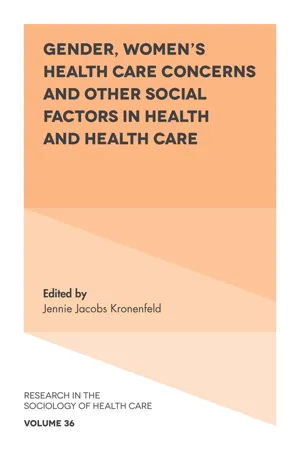
Gender, Women's Health Care Concerns and Other Social Factors in Health and Health Care
- 275 pages
- English
- ePUB (mobile friendly)
- Available on iOS & Android
eBook - ePub
Gender, Women's Health Care Concerns and Other Social Factors in Health and Health Care
About this book
This volume of Research in the Sociology of Health Care analyses micro-level gender issues and other social factors impacting macro-level health care systems. Examining the health and health care issues of patients and providers of care both in the United States and in other countries, chapters focus on linkages to policy and population concerns as ways to meet global health care needs.
Information
INTRODUCTION TO VOLUME
GENDER, WOMEN, AND OTHER SOCIAL FACTORS IN HEALTH AND HEALTH CARE
ABSTRACT
Purpose – This chapter provides an introduction to the volume along with a brief review of literature on gender, women’s health concerns, and other social factors in health and health care services.
Methodology/approach – Literature review.
Findings – The chapter argues for the importance of greater examination of gender, women’s health concerns, and social factors in health and health care services.
Originality/value – Reviews the issues of gender, women, and social factors and previews this book.
Keywords: Gender; women; social factors; income; education; health care
This chapter provides an introduction to Volume 36 in the Research in the Sociology of Health Care series, Gender, Women’s Health Concerns and Other Social Factors in Health and Health Care. The beginning of this chapter will briefly review some of the more important material about gender, women, and social factors in health and health care. The second part of this chapter will review the overall contents of the volume and the structure of the volume.
WOMEN, GENDER AND HEALTH, AND HEALTH CARE
Throughout the twentieth century and into the new century, an important feature of mortality trends has been that women live longer than men (Rieker, Bird, & Lang, 2010). This is more complicated than the first statement may imply, because although women have better mortality experiences, they have higher morbidity rates and in later years of life report a diminished quality of life (National Center for Health Statistics, 2009). Understanding these differences is complex, as there are variations across countries and other social factors. One of the most important of these is socioeconomic status along with racial and ethnic differences. Altogether, these also impact differences between men and women both in the United States and in many other countries in the world.
One approach to understanding of differences between men and women in health and health outcomes is the constrained choice model developed by Bird and Rieker (2008) in their book, titled Gender and Health. In this multilevel model, they conclude health is not only an individual responsibility but is also one shared by decision makers at multiple levels. The model argues that individuals make everyday choices that create health outcomes. These choices are made within the context of family, employment settings, and community. There is also a relationship with biological processes, such as stress responses, and all these go together to create health outcomes, both morbidity and mortality.
In addition to that book’s focus on gender and health, other scholars have focused on gender and health care (Anspach, 2010). Anspach points out that the health care system is a deeply gendered institution, and because of that, it often impacts men and women differently. They also note, as have many other authors, that women are more likely to seek medical treatment than men, and because of this, they become the principal consumers of health care. The care women receive is often different from the care men receive, and some of the earliest work on women, gender, and health focused on documenting these types of differences and were an important part of the resurgence of the feminist movement in the 1960s and 1970s in the United States, as it is related to the study of health and health care by gender.
Another issue about women in health care has to do with women as providers of health care. Fifty years ago, women providing care were more often nurses and physicians were men. This has been changing in the United States and in many other countries, and now, using US data, about 45% of medical students are women, although the overall sex composition of physicians is still more heavily male (only about 25% are women). This should grow in future years as more male physicians retire given that younger physicians are much closer to equal numbers of men and women. In nursing, it is still a very heavily female-dominated field, although there is some increase in the numbers of male nurses. About 90% of nurses are now women, versus 97% in the 1970s. Male nurses tend to earn more than female nurses, thus issues of unequal pay for women workers is true in the health care field even in areas in which women traditionally dominate in numbers. As providers, the impact of women in health care is linked to the overall growth of women in the labor force, both in the United States and across the world.
Another important issue related to gender and health is the passage of the Affordable Care Act (ACA) in 2010, which began a new era in health care coverage, with major implications for women’s health and access to care. Provisions such as the mandatory inclusion of maternity care, coverage without cost sharing for preventive services such as contraceptives, and a prohibition on charging women more than men for the same plan were all designed to address gaps and inequities in women’s health insurance. The Kaiser Family Foundation conducted a survey in 2013 to provide an initial examination into the range of women’s health and care experiences. They presented a report that examined women’s coverage, access, and affordability to care, as well as their connections to health providers and use of preventive care based on an analysis of a nationally representative sample of 2,907 women ages 18–64 (Salganicoff, Ranji, Beamesderfer, & Kurani, 2018). A smaller and shorter survey of 700 men ages 18–64 was also conducted and key findings were included for comparison. They point out that about one in three women ages 18–64 live in households that are below 200% of the federal poverty level (FPL) which was US$19,530 for a family of three in 2013. One in three women identify as racial and ethnic minorities (13% Black, 14% Hispanic, and 9% Asian or other) and half are in their childbearing years. A sizable minority of women also report that their health is fair or poor (15%) and over four in 10 have a health condition that requires monitoring and treatment (43%). Major findings were that logistical barriers to care beyond coverage and affordability are challenges for many women, such as a limited ability to take time off work to get health care as well as childcare and transportation problems. The ACA included new requirements for private plans to cover a wide range of recommended preventive screening and counseling services without cost sharing. Public awareness of these insurance reforms, however, is more limited. Women enrolled in Medicaid, despite their lower incomes and constrained provider options, obtain preventive screening and counseling services at rates that are on par with women with private coverage. They also found considerable room for improvement in the rates of counseling on reproductive and sexual health topics, a topic covered in much greater detail in the report (Salganicoff et al., 2018).
Another issue in care provided to women is that differences have been noted in communication styles between men and women providers and linked also to the sex of patients. Some procedures have been viewed as riskier for women, and women often present with different symptoms and other cultural assumptions about gender and disease (Anspach, 2010). Importantly, in the last few decades, research on gender and health care have been modifying away from an exclusive focus on gender to broadening the approach to include the intersection of gender with race, class, and other forms of inequality. The constrained choice model already discussed is one example of this type of work. The chapters in this volume in many cases help to contribute to these more complex understandings of issues of gender, often linked in with other social factors such as social class and race/ethnicity.
SOCIAL CLASS AND SOCIOECONOMIC STATUS
Studies examining social class and socioeconomic status (SES) and the components of that such as education and income and their impact on health and health care have long been an important part of medical sociology. In fact, some of the earliest work in the United States on medical sociology dealt with some of these issues. That people who have greater advantages in SES live longer is well covered in the literature and true both at the beginning of life as measured by infant mortality and across the life span. I have already discussed some of these differences and studies in an earlier volume in this series (Kronenfeld, 2015). This includes a discussion of some of the key impacts of educational differences and broader approaches to such topics including the fundamental cause approach, a sociologically based explanation for persistent associations between SES and disease (Link & Phelan, 1995, 1996). One recent issue, especially within the United States, is the impact of recent social policy changes on SES factors and health care utilization.
Especially within the United States, a country that has had the largest socioeconomic disparities in health care access of any wealthy country, the impact in the past decade of changes since the passage of the ACA is important to track. A recent paper has assessed changes in these disparities in the United States under the ACA by using survey data for the period of 2011–2015 from the Behavioral Risk Factor Surveillance System to assess trends in insurance coverage, having a personal doctor, and avoiding medical care due to cost (Griffith, Evans, & Bor, 2017). All analyses were stratified by household income, education level, employment status, and home ownership status. They found that health care access for people in lower socioeconomic strata improved in both states that did expand eligibility for Medicaid under the ACA and states that did not, but gains were larger in expansion states. The absolute gap in insurance coverage between people in households with annual incomes below $25,000 and those in households with incomes above $75,000 fell from 31% to 17% (a relative reduction of 46%) in expansion states and from 36% to 28% in nonexpansion states (a 23% reduction). As the ACA is under attack by the current Trump administration and aspects of it are being changed, it will be important to continue to follow data to see whether these improvements dissipate over time.
RACE AND ETHNICITY
In the early years of sociology within the United States, there was a major focus both on social class differences as just reviewed and, to the extent that data were available, to an early consideration of both racial and ethnic issues within the United States. From a health care and medical sociology perspective, these types of differences in recent years have become redefined as disparities with the growth of federal government efforts in health, and there has been more focus on race/ethnicity. I have already discussed some of this material in greater depth in an earlier volume within this series (Kronenfeld, 2012). If studies focus on race/ethnicity and ignore social class issues, many incorrect assumptions arise, and it becomes too easy to conclude that differences are linked either specifically to race/ethnicity or even to biological differences that may be linked to race and ethnicity (Issacs & Schroeder, 2004).
In a review article in the past decade, Takeuchi, Walton, and Leung (2010) argue that there is an important role played by segregation as a social process. They argue that segregation contributes to differential exposure to many particular environments and contexts and these different opportunity structures and community structures may influence health by shaping social processes. Looking at the Latina population in the United States, a recent review article has covered the Hispanic paradox (Dubowitz, Bates, & Acevado-Garcia, 2010) and pointed out how the sociopolitical context and patterns of migration contribute to health and to the paradox that Hispanics/Latinas have higher life expectancies than would be expected based on their higher representation among the poor. The more factors researchers consider in trying to understand the complexity between health differences, immigration, race/ethnicity, and SES, the more confusing and conflicting results researchers sometimes find. Perhaps some of the studies in this volume will add to better understanding as well as the growing complexity of this confusing literature along with the literature on gender and women within health and health care.
REVIEW OF CONTENTS OF THE VOLUME
This volume is divided into six parts. The first part is the introduction to this volume and contains only this chapter. The second part is on gender- and cancer-related issues and includes three chapters, one dealing with long-term survivorship issues with cancer and gender-related factors, one with younger women with breast cancer, and one on gender and health insurance coverage issues with cancer. In the first chapter, Powroznik, Stepanikova, and Cook explore how gender influences the experience of cancer care and propose a new explanation for gender differences in posttraumatic growth among individuals who received blood or marrow transplantation as treatment for lymphoma. The chapter uses mixed methods, combining quantitative examination of surveys with 180 survivors with qualitative findings from semi-structured face-to-face interviews with 50 survivors. Participants were 2–25 years after transplantation. The quantitative data indicates that compared to men, women report greater posttraumatic growth and more positive impacts of cancer despite having lower physical health. These gender differences are robust even after controlling for physical and emotional well-being, life satisfaction, and social support. Qualitative findings from in-depth interviews show that gender norms and expectations about masculinity and femininity shape how individuals experience illness and perform the role of patient and survivor. Expectations about being a good patient and survivor are more aligned with expectations about femininity and tend to conflict with expectations about masculinity. Gender norms discourage men from reporting personal growth from cancer and encourage women to overemphasize the positive aspects of having had cancer.
The second chapter in this part by Snyder, Tate, and Roubenoff uses an inductive analysis based on qualitative interviews of women diagnosed with breast cancer prior to 40 years of age (n = 69). They find four orientations to decision-making (Advocates, Bystanders, Co-pilots, and Downplayers) with involvement and empowerment being coupled for some respondents but decoupled for others. They argue their findings suggest expanding what it means to be an “active” patient as respondents had multiple ways of characterizing involvement, including being informed or following their doctor’s advice. Empowerment and involvement may be enacted differently for other social groups and other medical conditions. The last chapter in this part by Virgo and her colleagues examines associations by gender between cancer history and major health insurance transitions (gains and losses), and relationships between insurance transitions and access to care. Longitudinal 2008–2013 Medical Expenditure Panel Survey data were pooled yielding 2,223 cancer survivors and 50,692 individuals with no cancer history ages 18–63 years upon survey entry, with gender-specific sub-analyses. Initially uninsured cancer survivors were significantly more likely to gain insurance coverage than individuals with no cancer history. Females, in particular, were significantly more likely to gain insurance. Significantly higher rates of difficulty accessing needed medical care and prescription medications were reported by those remaining uninsured, those who lost insurance, and women in general. Remaining uninsured, losing insurance, and male gender were associated with lack of a usual source of care.
The third part in this volume includes two chapters related to Pregnancy and Childbirth, one dealing with the childbirth experience and one dealing with disparities issues in unintended pregnancies. In the first chapter, Liddell and Johnson investigate women’s perception of dignified treatment during birth and how this contributes to a salient, under-examined aspect of women’s childbirth experiences. They use a two-part conceptualization of dignity, respect and autonomy, to understand how birth experiences and interactions either facilitate or undermine women’s perceived dignity. Data came from the Listening-to-Mothers I survey, the first nationally representative study of post-partum women in the United States (n = 1,406). Through linear regression analysis, they separately modeled women’s perception of respectful treatment and women’s perception of medical autonomy during birth. Overall women reported high scores for both autonomy and respect. Differences between the models emerged related primarily to the role of interventions and provider support. While women’s perceived dignity is related to elements that she brings in to the delivery room (e.g., birth knowledge, health status), much variation was explained by the medical encounter itself (e.g., type of medical interventions, pain management, nurse support, and number of staff present). In the second chapter by Bertotti, she examines educational disparities in unintended pregnancy from a rational-choice perspective, defining pregnancy intention as a fixed state within decontextualized individuals. Evidence suggests that women’s reproductive intentions may be more relational than rational, and that relationship context varies by education. This study investigated if relationship context could explain educational disparities in unintended pregnancy. Using the 2006–2015 National Survey of Family Growth (n = 4,320 pregnancies), she calculated structural equation models and predicted probabilities to examine if relational stability (marital status) and partner specificity (wanting a baby with a particular man) mediated the association between education and pregnancy intendedness for White, Hispanic, and Black women. Relational stability and partner specificity mediated the association between education and pregnancy intention for all three groups. Education was insignificant after controlling for race, marital status, partner specificity, and age. Marital status was a better predictor for White women than Hispanic women, and was not statistically significant for Black women. Partner specificity had greater influence on pregnancy intendedness than marital status, and its effect varied only slightly by race. Thus, disparities in marriage and access to desired partners influence educational disparities in unintended pregnancy.
Part IV in the volume includes four chapters on use of health care and gender. The different papers cover topics such as impact of gender in the surgical decision-making process, the role of gender in trust in health care, pa...
Table of contents
- Cover
- Title Page
- Part I Introduction to Volume
- Part II Gender- and Cancer-Related Issues
- Part III Pregnancy and Childbirth
- Part IV Use of Health Care and Gender
- Part V Gender Issues Outside of the US and Europe
- Part VI Other Gender Topics
- Index
Trusted by 375,005 students
Access to over 1.5 million titles for a fair monthly price.
Study more efficiently using our study tools.
Frequently asked questions
Yes, you can cancel anytime from the Subscription tab in your account settings on the Perlego website. Your subscription will stay active until the end of your current billing period. Learn how to cancel your subscription
No, books cannot be downloaded as external files, such as PDFs, for use outside of Perlego. However, you can download books within the Perlego app for offline reading on mobile or tablet. Learn how to download books offline
Perlego offers two plans: Essential and Complete
- Essential is ideal for learners and professionals who enjoy exploring a wide range of subjects. Access the Essential Library with 800,000+ trusted titles and best-sellers across business, personal growth, and the humanities. Includes unlimited reading time and Standard Read Aloud voice.
- Complete: Perfect for advanced learners and researchers needing full, unrestricted access. Unlock 1.5M+ books across hundreds of subjects, including academic and specialized titles. The Complete Plan also includes advanced features like Premium Read Aloud and Research Assistant.
We are an online textbook subscription service, where you can get access to an entire online library for less than the price of a single book per month. With over 1.5 million books across 990+ topics, we’ve got you covered! Learn about our mission
Look out for the read-aloud symbol on your next book to see if you can listen to it. The read-aloud tool reads text aloud for you, highlighting the text as it is being read. You can pause it, speed it up and slow it down. Learn more about Read Aloud
Yes! You can use the Perlego app on both iOS and Android devices to read anytime, anywhere — even offline. Perfect for commutes or when you’re on the go.
Please note we cannot support devices running on iOS 13 and Android 7 or earlier. Learn more about using the app
Please note we cannot support devices running on iOS 13 and Android 7 or earlier. Learn more about using the app
Yes, you can access Gender, Women's Health Care Concerns and Other Social Factors in Health and Health Care by Jennie Jacobs Kronenfeld in PDF and/or ePUB format, as well as other popular books in Social Sciences & Gender Studies. We have over 1.5 million books available in our catalogue for you to explore.