- English
- ePUB (mobile friendly)
- Available on iOS & Android
eBook - ePub
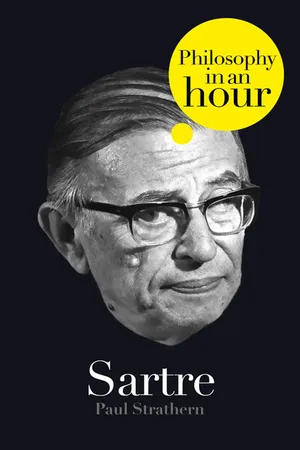
Sartre: Philosophy in an Hour
Information
Topic
PhilosophySubtopic
Philosophy History & TheorySartre’s Life and Works
Jean-Paul Sartre was born a bourgeois. His father was a young naval officer who died of a fever in 1906, when Sartre was one year old. Sartre was to describe this as ‘the greatest event of my life… Had he lived, my father would have lain down on top of me and squashed me’. Having been denied this oedipal fantasy, Sartre claimed that he grew up with no sense of filial obedience – ‘no super-ego… no aggressivity’. He had no interest in authority nor any wish to exercise power over others. So it comes as something of a surprise that this saintly childhood gave rise to an undying hatred for the bourgeoisie (and any middle-class habits or values associated with this worthy section of the community), a lifelong need to combat any sort of authority, and a desire to establish psychological dominance over all who came into close contact with him. Sartre was to examine with the brilliance of genius the intricate workings of his mind, but more obvious points often eluded him.
Sartre’s mother Anne-Marie, along with her saintly infant, returned home to live on the outskirts of Paris with her father Karl Schweitzer (uncle of the African missionary Albert Schweitzer). Grand-père Schweitzer was a typical French patriarchal figure of the period. He dressed in elegant suits and a Panama hat; his word was law in the otherwise entirely female household; and he was constantly unfaithful to his wife. In his autobiography Les Mots (Words), Sartre remembered him as ‘a handsome man with a flowing white beard who was always waiting for the next opportunity to show off… He looked so much like God the Father that he was sometimes taken for him.’ Here surely was a superego straight out of central casting. But Sartre refused to acknowledge his grandfather in this vacant psychological role.
Young Jean-Paul and his mother were treated like the children of the household, and Sartre came to regard Anne-Marie more as a close sister than as a mother. Unlike the father figure that he claimed he didn’t need, this mother-sister figure was to become an essential requirement for the rest of his life.
Judging from all descriptions, including his own, Sartre appears to have had a blissfully happy childhood. Surrounded by doting females, young Jean-Paul’s ego quickly expanded to make up for its lack of a superior element. As if sanctity were not enough, the child-saint now declared to himself, ‘I am a genius.’ No one contradicted him – even grandfather swept him into his arms and called him ‘My little treasure!’ (With characteristic obtuseness, Sartre was later to declare: ‘I hate my childhood and everything that survives from it.’)
Unlike other conceited little brats who come to the conclusion that they are a genius, Sartre had the imagination, endurance, and exceptional mind necessary to fulfill this self-appointed role. Young Sartre was soon filling exercise book after exercise book with long tales of knightly adventure and heroism.
It was now that Sartre suffered from the accident that was to mark his appearance for life. While on a seaside vacation he caught a cold. In those days the medical profession had a respectability that far exceeded its actual ability, and the young boy’s cold was allowed to develop disastrous complications. As a result, Sartre suffered from leukoma in his right eye, which led to strabismus and a partial loss of vision. In brutal unmedical language, he now had a grotesque squint, with one all-but-blind eye left in a permanent oblique stare. But solipsism can soon overcome even such blemishes, and Jean-Paul’s childish idyll continued.
Then something really awful happened. His mother had the thoughtless effrontery to marry again. Jean-Paul was horrified. He was no longer the center of Anne-Marie’s attention, and the new Madame Mancy moved to faraway La Rochelle with her usurper-husband Joseph. At the age of twelve, the awkward, wall-eyed child traveled to the port of La Rochelle to live with his mother and Joseph Mancy. In Sartre’s autobiography (written in his fifties) his forty-three-year-old stepfather is remembered with a vividness that speaks of deep feeling. ‘My mother did not marry my stepfather for love… he was not very pleasant… a tall thin man with a black moustache… uneven complexion… very large nose.’ The authoritarian and utterly bourgeois Monsieur Mancy was ideally cast for the role of the wicked stepfather. He was rich, lived in an opulent mansion, and was an eminent citizen in a provincial city of impeccable provincial complacency. Joseph Mancy was president of the local Delaunay-Bellville shipyards. He ran his business efficiently, in old-fashioned capitalist style. (Any threat of a strike was preempted with a lockout, until hunger resolved the issue.) Every evening after work he would call his stepson into the glittering front salon where he would give him additional lessons in geometry and algebra. In keeping with his general demeanor Monsieur Mancy preferred the orthodox approach to teaching. Persistent failure to arrive at the correct answer would result in a slap.
Meanwhile the little prig in his smart Parisian knickerbockers was greeted with whistles of derision by his less fashionable fellow pupils at the lycée. This baptism of fire induced self-sufficiency and introversion. Sartre was not one to be cowed by bullies. His undefeated egoism developed into a full independence of mind.
The more perceptive among his classmates recognized that the short, puny dandy who had a face like a frog possessed an exceptional mind – despite the fact that he didn’t excel in exams. (Possibly as a direct result of his stepfather’s insistent tutoring, France’s best mind of his generation usually settled about a third of the way down from the top of his class.) Sartre occupied the traditional double role of resident genius and class scapegoat. He was the unpleasant spotty little character in glasses who knew everything (and made sure everyone knew this); but he had also developed the revealing habit of making blunders. One anecdote will suffice.(Characteristically the source is Sartre himself, forty years later.) Like all the other boys at the lycée, Sartre would fantasize about the women in the port’s red-light district. His exceptional imagination had soon outclassed the rather paltry exploits of his teenage classmates. ‘I told them that there was this woman with whom I went to the hotel, that I met her in the afternoon, and that we did what they said they did with their whores… I even asked my mother’s maid to write me a letter: ‘Dearest Jean-Paul… ’ They guessed my trick… I confessed… and became the laughing-stock of the class.’
These were tough times. World War I had broken out, and many of Sartre’s fellow pupils were living alone with their mothers, their fathers having been called to the front. The carnage in the trenches took its toll, and his bereaved classmates took out their grief-fueled aggression on anyone perceived to be in a position of weakness. Sartre developed a mental toughness as well as a certain ambivalence. He refused to conform just to join a gang of thoughtless idiots, but he longed to be accepted. He wanted to be popular, but on his own terms. This ambivalence too would remain lifelong.
But in the privacy of his room the little frog-face with the walleye would become a prince. Seated at his desk, the boy who kept consoling himself – ‘I am a genius’ – was already starting on the impossible task of becoming one. The exercise books filled with tales of romantic chivalry had given way to autobiographical texts. And now he began to write entire novels. By the age of fourteen he had completed his second novel, Goetz von Berlichingen, about a medieval German tyrant. This reaches its climax when the tyrant’s subjects rise up against him, destroying the local mills and weaving shops (some of which bear more than a passing resemblance to shipyards). The tyrant is finally put to death in ingenious and excruciating fashion. His head is shoved through a hole in a steeple clock, so that it emerges at the roman numeral XII. The tyrant sweats out his last moments of life in increasing anguish as the arm of the clock rises second by second toward the point where it will decapitate him at noon.
This combination of anguish, violence, and mortal extremity were to be hallmarks of the mature writer, in whose works they retain all the immediacy of adolescent angst. The intense teenage growing pains that Sartre now experienced were to leave an indelible mark. At this age such feelings are often inextricably mixed with awakening philosophical questioning. Part of Sartre’s genius was his ability to retain this combination and the emotional-intellectual force it generates in a young mind growing into awareness and bewilderment.
In 1919 Sartre began stealing money from his mother’s purse. This he used to curry favor with his classmates, buying them exotic cream cakes and rum babas at a smart local café. Sartre’s joy at his popularity, the sickly taste of the cakes, is ...
Table of contents
- Title Page
- Table of Contents
- Introduction
- Sartre's Life and Works
- Further Information
- About the Author
- Copyright
- About the Publisher
Trusted by 375,005 students
Access to over 1.5 million titles for a fair monthly price.
Study more efficiently using our study tools.
Frequently asked questions
Yes, you can cancel anytime from the Subscription tab in your account settings on the Perlego website. Your subscription will stay active until the end of your current billing period. Learn how to cancel your subscription
No, books cannot be downloaded as external files, such as PDFs, for use outside of Perlego. However, you can download books within the Perlego app for offline reading on mobile or tablet. Learn how to download books offline
Perlego offers two plans: Essential and Complete
- Essential is ideal for learners and professionals who enjoy exploring a wide range of subjects. Access the Essential Library with 800,000+ trusted titles and best-sellers across business, personal growth, and the humanities. Includes unlimited reading time and Standard Read Aloud voice.
- Complete: Perfect for advanced learners and researchers needing full, unrestricted access. Unlock 1.5M+ books across hundreds of subjects, including academic and specialized titles. The Complete Plan also includes advanced features like Premium Read Aloud and Research Assistant.
We are an online textbook subscription service, where you can get access to an entire online library for less than the price of a single book per month. With over 1.5 million books across 990+ topics, we’ve got you covered! Learn about our mission
Look out for the read-aloud symbol on your next book to see if you can listen to it. The read-aloud tool reads text aloud for you, highlighting the text as it is being read. You can pause it, speed it up and slow it down. Learn more about Read Aloud
Yes! You can use the Perlego app on both iOS and Android devices to read anytime, anywhere — even offline. Perfect for commutes or when you’re on the go.
Please note we cannot support devices running on iOS 13 and Android 7 or earlier. Learn more about using the app
Please note we cannot support devices running on iOS 13 and Android 7 or earlier. Learn more about using the app
Yes, you can access Sartre: Philosophy in an Hour by Paul Strathern in PDF and/or ePUB format, as well as other popular books in Philosophy & Philosophy History & Theory. We have over 1.5 million books available in our catalogue for you to explore.