![]()
Estuaries
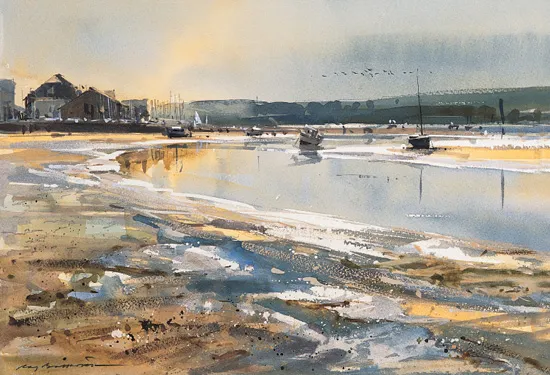
Morning Flight Over the Exe Estuary watercolour 25 × 36 cm (10 × 14 in)
Here the reserved highlights of the white paper contrasted with the soft wet-into-wet washes and the texture created by dry-brush technique give a unique atmosphere and mood of which only this medium is capable.
Over many years I have painted almost every estuary in the West Country. The Exe, being on my doorstep, is still my favourite, but each one is different in its light, mood and colours. Painting at the river’s edge is a real joy, and a subject of which I never tire. What makes it so exciting for me is the ever-changing source of material as the tide sweeps in and out, continually casting a new aspect on both land and water. Watercolour is perhaps the ideal medium as its essence of translucency and expressiveness lends itself beautifully to painting both sky and water.
Thoughtful planning
Although the transient effects of sky and water lend themselves to painting in watercolour, the unpredictability of the medium means that much forward planning is necessary as mistakes cannot be easily remedied. Nevertheless, despite its difficulties, I still find it the most exciting medium to use and when it works it’s magical.
While estuaries make a far prettier sight when the tide is in, it is at low tide that I find the subject most inspiring. The contrasts and textures of sand, wet mud, tide-pools and water give far more possibilities for an interesting composition. The subject also lends itself to combining watercolour and pastel in a mixed media painting in order to fully exploit these contrasts and textures. The transparency and fluidity of watercolour and the opacity and vibrancy of pastel work extremely well together.
Still water and reflections
Whichever medium you choose, in achieving wet-looking water you will need to keep your painting technique simple. Watercolour is the most obvious choice and often a few sweeping brush strokes on damp paper can give an instant impression of still water. However, opaque mediums such as gouache, oils and pastels can also be equally suggestive if simply painted.
The essential characteristic of still water is that it reflects the sky and whatever is close to it in the landscape. Water that is nearer to you always appears darker, as the depth of the water or the ground underneath is the predominant influence on tone and colour. Remember, too, that reflections always have less intensity of both colour and tone than the objects they mirror. A reflection of a dark boat, for instance, will be reflected lighter and vice versa. An object that stands upright in the water produces a reflection of the same length, but if the object leans towards you then it will appear longer. If the object is leaning away from you then the reflection appears shorter.
When the surface of the water is disturbed, reflections break up and appear longer than the reflected object. These broken reflections too follow the laws of perspective. As they recede into the distance they gradually appear smaller, flatter and more closely spaced.
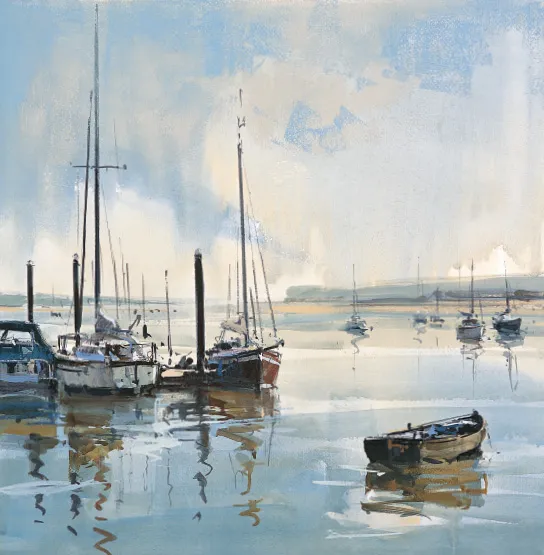
Passing Shower, Topsham mixed media 43 × 43 cm (17 × 17 in)
Tranquillity was the inspiration here and the translucent washes of watercolour add to this feeling. A small amount of pastel was added discerningly to create texture and contrast. It is important not to apply too much pressure on the brush when painting in watercolour. I always liken the correct handling to the brush ‘dancing’on the paper.
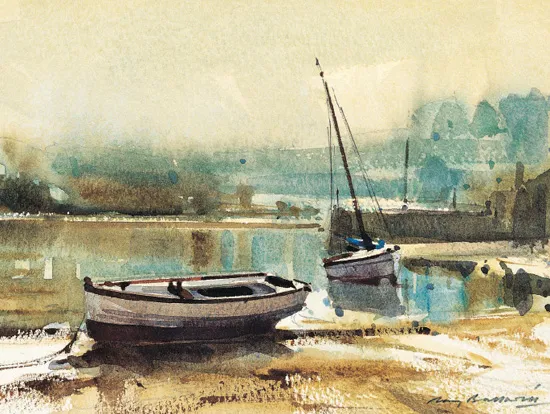
Morning Mist watercolour 13 × 18 cm (5 × 7 in)
This atmospheric painting of the Yealm estuary in Devon shows to good effect a number of the classic watercolour techniques.
Painting water and foreshore
When I am painting estuaries, the wide variety of pattern, texture and colour to be found in sand and wet mud never ceases to amaze me. Sound observation will soon show you that the textural world around you can be very exciting in its unexpectedness. Of course there are many ways of painting water and foreshore, but over the next few pages you will find just a few examples of the techniques that I employ with each medium.
When painting in watercolour, use a large container of water and be sure to refill it regularly.
Be careful not to overwork a technique, as it could easily make the painting too contrived and gimmicky. There are also many products available to help you achieve effects, but my advice is to use these with discretion. However, there are no hard and fast rules and almost endless ways of applying paint to paper, so it is worth experimenting to achieve the effects you require.
Watercolour techniques
Watercolour’s unpredictability and the random effects that can be achieved with it are part of its charm. A few classic techniques are described here to give you a starting point from which to explore further.
Wet-into-wet
This is the perfect technique for suggesting water and reflections. When watercolour is applied to either damp paper or wet paint it merges to give a soft and hazy effect.
Dry brush
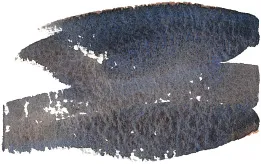
As its name implies, this technique uses a minimum of paint direct from the tube to create a broken colour when applied to a Not or Rough surfaced paper. The paint catches the tooth of the paper, creating a textured effect with economy by a simple brushstroke. I often soften edges by painting over some areas with water. Dry brush is also useful for creating a sparkle on water with white gouache.
Masking fluid
This liquid latex is useful to reserve highlights, particularly when you need to lay a wash over a large area. When it is applied with an old brush to a Not or Rough watercolour paper, the tooth of the paper can be used to good effect to produce texture which will suggest wet, glistening mud, for instance. When the masking fluid is dry it can be removed by rubbing off with a finger.
Granulation
This can produce a subtle grainy texture to a wash, which is useful when placed deliberately in a painting to make large areas more interesting. Certain watercolour pigments have a tendency to granulate (manufacturers’ charts will guide you here), but you can also buy a granulation medium for this purpose.
Spattering
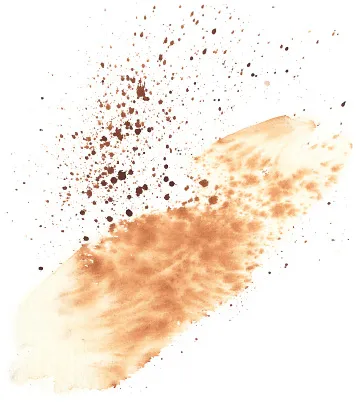
Flicking or spattering paint onto a support is an effective way of suggesting stones, pebbles and textures in sand. This can be done onto dry or damp paper, giving the two completely different effects shown here. For this I used a bristle brush, but for a slightly denser spatter, I tap a loaded brush across the handle of another brush.
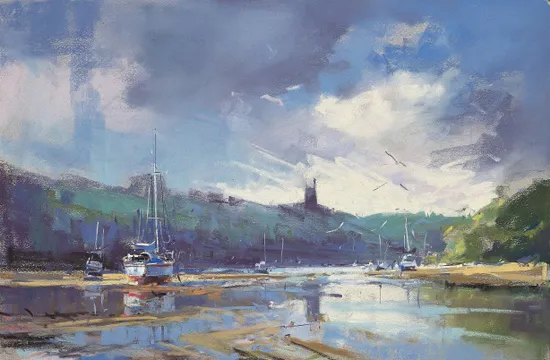
On the Yealm Estuary pastel 37 × 55 cm (14½ × 21½ in)
Blended pastels are the perfect medium for sky and water, as this painting shows. The strong horizontal strokes in the water also impart a feeling of tranquillity to the scene.
Pastel techniques
Although pastels are an opaque medium, similar effects to watercolour can be achieved. It is the choice of support that is the main difference...