![]()
![]()
Into the Frozen North
| WHEN FRIDTJOF NANSEN STEERED HIS SHIP INTO THE PACK ICE NORTH OF SIBERIA ON 20 SEPTEMBER 1893, HE INTENDED TO CATCH AN UNDISCOVERED CURRENT IN THE SEA ICE THAT WOULD TRANSPORT THEM TO THE NORTH POLE. THIS PLAN WOULD FAIL, LEAVING NANSEN AND A COLLEAGUE STRANDED IN THE ARCTIC WASTES FOR FIFTEEN MONTHS. | |
| DATE: 1895–6 SITUATION: ARCTIC EXPLORATION CONDITION OF CONFINEMENT: STRANDED NEAR THE NORTH POLE DURATION OF CONFINEMENT: 15 MONTHS MEANS OF ESCAPE: DOG-SLEDGING, TREKKING, KAYAKING NO. OF ESCAPEES: 2 DANGERS: FREEZING TO DEATH, STARVATION, WILD ANIMAL ATTACK EQUIPMENT: HUSKIES, SLEDGE, SKIS, RIFLES |
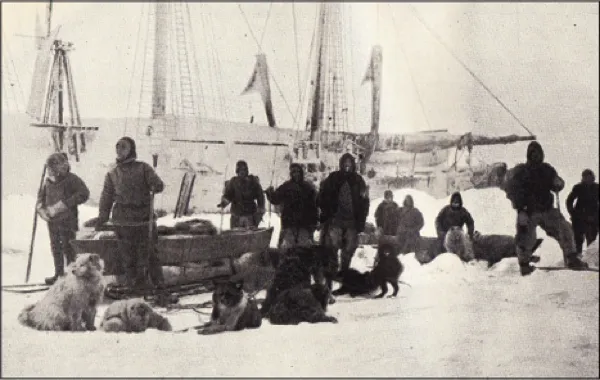
Nansen prepares to leave his ship Fram and begin his sledge journey to the North Pole on 14 March 1895.
Sailing to the North Pole
Fridtjof Nansen was an explorer with a very bold plan. It was 1890 and no man had yet made it to the North Pole. Nansen proposed a mission to do just that, by sailing a boat into the pack ice and using its natural drift to journey north.
There was a scientific basis for this theory. In June 1881 the US Arctic exploration vessel Jeannette was crushed and sunk off the Siberian coast. Wreckage from this ship was later found on Greenland.
Henrik Mohn, a distinguished Norwegian meteorologist, predicted the existence of an ocean current that flowed east to west across the polar sea, possibly over the pole itself. If a ship could be built strong enough it could, in theory, enter the ice by Siberia and simply drift to Greenland via the pole.
Nansen kept this idea in the back of his mind for the next few years as he cut his adventuring teeth. He made a triumphant expedition to Greenland then began to develop a serious plan for a polar venture in earnest.
In February 1890 he presented his plan to the Norwegian Geographical Society. He needed a small, manoeuverable and immensely strong ship. It must be able to carry fuel and provisions for twelve men for five years. He would sail this ship through the North East Passage to where the Jeannette sank and then enter the ice. The vessel would then catch the ice’s natural drift west towards the pole and beyond, eventually coming out into the sea between Greenland and Spitsbergen.
‘an illogical scheme of self-destruction’
Many other experienced explorers laughed at him, including Adolphus Greely, Sir Allen Young and Sir Joseph Hooker.
But Nansen was driven, passionate and eloquent. He persuaded the Norwegian parliament to give him a grant. Several private investors also chipped in and the remaining balance came from a public appeal. Crazy idea or not, he was going to do it.
The mission
Nansen asked Norway’s top shipbuilder, Colin Archer, to create the unique vessel that would take him to the pole. Archer rose to the challenge, building a squat, rounded ship that the ice could not grip. He used South American greenheart, the hardest timber available. The hull was 60–70 cm (24–28 inches) thick, increasing to 1.25 metres (48 inches) at the bow. The ship was launched by Nansen’s wife Eva at Archer’s yard at Larvik, on 6 October 1892, and was named Fram (‘Forward’ in English).
Thousands of men applied to join the expedition, but only twelve could go. Competition for places was so intense that the dog-driving expert Hjalmar Johansen had to sign on as ship’s stoker. Nansen appointed Otto Sverdrup from his Greenland expedition as captain of Fram and his second-in-command.
Fram left Christiania on 24 June 1893, cheered on by thousands of well-wishers, and headed north round the coast of Norway. After a final stop in Vardø, the expedition set out through the North East Passage along the northern coast of Siberia.
These waters were largely uncharted and their progress through the treacherous fog and ice floes was slow. They also spent days hindered by ‘dead water’ where a layer of fresh water lying on top of heavier salt water creates enough friction to stop a boat.
Fridtjof Nansen (foreground) and Hjalmar Johansen.
‘At last the marvel has come to pass—land, land, and after we had almost given up our belief in it!’
Eventually, they passed Cape Chelyuskin the most northerly point of the Eurasian continental mass. Then, on 20 September, Fram reached the area where the Jeannette had been crushed. Nansen followed the pack ice northwards to 78°49’N, 132°53’E, before cutting the engines and raising the rudder.
It would be two and a half years before they were back on the open sea.
Drifting north
To Nansen’s frustration, the ship zigzagged for the first few weeks, rather than moving towards the pole. On 19 November, Fram was actually further south than where she had entered the ice. It was only in January 1894, that she started to progress more steadily north. On 22 March they passed 80° of latitude. But the drift was slow: just 1.6 km (1 mile) a day. At this rate it would take them five years to get to the pole.
Nansen thought of a new plan – to leave the ship at latitude 83° with Hjalmar Johansen and drive a dog sledge to the pole. They would then make for the recently-discovered Franz Josef Land before crossing to Spitsbergen and picking up a ship home. The Fram would meanwhile continue its drift until it popped out of the ice in the North Atlantic.
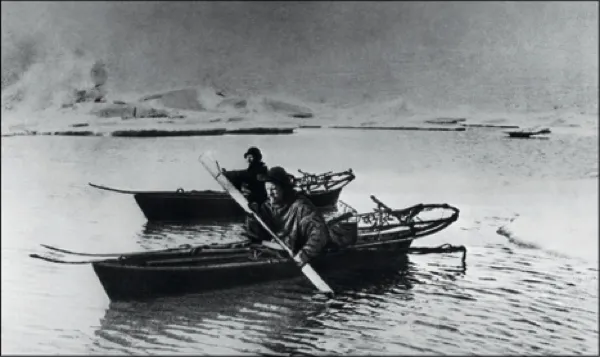
Preparing the clothing and equipment for this plan took up the whole of the 1894–5 winter. The crew built kayaks, which the polar pair would need when they reached open water on the return journey. Nansen also had to master dog-driving, which he practised on the ice.
The sprint for the pole
On 14 March 1895, with the ship’s position at 84°4’N, above Greely’s previous Farthest North record of 83°24’, Nansen and Johansen set out. The men had 356 nautical miles (660 km; 410 miles) of ice between them and the top of the world, and fifty days’ worth of provisions. That meant a daily trek of seven nautical miles (13 km; 8 miles).
At first they set a good pace, averaging nine nautical miles a day, (17 km; 10 miles). But the ice became rougher and their progress slowed. They were also marching against the same drift that had previously carried their ship, in effect pushing them two steps back for every three they took forward.
It was soon clear that they didn’t have enough food to make it to the pole and on to Franz Josef Land. Nansen’s heart must have been breaki...