CHAPTER 1
FEBRUARY 19, 1979. At seven that morning my dad, his girlfriend Sandra and I took off from Santa Monica Airport headed for the mountains of Big Bear. I had won the Southern California Slalom Skiing Championship the day before and that afternoon we drove back to Santa Monica for my hockey game. To avoid another round-trip in the car my dad had chartered a plane back to Big Bear so that I could collect my trophy and train with the ski team. My dad was forty-three. Sandra was thirty. I was eleven.
The Cessna 172 lifted and banked over Venice Beach then climbed over a cluster of buildings in Westwood and headed east. I sat in the front, headphones and all, next to pilot Rob Arnold. Rob fingered the knobs along the instrument panel that curved toward the cockpit’s ceiling. Intermittently, he rolled a large vertical dial next to his knee, the trim wheel, and the plane rocked like a seesaw before leveling off. Out the windshield, way in the distance, a dome of gray clouds covered the San Bernardino Mountains, the tops alone poking through. It was flat desert all around the cluster of peaks, and the peaks stood out of the desert as high as 10,000 feet.
I was feeling especially daring because I had just won the slalom championship and I thought about the big chutes carved into those peaks—concave slides, dropping from the top of the peaks down the faces of the mountains like deep wrinkles. I wondered if they were skiable.
Behind Rob sat my dad. He read the sports section and whistled a Willie Nelson tune that I’d heard him play on his guitar many times. I craned around to see behind my seat. Sandra was brushing out her silky dark brown hair. She’s dressed kind of fancy, I thought.
How long, Dad? I said.
He peered over the top of the newspaper.
About thirty minutes, Boy Wonder, he said. We might get a look at your championship run as we come around Mount Baldy.
Then he stuffed an apple in his mouth and folded the newspaper into a rectangle. He would fold the Racing Form the same way, watermelon dripping off his chin on one of those late August days down at the Del Mar track where the surf meets the turf. We’d leave Malibu early in the morning and drive sixty miles south to ride a few peelers off the point at Swami’s, named for the ashram crowning the headland. If there was a long lull in the waves Dad would fold his legs up on his board and sit lotus, pretending to meditate, embarrassing me in front of the other surfers. Around noon we’d head to Solana Beach, which was across the Coast Highway from the track. We’d hide our boards under the small wood bridge because they wouldn’t fit inside Dad’s ’56 Porsche, then we’d cross the highway and railroad tracks to watch the horses get saddled. When they came into the walking ring Dad would throw me on his shoulders and hand up a fistful of peanuts for lunch. Pick a horse, Boy Wonder, he’d say. Without hesitation he’d bet my horse to win. Once a long shot named Scooby Doo won by a nose and Dad gave me a hundred-dollar bill to spend however I wanted.
The mountaintops appeared higher than the plane. I stretched my neck to see over the plane’s dashboard, clasping the oversized headphones. As we approached the foothills I heard Burbank Control pass our plane onto Pomona Control. Pilot Rob told Pomona that he preferred not to go above 7,500 feet because of low freezing levels. Then a private plane radioed in, warning against flying into the Big Bear area without the proper instruments.
Did you copy that? said the control tower.
Roger, said pilot Rob.
The nose of the plane pierced the first tier of the once distant storm. A gray mist enveloped us. The cabin felt compressed with noise and we jiggled and lurched. Rob put both hands on the steering wheel, shaped like a giant W. There was no way we were going to get to see my championship run through these clouds, I thought. Not even the slopes of Baldy where my dad and I had snagged a couple great powder days last year.
Then the gravity of the other pilot’s warning interrupted my daydream.
I looked back at my dad. He gobbled down the apple core, smacking his lips with satisfaction. His sparkling blue eyes and hearty smile calmed my anxiety about the warning. His face beamed with pride for me. Winning that championship was evidence that all our hard work had finally paid off, that anything is possible, like Dad always said.
Over his shoulder a crooked limb flashed by the window. A tree? Way up here? No way. Then the world turned back to gray. It was just a trick of light.
Dad studied me. His gaze seemed to suspend us as if we didn’t need the plane—two winged men cruising a blue sky. I was about to ask how much longer it would be.
A bristle of pine needles streaked past the window behind him. A shock of green, clawing open the mist. It was snowing now. Then a spiky limb lunged at the window. An evil ugly thing that Dad was unaware of. It sucked all life from the cabin, scorching the scene like a photograph eaten by fire. Suddenly my dad’s face was blotched and deformed.
Time seemed to decelerate as if lassoed by a giant rubber band. Fog pressed against all the windows and there was no up or down, no depth at all, as if the plane were standing still, a toy hanging from a string. The pilot reached down with one hand and spun the knee-high trim wheel. I wanted him to spin the dial faster—we’ll climb faster, away from the trees. But he abandoned the trim wheel and steered the giant W with both hands, jerking us side to side. What about that dial? Should I spin it for him? A branch out the window caught my eye.
Watch out! I yelled, curling my four-foot-nine, seventy-five-pound body up tight.
The wing clipped a tree, sending a thud into my spine, and the plane twisted ass-backwards. We bounced like a pinball off two more trees—metal ripping, the engine revving. I was fixated on the trim wheel. Too late to spin it now….
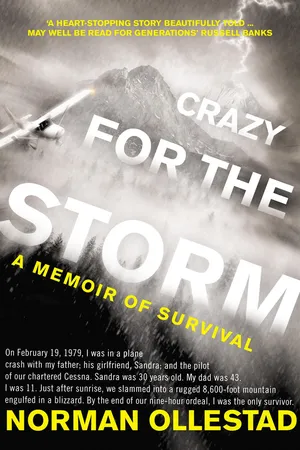
We slammed into Ontario Peak, 8,693 feet high. The plane broke apart, flinging chunks of debris across the rugged north face and hurling our bodies into an icy chute.
We were sprawled amongst the wreckage. Our bodies teetered on the 45-degree pitch threatening to plunge us into an unknown freefall. Exposed to freezing snow and wind, we dangled 250 feet from the top—the distance between life and death.
CHAPTER 2
THE SUMMER BEFORE the crash my grandmother’s washing machine broke. Grandma and Grandpa Ollestad had retired to Puerto Vallarta, Mexico, and the inflated prices for appliances in Guadalajara or Mexico City would have strained their budget. Also, renting a truck and picking up a new machine themselves was a major ordeal in those days. So my dad decided he would go to Sears, buy a new washer and haul it down to Vallarta himself. He would borrow Cousin Denis’s black Ford pickup, cross the border in San Diego and cruise the Baja Peninsula highway all the way to La Paz. He’d take the ferry across the Sea of Cortez to Mazatlán, which was mainland Mexico, then head farther south through the deep jungles, hitting as many of the rumored surf spots as he could before reaching Vallarta.
Hearing this news made me stiffen with fear. I went silent when my mom explained it all to me on our way home from summer school, where she taught second grade and I was preparing for sixth. She didn’t say anything about me having to go but it was in the air—looming—more threatening than if it were a certainty. The idea of baking inside that pickup truck for three or four days and hunting for surf—and worse, finding it and having to paddle out in big waves and float alone out there with just my dad in the vast sea—was not appealing at all. He would be focused on the surf and I would be left to fend for myself. I envisioned my body crushing under the lip of a wave, tossing around, clawing upward, gagging for air.
Mom’s car turned onto the Pacific Coast Highway and I heard the ocean shushing. I was staring at my blue Vans, listening to the Beatles on the eight-track, and I felt carsick and had to look out the window.
We arrived at my mom’s house on Topanga Beach, the southern-most cove in Malibu. The homes were built right on the sand, slapdashed together and teetering at all angles as if shelter were an afterthought, second to the essential need of being on the beach. My dad used to live there also. When I was three he moved across the highway into a cabin on the edge of Topanga Canyon. By the time I was ten I had gathered various tidbits of information, forming a sketchy portrait of what broke up my parents.
Mom complained that sometimes the phone would ring in the middle of the night and Dad would leave without a word and return with no explanation. Mom knew it had to do with Grandpa Ollestad or Uncle Joe, my dad’s half brother, who always needed Dad to save their ass, but Dad wouldn’t talk about it. When Mom protested her exclusion from certain family secrets, my dad just shrugged it off. He would go surfing or simply walk away if my mom persisted. The final straw had been when my dad secretly loaned Uncle Joe money from Mom and Dad’s joint savings account and then refused to tell my mom why. Right after this incident a French guy named Jacques came to visit. He was a friend of a friend of Dad’s. My dad had just gone through major knee surgery and could barely move around, so he loaned Jacques a surfboard and called out instructions from the porch, using his crutch to guide Jacques to the takeoff spot. Dad didn’t have the strength to show Jacques around Malibu, so Mom took him to Point Dume—a chain of pristine coves—and to Alice’s restaurant on the pier, and to the Getty Museum. After Jacques went back to France Dad stopped coming home at night. This lasted a couple of weeks. Then he returned for a few days, until he finally moved his stuff into the cabin across the highway.
Mom started hanging out with a guy named Nick. Right from the get-go Nick liked to mix it up, which was the opposite of my dad, who was reluctant to fight with my mom. Nick and Mom had spectacular clashes in front of everyone on the beach. It wasn’t that abnormal really—a lot of people on Topanga Beach who were married were kissing other people, fighting with their new boyfriends or girlfriends, and suddenly moving into other houses. It was an incomplete picture of what went wrong between Mom and Dad. Something was obviously broken, that’s all I knew, and was forced to accept it.
Mom parked the car in the garage and I immediately found my three-legged golden retriever Sunshine. She was waiting on the outdoor walkway that ran along the side of our house. Sunny and I ran to the porch, jumped over our beach stairs and ambled up the beach to the point—a curve of sand that came to a tip at the north end of the cove.
Two girls my age cantered their horses bareback through the waves washing along the shore. I held Sunny so she wouldn’t spook the horses. The girls lived up the canyon in the Rodeo Grounds, below where my dad lived, and as always we just waved to each other. The horses kicked up salt water onto the girls’ legs, which shimmered in the late afternoon light.
When they disappeared up the mouth of the canyon I threw Sunny’s stick into the surf. A blond dude with a long beard dressed in full Indian garb did a rain dance toward the setting sun. He reminded me of Charles Manson, who was always hanging around the beach when I was a baby, and used to serenade my aunt while she rocked me in her arms on our beach stairs.
Good thing I never went up to that commune he kept talking about, my aunt said when she told me the story.
After dinner I tried to fall asleep to the crashing waves. I read the Hardy Boys to help take my mind off the trip to Mexico. Later I woke and made a tent with my covers and played a spy game, radioing secret information to headquarters via the rusted posts of my old brass bed. Sunshine lay curled at the foot of the bed and guarded our hideout. I petted her and told her about how I hated having to surf, hating not being able to play all weekend like the kids in the Pacific Palisades.
I often complained to my dad about not living in a neighborhood. He told me that one day I’d realize how lucky I was living right on the beach, and that since Eleanor (my unofficial godmother) lived in the Palisades and I got to stay there sometimes, I was doubly lucky.
But she doesn’t have a pool, I said, and Dad rebutted that I had the biggest pool in the world right in my own front yard.
Before I was born my mom used to work at Eleanor’s nursery school, Hill’n Dale, and my parents became close friends with Eleanor and her husband Lee. I started going to Hill’n Dale when I was three and Eleanor immediately lavished me with attention. We have the same birthday, May 30, she liked to tell everyone. Ever since the first grade I had walked the two blocks from grammar school to Hill’n Dale, hanging out there until my mom or dad picked me up after work. All those years of seeing Eleanor practically every day made me think of her as my other mother, and I told people so.
Morning brought good news—my dad had to prepare a malpractice case with his law partner Al before leaving for Mexico so I wouldn’t have to surf this weekend, and Sandra would be joining my dad on the trip to Mexico. The odds of not having to go were now heavily in my favor. I was so dizzy with relief that I didn’t realize what Nick had in store for me until it was too late. Nick had been living with my mom for several years by now and he talked about mouthpieces and jabs and said that Charley, the only boy my age still living on the beach, was coming over. I was preoccupied, basking in a heaven devoid of Mexico and teeming with sleepovers and birthday parties and frosted cakes.
The sand was hot and white. It was August and the fog was long gone and the sun beat down. Nick and his friend Mickey drank beer and drew a circle in the sand.
That’s the boxing ring, said Nick. Don’t step outside the ring or you’ll be automatically disqualified.
Everybody said Nick looked like Paul Newman. He was taller than my dad and didn’t have broad shoulders—I had decided it was because he didn’t surf. He was different from my dad in a lot of other ways too. He would never dance at parties like my dad always did. And Nick didn’t play any instruments like my dad, or sing—stuff Dad learned to do when he was a child actor. Dad was in the classic Cheaper by the Dozen, acting in several films and TV shows through his early twenties. On a show called Sky King Dad played a mechanic, which was funny because he couldn’t fix anything, not even my bike. And I couldn’t imagine Nick running a summer cheerleading camp like my dad did. That’s how Dad met my mom—he was recruiting song girls to teach at his camp and my mom was staying with one of the song girls in an apartment in Westwood by UCLA. It was 1962. Dad had just resigned from the FBI and was working as an assistant U.S. attorney under Robert Kennedy. He and his friend Bob Barrow, who grew up near Dad in South Los Angeles, cooked up the idea of organizing a summer cheerleading camp as a way to make some extra money and meet college girls. Dad would teach the girls dance routines in the mornings before suiting up and going into the Department of Justice.
On their first date Dad took my mom to Topanga Beach. He played guitar for her and convinced her to paddle out surfing with him. They got married a year later, moving into a house on the beach.
Mickey helped Charley and me string up our boxing gloves. Mine had been acquired in a trade for my Raggedy Ann doll with a boy who was moving from the beach. This went down following a particularly tyrannical evening with Nick after which I had announced my desire to learn how to box. Then a few days later, as if to show that he was unfazed by my sudden urge to box—an obvious gesture meant to protest Nick’s drunken rages—Nick put together this little bout between Charley and me.
It’ll be good for you,...