![]()
1 The elements of architecture
Evidence of the great historical styles of the past is all around us. Whoever built your home was working within a tradition – even if at first sight it might seem as though there is nothing special about it. For every house, in every style, belongs to the developing history of architecture. With careful analysis of what you see every day, you can step into the world of architectural history, and begin to appreciate the many beauties of the buildings of our towns and cities.
Analysing your home
The first step towards understanding architectural history is to analyse exactly what you see around you. What are the major component parts that your house is made of? What do they look like, and how were they put together?
Walls and roofs
If your house is built with plain brick or plastered walls, the chances are that you have never given them much thought. And yet these are the most important parts of any home. The purpose of a house from the beginning of time has been to build somewhere that is protected from the elements. The very first houses were shelters created out of whatever material was available. In England, with its dense woodlands, sections of tree trunks were tied together to form a rigid tent, and its surface was covered with woven twigs and leaves. Sometimes walls were built up using mud and clay. Once sturdier materials could be moved from place to place, the first upright masonry walls began to appear.
The wall and the roof are still the most important elements in architecture, and very probably their appearance was the first thing that the builder of your house decided on.
The walls
Step outside your home and look carefully at the surface of the outer walls:
• is it made of timber?
• is it made of brick?
• is it made of stone?
• is it covered in plaster, or render?
• is it made from a concrete frame?
The location of your house may well account for the material of the outer face of the walls. It is only comparatively recently in the history of architecture – for most people, less than two hundred years – that it has been economically viable to move heavy building materials around the country. Well into the twentieth century such expensive transportation was still avoided if possible. That means that in most cases the surface of the walls will be made from a material that can be found locally. If you live in a more recent home, you need only look at the fronts of older buildings to get a clear idea of what the local building material is.
Timber walls
Walls built with timber frames are comparatively rare in Britain, although many have survived from hundreds of years ago. Originally, numerous houses were built with timber frames and covered with timber clapboarding, but as brick and stone became increasingly available, and because the priority in a wet country was to keep warm and dry, the timber cladding was often later replaced with brick. On the other hand, when English settlers arrived in the Americas in the sixteenth and seventeenth centuries, they found plentiful supplies of timber which could be easily felled and worked. The result was a style of architecture which has remained popular ever since, especially on the east coast of the United States.
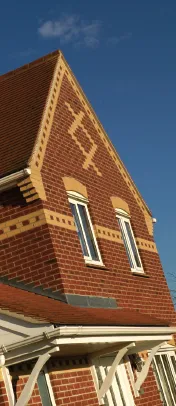
Builders traditionally used local building materials, which accounts for the wonderful variety of brick and stone in our houses. This modern house echoes that tradition.
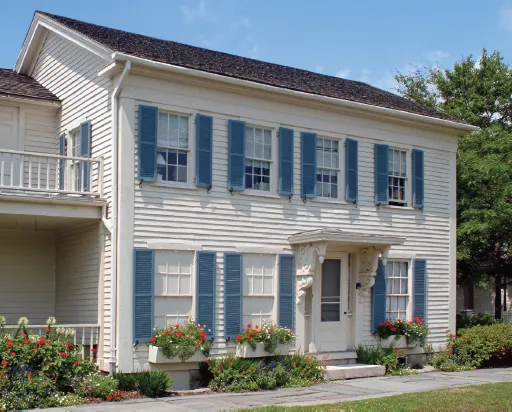
English settlers in the New World used plentiful local timber to build in a way that was familiar from home.
A timber frame with timber cladding is not necessarily inferior to masonry construction. Units can be prefabricated and transferred quickly and cheaply to site, and because of their natural appearance can easily blend in with any other local material. Nowadays, thermal insulation standards can be met with thick layers of mineral wool or other modern materials, and so the protective properties of the external layer are less important than they were traditionally. In fact, the Nordic countries with their plentiful forests make great use of timber-framed, timber-clad structures for modern high-quality housing, and it is likely that their use will spread.
Brick and stone
The most solid building materials are found under the earth. In Britain, there is a large selection of stones and clays which have provided a tremendous variety of building materials. In the south-east of the country, around London, the clay is just right for making bricks, and so for many people who have seen the characteristic rows of houses in the capital, England is a country of brick. But there is also a long belt of limestone that stretches across the land from Dorset in the south-west up to Yorkshire in the north-east. This provides the varied and attractive stones that characterize the architecture of much of the centre of the country. There are also coloured sandstones in the west and north-west.
Because the wall is the most important part of any house, builders will have to adapt their work to the natural properties of the material. Brick can be cast into small units. Most limestones can be easily cut and carved into blocks, sometimes into the largest units that can be comfortably manoeuvred into place by a mason working alone. And because the dense granites of the far north and west of the country are so difficult to cut and so inconvenient to move around on a building site, the architecture of those regions is correspondingly plain and massive.
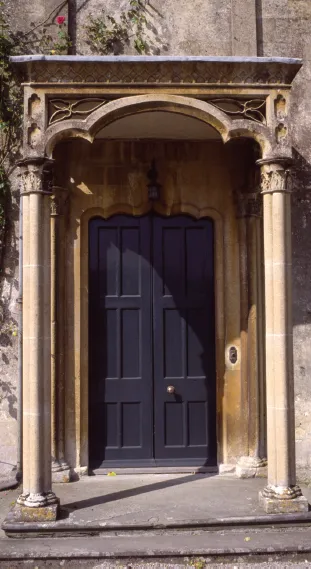
Most kinds of limestone used in building are well suited for decorative carving.
Rendered walls
Quarrying and working with stone is always going to be a relatively expensive part of the building process, and yet in many countries the local clay is not suitable for making good quality wind- and rainproof bricks. The solution is to cover a wall with a thick mix of plaster, properly known as render, usually based on gypsum or more commonly lime mixed with other materials including sand or gravel. In some areas, including for example those parts of Scotland where an expensive granite is the local natural building material, one can see a great deal of housing built of cheap bricks or blocks which are protected against the rain by a thick layer of render.
Although a rendered wall is therefore a comparatively cheaper solution, it does have many advantages. It can be painted in cheerful colours, and in some parts of England, especially East Anglia, the surface was often decorated by pressing it when wet with patterned wooden moulds. This is known as pargetting.
Concrete walls
Concrete walls – usually, in fact, concrete frames with panels made from other materials – are the result of architectural fashion rather than of natural circumstances. If you live in a building such as a block of flats from the 1950...