![]()
PART ONE
The land of the Greeks
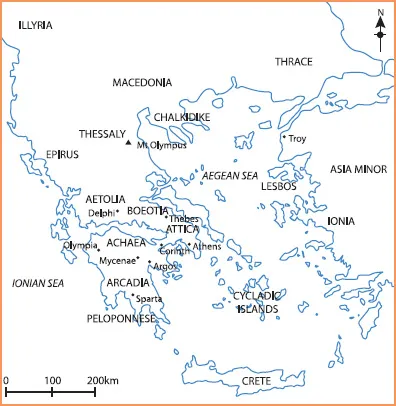
The world of the ancient Greeks extended much further than mainland Greece, with the establishment of Greek colonies throughout the Mediterranean region and the Black Sea. Greece itself was not a single united country, but a host of independent city-states that shared a common culture.
The most powerful city-state
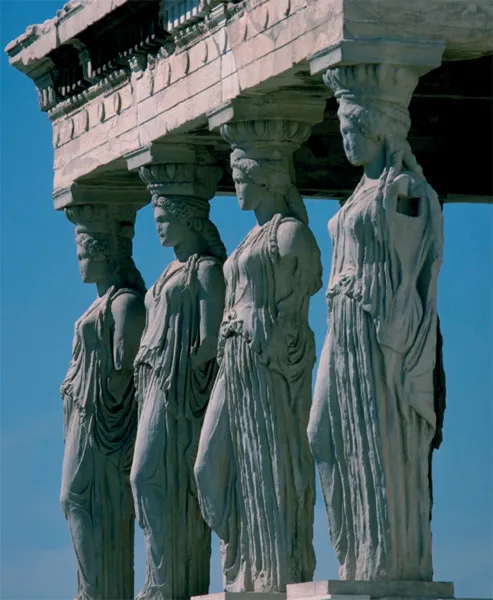
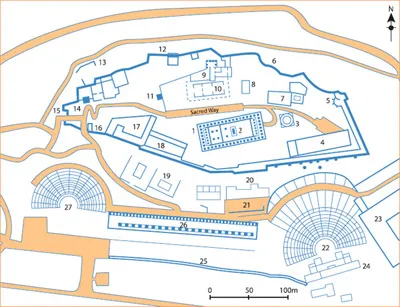
Athens, dominated by the temple of the Acropolis, was the most important of all the Greek city-states.
![]()
THE GREEK WORLD
Situated in the central Mediterranean, with easy access by sea to Egypt and north Africa, Asia Minor and what is now modern western Europe, Greece was positioned ideally as a centre of trade and cultural exchange. Its mountainous landscape, meanwhile, made invasion by outsiders difficult and allowed the various small city-states to develop in relative peace and largely independent of their neighbours.
COLONIZATION
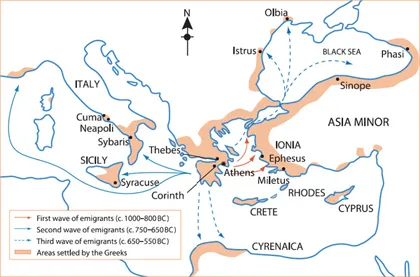
Hot, dry and mountainous, mainland Greece offered little good farmland, so from an early date the Greeks explored far afield in search of places where they could grow crops to feed the population. Colonization of coastal areas throughout the Mediterranean and Black Sea region increased from around 750 BC, spreading Greek influence the length and breadth of the known world. By 600 BC, there were some 1,500 Greek colonies around the Mediterranean.
Thriving colonies were also established to the north and east, in what is now modern Bulgaria and Turkey, as well as on numerous islands in the Aegean Sea. There was also a strong Greek presence in north Africa, southern Italy, Sicily and southern France.
GREEK CULTURE
Everywhere the Greeks went, they took their culture with them, building temples, establishing trade links and communicating their ideas about religion, art, science and philosophy.
![]()
GREEK CITY-STATES
Greece was not one united country but a collection of independent city-states, all of which had their own patron gods, laws and constitutions. The first communities grew up where there was a good water supply and suitable farmland. These small communities later combined to form the first city-states, which typically included a city (usually a seaport) and the surrounding land with its villages and farms.
FIERCE INDEPENDENCE
Each city-state (or polis – hence the word ‘politics’) developed its own distinctive character. Cities were usually separated from their neighbours by mountains, valleys or the sea, which limited contact between them. However, city-states traded enthusiastically with each other and shared the same language, religion and other cultural features. Citizens were fiercely loyal to their particular state and, if called upon, would fight to defend their homeland. If attacked, citizens retreated to the acropolis (a citadel or walled area at the highest point of the city). The development of Greek civilization was regularly interrupted by squabbles between neighbouring states, although on rare occasions they allied to resist invasion by foreign armies (namely, against the Trojans in the late twelfth century BC, the Persians in the fifth and sixth centuries BC and Alexander the Great in the fourth century BC).
ATHENS
Athens was the largest and most powerful of the ancient city-states. At its peak in the Classical Period, it had over 250,000 inhabitants and was a centre of culture and learning. Named after its patron, the goddess Athena, it developed around a hill called the Acropolis, which was originally a fort but later became the religious heart of the state and the site of the Parthenon and other temples.
Athenian culture
The Athenians were responsible for many of the great advances of ancient Greek civilization, from democracy to philosophy and the theatre. It was home to celebrated philosophers, politicians and artists, and was a thriving trading centre, with business being conducted in its marketplace (the agora). The funds provided by such trade paid for the construction of many great buildings and other treasures for which Athens became famous.
Defence
The Athenians possessed a large fleet and forged alliances with other states around the Aegean Sea. Their army was less strong, however, and was run on a part-time basis, with ordinary citizens being expected to help defend the state when it was attacked.
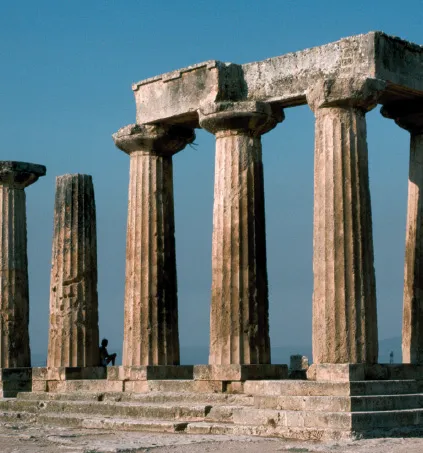
The temple ruins at Corinth, which was second only to Athens among the Greek city-states.
CORINTH
The city-state of Corinth was situated in southern Greece, in the Peloponnese region on the Isthmus of Corinth. It was first settled some time before 3000 BC and emerged as a thriving centre for trade during the eighth century BC. In due course, it became the second largest and richest of the Greek city-states, after Athens. Rivalry between Corinth and Athens eventually led to the Peloponnesian War. Corinth was destroyed by the Romans in 146 BC.
CRETE
Crete, the largest of all the Greek islands, was an independent territory in the eastern Mediterranean. It was colonized around the sixth millennium BC and became home to the powerful Minoan civilization. Many Minoan relics have been found on the island, notably the royal palace at Knossos. Crete traded with many other Greek states but otherwise kept out of their quarrels and had little impact on later Greek civilization, although Cretan pirates were much feared. The island fell to Rome in 67 BC.
EPHESUS
Ephesus was a Greek city-state in Ionia, on the west coast of Asia Minor. An important trading centre, it thrived under the Persians, against whom it had waged war previously, and subsequently under the Romans. Its glories included a huge temple that was dedicated to the goddess Artemis. It was sacked by the Goths in 262 AD.
MILETUS
Miletus was an Ionian city-state that was founded around 1000 BC. Its early wealth was based on the trade in wool. Its enterprising merchants forged many links throughout the region and promoted Greek ...