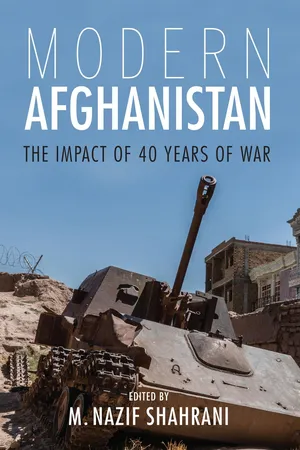
What impact does 40 years of war, violence, and military intervention have on a country and its people? As the "global war on terror" now stretches into the 21st century with no clear end in sight, Identity and Politics in Modern Afghanistan collects the work of interdisciplinary scholars, aid workers, and citizens to assess the impact of this prolonged conflict on Afghanistan. Nearly all of the people in Afghan society have been affected by persistent violent conflict. Identity and Politics in Modern Afghanistan focuses on social and political dynamics, issues of gender, and the shifting relationships between tribal, sectarian, and regional communities. Contributors consider topics ranging from masculinity among the Afghan Pashtun to services offered for the disabled, and from Taliban extremism to the role of TV in the Afghan culture wars. Prioritizing the perspective and experiences of the people of Afghanistan, new insights are shared into the lives of those who are hoping to build a secure future on the rubble of a violent past.
- 456 pages
- English
- ePUB (mobile friendly)
- Available on iOS & Android
eBook - ePub
About this book
Information
PART I:
TECHNOLOGIES OF POWER—COMPETING DISCOURSES ON NATIONAL IDENTITY, STATEHOOD, AND STATE STABILITY
1
AFGHANISTAN: A TURBULENT STATE IN TRANSITION
Amin Saikal
AFGHANISTAN IS THE only country in the world with the dubious reputation of having been invaded by all three major powers—Great Britain, the Soviet Union, and the United States—over the last one-and-a-half centuries. Yet, all these powers have failed to tame the country and to shape it according to their ideological and geopolitical preferences. At the close of 2014, the United States and its allies withdrew most of their troops from Afghanistan, leaving only limited contingents for two years, although President Donald Trump decided to increase the number of American troops, with an emphasis on ‘killing terrorists’ and enhancing pressure on Pakistan to halt its support for insurgent Taliban and their affiliates. Afghanistan was once again placed in the throes of a major political, economic, and security transition. At the time of the withdrawal, the country remained domestically fragile and externally vulnerable, with the Taliban-led insurgency maintaining a robust posture. As such, it was not clear where this transition would eventually take the country. Many questions remained about the fate of Afghanistan and the impact that the ongoing conflict has had on the country’s socially divided and multifaceted society since the communist coup of April 1978.
The US invasion of Afghanistan has not been the first attempt by an international superpower to steer the course of Afghanistan’s future. Yet it has given rise to a cluster of problems that need to be considered both in their specific context and in comparison with other modern military interventions. After providing the necessary historical background to the US-led intervention in Afghanistan, this chapter focuses on the contemporary set of problems in Afghanistan, mainly until the advent of the National Unity Government in September 2014 through four major interrelated issues. The first is the intervention’s original goals and its conduct. The second is the capability of the Afghan security forces to deal with the Taliban-led insurgency. The third is the set of common variables that impeded success in the US involvement in Vietnam, the Soviet occupation of Afghanistan, and finally, the US experience in Afghanistan. The fourth is possible directions that the Afghan situation may take in the coming years.
Background
Landlocked Afghanistan is often described as a country important largely because of its strategic location, as it is sensitively situated at the crossroads of Central, South, and West Asia, as well as the Far East. This location has proved to be both an asset and a curse for the country. It has led scholars to describe Afghanistan as a potential “hub of connectivity,” part of “the heartland of Eurasia,” a “geographical pivot of history,” a “highway of conquest,” and at the same time, “unconquerable” and a “graveyard” for those powers that have sought to dominate it.1 Beyond its geostrategic value, the country has historically had little to offer to the outside world in terms of either human or natural resources. However, this situation may change with Afghanistan’s recent claim that it possesses US$1 trillion worth of valuable minerals buried deep under its harsh and treacherous terrain (Risen 2010).
Afghanistan has indeed lived up to all of these descriptions at different moments since its consolidation as a state in 1747. Neither the two British imperial expeditions in the country (1839–1842, 1878–1880) nor the Russians’ counterefforts to subdue Afghanistan as part of what Rudyard Kipling popularized as the “Great Game” between the two imperial powers for domination in Central Asia, came to any good for the imperial predators (Kipling 1901). Nor did the Soviet occupation of Afghanistan in the 1980s succeed in transforming the country into a stable socialist state, as had been desired. If anything, the Soviet adventure was a major disaster for both the Afghan people and the Soviets.2 It shattered many Afghan traditional social institutions and formations without replacing them with durable alternatives. The invasion also enabled the Soviets’ adversaries, the United States in particular, to give back to the Soviet Union what they had helped to inflict on the United States in Vietnam a decade earlier—a humiliating defeat. The United States’ support of the Afghan Islamic resistance forces, the mujahideen, was instrumental in defeating Afghanistan’s Soviet-sponsored communist government. Yet, it also resulted in the empowerment of a new breed of armed and wealthy strongmen who have popularly become known as warlords, endowed with protection, dispensation, and patronage capabilities. These figures effectively eclipsed the influence of the traditional power holders in Afghan society, who derived their prowess from landed and conservative religious and social structures, and operated either in alliance with an almost perpetually weak central government, or in cahoots with one another.
The Soviet departure, and the concomitant US claim of the triumph of liberalism over communism and of capitalism over socialism, was accompanied by the superpowers’ abandonment of postcommunist war-torn Afghanistan. Left to their own devices and at the mercy of their neighbors, especially Pakistan, the Afghans were in a fractious state. The result was internecine conflict between various mujahideen groups, as well as Pakistan’s “creeping invasion” of Afghanistan, which eventually empowered the medievalist Islamic Taliban and transformed Afghanistan into a hub for international terrorism. Had it not been for the September 11, 2001 Al Qaeda terrorist attacks on the United States, Afghanistan would likely have remained subject to the dark, Pakistan-backed rule of the Taliban for many more years.
These outside rivalries and interventions have historically interacted with the mosaic ethno-tribal and sectarian Afghan society, whose people have been mostly traditional, illiterate, and fiercely, although not radically, Muslim. In conjunction with the emergence of strongmen and royal polygamy—which caused intense interdynastical rivalries lasting at least until 1978—Afghanistan’s social diversity has played a key role in holding the Afghans back from building strong domestic structures and institutions, and from forging an enduring national unity (Saikal 2012, chaps. 4, 6, 9). The country’s internal fragility has, in turn, rendered it vulnerable to periodic domestic rebellions and external interventions. Rule by strongmen and the personalization instead of institutionalization of politics, interrupted by a few periods of relative peace and stability (especially from 1930 to 1978), became a dominant feature of the country. Afghanistan thus evolved as a weak state in dynamic relations with strong microsocieties that functioned in loose relationships with one another and the central authority in Kabul (see Shahrani 1986, 23–74).
The underlying institutions that could ensure the growth of a viable and enduring political order that would underpin stability and continuity as well as effective social and economic development, remained persistently unsolidified. In general, poor governance, patronage, corruption, human rights violations, dependence on foreign aid, and stunted social and economic reforms remained the hallmark of national life in Afghanistan. The progress achieved during the longest period of relative tranquility in modern Afghan history (1930–1978) was limited in scope and was managed within an informal triangular relationship between the ruling royal elite, the local strongmen, and the religious establishment, and in compliance with the political needs of those in positions of power and authority. The emergence of a small group of intelligentsia under any particular regime was invariably suppressed or decimated by the succeeding political and ideological cluster, depriving Afghanistan of the very asset that it badly needed to move it beyond stagnation and backwardness.
The US-Led Intervention
Against this historical backdrop, the United States launched its military campaign, with a seemingly promising start. The immediate goals of the campaign were to oust the Taliban, to destroy the Al Qaeda terrorist network, and to capture the latter’s leader, Osama Bin Laden. The first goal was rapidly achieved. Al Qaeda’s leadership and fighters were dispersed, potentially opening the way for building, as President George W. Bush put it, a new stable, secure, prosperous, and democratic Afghanistan, so that the country would never again be a hub for extremism and terrorism (Saikal 2013). An interelite Afghan settlement under the auspices of the United Nations (UN), without the Taliban’s participation but with the determining influence of Washington and the cooperation of Tehran, was forged in Bonn by December 2001 (Saikal 2014b, chap. 3). This agreement delivered a coalition administration under the leadership of a little-known ethnic Pashtun with some appealing credentials, Hamid Karzai. It also legitimized the interventionist role of the UN as well as the United States and its allies in Afghanistan. Meanwhile, Washington prompted Pakistan’s military ruler, General Pervez Musharraf, to declare Pakistan’s support for the United States against its clients, the Taliban and Al Qaeda, and for what President Bush declared as America’s wider war on terror.
While the United States quickly removed the Taliban from power, they did not succeed in defeating them or their supporters. This was in part due to the United States’ inability to exert enough pressure on Pakistan to cut all its ties with the Taliban and restructure its Afghanistan policy in support of US efforts toward stabilization and reconstruction. The Taliban and their affiliates, most importantly Al Qaeda, simply melted away into the treacherous landscape of Afghanistan and across the border into Pakistan to fight another day. Islamabad ostensibly sided with America in return for massive economic and military aid, but ultimately found it expedient to keep its organic links with the Taliban as leverage to shape US involvement in Afghanistan in line with its own strategic interests. In addition, the United States remained too focused on fighting the so-called war on terror, a battle that soon became as elusive as its targets. At the same time, the Bush administration developed an obsession with toppling the regime of America’s old foe in Iraq, Saddam Hussein, as a precondition to consolidating the objectives for which it had invaded Afghanistan.
Today, more than three thousand American and allied soldiers have been killed and thousands more injured and diseased in the theater of the war. US$1 trillion have been spent on military operations and some US$100 billion on Afghanistan’s reconstruction, not to mention the incalculable loss of Afghan lives and property. Yet, Afghanistan is still far from reflecting America’s original main objectives (Saikal 2014b, chap. 2). This is not to claim that certain infrastructural, telecommunications, and social and civil society developments have not taken place. On the contrary, Afghanistan today has a larger pool of young educated people, with greater political and social awareness who are capable of doing the heavy lifting for a better future, and who deserve to be given the necessary opportunity to do so. The country’s smaller minorities, who belong to ethnic groups other than the largest Pashtun cluster, which comprises around 42 percent of the Afghan population and to whose rival tribes many members of the Afghan ruling elite and the Taliban belong, are empowered to play a greater role in their country than at any time previously.3 Afghanistan has also been put on a very basic and shaky but nonetheless electoral process of governance. This was largely reflected in the April 2014 presidential election to replace Karzai, when some seven million Afghans out of the twelve million who had registered to vote cast their ballot for an electoral transfer of power for the first time in Afghan history. As flawed as that ballot may have been, it represented the wish of the Afghan people for the creation of a popularly sanctioned, credible government. In addition, Afghanistan has achieved possibly the highest level of freedom of expression and media in the region.
Yet, the country remains mired in instability, insecurity, poverty, patronage, corruption, national divisions, and a culture of drugs and deception, with the influence of strongmen pervasive throughout the country and electoral fraud continuing to plague the nation. While the first round of the 2014 presidential election was promising, with Abdullah Abdullah and Ashraf Ghani emerging as frontrunners with 45 percent and 32 percent, respectively, the runoff between the two was marred by widespread fraud. As Abdullah challenged the preliminary results of the runoff that favored Ghani by a large margin, a potentially devastating dispute began to loom. This prompted US secretary of state John Kerry to make an emergency visit to Kabul where he secured the agreement of Abdullah and Ghani to an audit of all the votes and to the formation of a “National Unity Government,” irrespective of who won the election.4
Given the rising costs of the war and complexity of the Afghan situation, the United States and its allies found it expedient, as far back as 2009, to disentangle themselves from what had shaped up to be an “Afghan trap.” The war had become the longest the United States had fought over the last century. The US government and allied pa...
Table of contents
- Cover
- Half Title
- Title
- Copyright
- Dedication
- Contents
- Preface
- Acknowledgments
- Maps
- Introduction: The Impact of Four Decades of War and Violence on Afghan Society and Political Culture / M. Nazif Shahrani
- Part I: Technologies of Power—Competing Discourses on National Identity, Statehood, and State Stability
- Part II: Personal and Collective Identities, Gender Relations, and the Trust Deficit
- Part III: Adapting to a New Political Ecology of Uncertainties at the Margins
- Part IV: Violence, Social Services Delivery, and the Rising Trust Deficit
- Index
- Back Cover
Trusted by 375,005 students
Access to over 1.5 million titles for a fair monthly price.
Study more efficiently using our study tools.
Frequently asked questions
Yes, you can cancel anytime from the Subscription tab in your account settings on the Perlego website. Your subscription will stay active until the end of your current billing period. Learn how to cancel your subscription
No, books cannot be downloaded as external files, such as PDFs, for use outside of Perlego. However, you can download books within the Perlego app for offline reading on mobile or tablet. Learn how to download books offline
We are an online textbook subscription service, where you can get access to an entire online library for less than the price of a single book per month. With over 1.5 million books across 990+ topics, we’ve got you covered! Learn about our mission
Look out for the read-aloud symbol on your next book to see if you can listen to it. The read-aloud tool reads text aloud for you, highlighting the text as it is being read. You can pause it, speed it up and slow it down. Learn more about Read Aloud
Yes! You can use the Perlego app on both iOS and Android devices to read anytime, anywhere — even offline. Perfect for commutes or when you’re on the go.
Please note we cannot support devices running on iOS 13 and Android 7 or earlier. Learn more about using the app
Please note we cannot support devices running on iOS 13 and Android 7 or earlier. Learn more about using the app
Yes, you can access Modern Afghanistan by M. Nazif Shahrani in PDF and/or ePUB format, as well as other popular books in History & Military & Maritime History. We have over 1.5 million books available in our catalogue for you to explore.