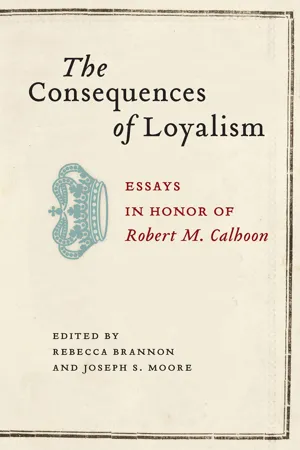
This anthology examines the role of Loyalism in the American Revolution, building on the pioneering work of historian Robert M. Calhoon.
Calhoon's work on American Loyalists redefined their role in the Revolution, showing them to be dynamic figures adapting to a society in upheaval. In
The Consequences of Loyalism, editors Rebecca Brannon and Joseph S. Moore shed light on Calhoon's foundational influence and explore the continuing scholarship in the wake of his prolific career.
This volume unites sixteen previously unpublished essays that build on Calhoon's work and consider Loyalism's relationship to conflict resolution, imperial bureaucracy, and identity creation. In the first of two sections, scholars discuss the complexities of Loyalist identity, while considering Calhoon's earlier work. In the second section, scholars work from Calhoon's later publications to investigate the consequences of Loyalism both for the Loyalists, and for the legacy of the Revolutionary War.
This book brings Loyalist dilemmas alive, digging into their personalities and postwar routes. Loyalists from all facets of society fought for what they considered their home country: women wrote letters, commanders took to the battlefield, and thinkers shaped the political conversation. This volume complements Calhoon's influential work, expands the scope of Loyalist studies, and opens the field to a deeper, perhaps revolutionary understanding of the king's men.
eBook - ePub
The Consequences of Loyalism
Essays in Honor of Robert M. Calhoon
- 344 pages
- English
- ePUB (mobile friendly)
- Available on iOS & Android
eBook - ePub
The Consequences of Loyalism
Essays in Honor of Robert M. Calhoon
About this book
Trusted by 375,005 students
Access to over 1.5 million titles for a fair monthly price.
Study more efficiently using our study tools.
Information
Notes
ABBREVIATIONS
AO | Audit Office Papers, TNA |
DLAR | David Library of the American Revolution |
HSP | Historical Society of Pennsylvania |
NARA | National Archives and Records Administration |
NCA | State Archives of North Carolina |
NHPL | Petitions to the Legislature, New Hampshire State Archives |
NHPSP | New Hampshire Provincial and State Papers, Nathaniel Bouton et al., eds. (Concord, NH, 1874–96) |
NSA | Nova Scotia Archives |
NYHS | New-York Historical Society |
NYPL | New York Public Library |
PRO | The Public Record Office, TNA |
PYM | Philadelphia Yearly Meeting (Arch Street) Meeting for Sufferings, Minutes 1775–1785, Haverford Special Collections, Pennsylvania |
SRNC | The State Records of North Carolina, vols. 11–25, ed. Walter Clark (Raleigh: P. M. Hale et al., 1886–1907) |
T | Treasury Papers, TNA |
TJP | Thomas Jefferson Papers |
TNA | The National Archives of UK |
WMQ | William and Mary Quarterly |
INTRODUCTION
1. Ruma Chopra, “Enduring Patterns of Loyalist Study: Definitions and Contours,” History Compass 11, no. 11 (2013): 983.
2. John Adams to James Lloyd, January 28, 1815, Founders Online, National Archives, last modified July 12, 2016, http://founders.archives.gov/documents/Adams/99-02-02-6401 [accessed July 24, 2016]; Henry Laurens to Edward Bridgen, Nantes, August 10, 1782, in The Papers of Henry Laurens, 16 vols., ed. Philip M. Hamer, George C. Rogers, and David R. Chesnutt (Columbia: Published for the South Carolina Historical Society by the University of South Carolina Press, 1968–2003), 15: 554–55.
3. Robert M. Calhoon, The Loyalists in Revolutionary America, 1760–1781 (New York: Harcourt Brace Jovanovich, 1973), ix; Paul H. Smith, “The American Loyalists: Notes on Their Organization and Numerical Strength,” WMQ 3rd. ser., 25, no. 2 (1968): 267–70.
4. Maya Jasanoff, Liberty’s Exiles: American Loyalists in the Revolutionary World (New York: Knopf, 2011), 351–358; Philip Ranlet, “How Many American Loyalists Left the United States?” Historian 76, no. 2 (2014), 291–306.
5. Patrick Spero and Michael Zuckerman, eds., The American Revolution Reborn (Philadelphia: University of Pennsylvania Press, 2016), 5–6; David Armitage, Civil Wars: A History in Ideas (New York: Knopf, 2017), 121–158.
6. Jim Piecuch, Three Peoples One King: Loyalists, Indians, and Slaves in the Revolutionary South, 1775–1782 (Columbia: University of South Carolina Press, 2008).
7. Ruma Chopra, Choosing Sides: Loyalists in Revolutionary America (Lanham, MD: Rowman & Littlefield, 2013), 37, 49; Harvey Amani Whitefield, North to Bondage: Loyalist Slavery in the Maritimes (Vancouver: University of British Columbia Press, 2016); Cassandra Pybus, Epic Journeys of Freedom: Runaway Slaves of the American Revolution and Their Global Quest for Liberty (Boston: Beacon, 2006).
8. Robert M. Calhoon, “The Reintegration of the Loyalists and the Disaffected,” in The American Revolution: Its Character and Limits, ed. Jack P. Greene (New York: New York University Press, 1987), 51–74; David E. Maas, The Return of the Massachusetts Loyalists (New York: Garland, 1989); David E. Maas, “The Massachusetts Loyalists and the Problem of Amnesty, 1775–1790,” in Loyalists and Community in North America, ed. Robert M. Calhoon, Timothy M. Barnes, and George A. Rawlyck (Westport, CT: Greenwood, 1994), 65–75.
9. Michael A. McDonnell and David Waldstreicher. “Revolution in the Quarterly? A Historiographical Analysis.” WMQ 3d ser., 74, no. 4 (October 2017): 661.
10. Calhoon, Loyalists in Revolutionary America, ix.
11. Robert M. Calhoon, Political Moderation in America’s First Two Centuries (Cambridge: Cambridge University Press, 2009).
“THE SUCCESS OF EITHER LIES IN THE WOMB OF TIME”
1. John Randolph to Thomas Jefferson, September 1775, The Papers of Thomas Jefferson (hereafter TJP), 42 vols., ed. Julian P. Boyd (Princeton: Princeton University Press, 1950), 1:244.
2. Thomas Jefferson to John Randolph, August 25, 1775, TJP 1:241.
3. John Randolph, Considerations on the Present State of Virginia (Williamsburg, 1774).
4. Samuel Crisp, Virginia: A tragedy, as it is acted at the Theatre-Royal in Drury-Lane, by His Majesty’s servants (London: Printed for J. and R. Tonson and S. Draper, 1754) Act I, Scene II, 50. This play intentionally illustrates, in grand metaphor, the idea of Virginia as a place in the mid-eighteenth-century British mind.
5. “Sacred knot” was a common 18th-century British reference to loyalty. Ibid and Anon., “Loyalty to our King,” (London, 1745), preface.
6. Samuel Crisp, Virginia: A tragedy.
7. Edmund Randolph, “History of Virginia,” Journal of American History 57, no. 3 (1970): 176.
8. Andrew Jackson O’Shaughnessy, An Empire Divided: The American Revolution and the British Caribbean (Philadelphia: University of Pennsylvania Press, 2000). O’Shaughnessy describes a strikingly similar set of characteristics and political perceptions among British West Indians, who were able to keep the island provinces in the empire, and metropolitan Virginians, who could not.
9. Michael McKeon, The Secret History of Domesticity: Public, Private, and the Division of Knowledge (Baltimore: Johns Hopkins University Press, 2005), 74–80.
10. Thomas Jefferson, Declaration of Independence (1776), https://www.loc.gov/exhibits/jefferson/jeffdec.html, accessed February 23, 2018; Robert Munford, The Patriots, in A Collection of Plays and Poems, by the Late Col. Robert Munford, of Mecklenburg County, in the State of Virginia (Petersburg, VA: William Prentis, 1798).
11. Letter from Francis Atterbury to Sir Jonathan Trelawny, June 13, 1702, in The Epistolary Correspondence, Visitation Charges, Speeches, and Miscellanies of the Right Reverend Francis Atterbury (London, 1784), 69; Paul Langford, A Polite and Commercial People: England, 1727–1783 (New York: Oxford University Press, 1992), esp. chap. 3; David S. Shields, Civil Tongues and Polite Letters in British America (Chapel Hill: University of North Carolina Press, 1997), xviii; J. G. A. Pocock, “Virtues, Rights, and Manners,” in Virtue, Commerce, and History: Essays on Political Thought and History, Chiefly in the Eighteenth Century (Cambridge: Cambridge University Press, 1985), 49–50. Shields’s analysis of discursive practices in the context of gentility unfortunately overlooks the salient characteristics of Augustan political praxis and its focus on moderation.
12. Robert M. Calhoon, Political Moderation in America’s First Two Centuries (Cambridge: Cambridge University Press, 2009), 24–81; Erin Skye Mackie, ed., The Commerce of Everyday Life: Selections from “The Tatler” and “The Spectator” (London: Bedford/St. Martin’s, 1998); Julian Hoppit, A Land of Liberty? England 1689–1727 (Oxford: Oxford University Press, 2002), 430–34; Paul Langford, “The Uses of Eighteenth-Century Politeness,” Transactions of the Royal Historical Society, 6th ser. 12 (2002): 311–31; J. G. A. Pocock, “The Varieties of Whiggism from Exclusion to Reform: A History of Ideology and Discourse,” in Virtue, Commerce, and History: Essays on Political Thought and History, Chiefly in the Eighteenth Century (Cambridge: Cambridge University Press, 1985), 215–51; Lawrence E. Klein, “Joseph Addison’s Whiggism,” in “Cultures of Whiggism”: New Essays on English Literature and Culture in the Long Eighteenth Century, ed. David Wormersley (Newark: University of Delaware Press, 2005), 108–26; Tone Sundt Urstad, Sir Robert Walpole’s Poets: The Use of Literature as Pro-Government Propaganda, 1721–1742 (Newark: University of Delaware Press, 1999), esp. 110–15.
13. Pocock, “Virtues, Rights, and Manners.”
14. See O’Shaughnessy, Empire Divided.
15. Joanne B. Freeman, Affairs of Honor: National Politics in the New Republic (New Haven: Yale University Press, 2001), 8.
16. Alison Gilbert Olson, Making the Empire Work: London and American Interest Groups, 1790–1890 (Cambridge, MA: Harvard University Press, 1992).
17. J. G. A. Pocock, “Hume and the American Revolution: The Dying Thoughts of a North Briton,” in Virtue, Commerce, and History: Essays on Political Thought and History, Ch...
Table of contents
- Cover
- Title Page
- Copyright
- Dedication
- Contents
- List of Illustrations
- Preface
- Acknowledgments
- Introduction
- I. Perceptions
- II. Moderation
- Notes
- List of Contributors
- Index
Frequently asked questions
Yes, you can cancel anytime from the Subscription tab in your account settings on the Perlego website. Your subscription will stay active until the end of your current billing period. Learn how to cancel your subscription
No, books cannot be downloaded as external files, such as PDFs, for use outside of Perlego. However, you can download books within the Perlego app for offline reading on mobile or tablet. Learn how to download books offline
Perlego offers two plans: Essential and Complete
- Essential is ideal for learners and professionals who enjoy exploring a wide range of subjects. Access the Essential Library with 800,000+ trusted titles and best-sellers across business, personal growth, and the humanities. Includes unlimited reading time and Standard Read Aloud voice.
- Complete: Perfect for advanced learners and researchers needing full, unrestricted access. Unlock 1.5M+ books across hundreds of subjects, including academic and specialized titles. The Complete Plan also includes advanced features like Premium Read Aloud and Research Assistant.
We are an online textbook subscription service, where you can get access to an entire online library for less than the price of a single book per month. With over 1.5 million books across 990+ topics, we’ve got you covered! Learn about our mission
Look out for the read-aloud symbol on your next book to see if you can listen to it. The read-aloud tool reads text aloud for you, highlighting the text as it is being read. You can pause it, speed it up and slow it down. Learn more about Read Aloud
Yes! You can use the Perlego app on both iOS and Android devices to read anytime, anywhere — even offline. Perfect for commutes or when you’re on the go.
Please note we cannot support devices running on iOS 13 and Android 7 or earlier. Learn more about using the app
Please note we cannot support devices running on iOS 13 and Android 7 or earlier. Learn more about using the app
Yes, you can access The Consequences of Loyalism by Rebecca Brannon, Joseph S. Moore, Rebecca Brannon,Joseph S. Moore in PDF and/or ePUB format, as well as other popular books in History & Early American History. We have over 1.5 million books available in our catalogue for you to explore.