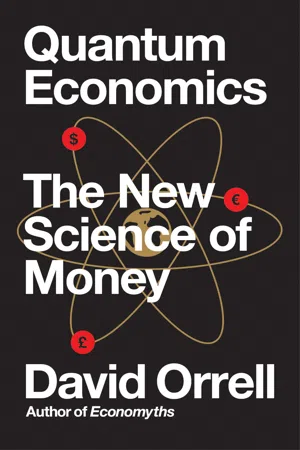
A decade after the financial crisis, there is a growing consensus that economics has failed and needs to go back to the drawing board. David Orrell argues that it has been trying to solve the wrong problem all along.
Economics sees itself as the science of scarcity. Instead, it should be the science of money (which plays a surprisingly small role in mainstream theory). And money is a substance that turns out to have a quantum nature of its own.
Just as physicists learn about matter by studying the exchange of particles at the subatomic level, so economics should begin by analysing the nature of money-based transactions.
Quantum Economics therefore starts with the meaning of the phrase 'how much' – or, to use the Latin word,
quantum.
From quantum physics to the dualistic properties of money, via the emerging areas of quantum finance and quantum cognition, this profoundly important book reveals that quantum economics is to neoclassical economics what quantum physics is to classical physics – a genuine turning point in our understanding.
- 304 pages
- English
- ePUB (mobile friendly)
- Available on iOS & Android
eBook - ePub
About this book
Information
PART 1
QUANTUM MONEY
CHAPTER 1
THE QUANTUM WORLD
The great revelation of the quantum theory was that features of discreteness were discovered in the Book of Nature, in a context in which anything other than continuity seemed to be absurd according to the views held until then.
Erwin Schrödinger, What is Life? (1944)
Natura non facit saltum (Nature makes no sudden leaps) Epitaph of Alfred Marshall’s 1890 Principles of Economics.
It remained there until the final edition of 1920
Money, according to the media theorist Marshall McLuhan, is a communication medium that conveys the idea of value. To understand the properties of this remarkable medium, we begin by looking at a different kind of exchange – that of energy between particles. This chapter traces the quantum revolution in physics which began in the early twentieth century, and shows how its findings changed the way we think about things like matter, space, time, causality, and even the economy. As we’ll see, economic transactions have more in common with the quantum world than one might think.
How much? This was the question pondered by the German physicist Max Planck in the late nineteenth century. How much energy is carried by a light beam?
Planck’s employer was the Imperial Institute of Physics and Technology, near Berlin, and his work was sponsored by a local electrical company. Their interest was in getting the most light out of a bulb with the least energy. A first step was to figure out a formula for how much light is produced when you heat something up.
Anyone who has placed a poker in a fire knows that as the metal heats it begins to glow red, then yellow, and then – at very high temperatures – a bluish white. When you turn on a lightbulb the thin filament inside does the same thing, except that it skips quickly to the white.
Scientists at the time knew that light was a wave, and that both the colour and the energy were determined by the frequency (or the closeness of the wave crests).* When something is heated, it emits light at a range of frequencies which depend on the temperature. An object at room temperature emits light in the low-frequency, low-energy infrared range, which is visible only through night-vision goggles. At extremely high temperatures, most of the light is in the invisible, high-frequency, high-energy ultraviolet range, but the object appears to our eyes as white – which is a mix of all frequencies.
The problem was with conventional theory, which predicted that a heated object would always emit light at all frequencies. Since high-frequency waves carry a lot of energy, an implication was that the energy would be channelled into arbitrarily short wavelengths of unlimited power. The question how much was therefore giving a puzzling answer: infinitely much. Instead of warming us, a log fire would vaporise us.
Few people at the time were calling for a revolution in physics. When Planck was contemplating a career in physics, a professor advised him against it, saying that ‘in this field, almost everything is already discovered, and all that remains is to fill a few holes’.1 In 1894 the American physicist and future Nobel laureate Albert Michelson had announced that ‘it seems probable that most of the grand underlying principles have been firmly established and that further advances are to be sought chiefly in the rigorous application of these principles to all the phenomena which come under our notice’.2 And Planck was not setting out to disrupt the field when he found a way in 1901 to model the radiation distribution with a neat formula. He just needed to use a little trick, which was to assume that the energy of light could only be transmitted in discrete units. The energy of one of these units was equal to its frequency multiplied by a new and very small number, denoted h. To name these little parcels of energy, Planck chose the word quanta.
The only problem with this assumption was that it violated the time-honoured principle that Natura non facit saltum: nature makes no sudden leaps. Or as Aristotle put it in Metaphysics, ‘the observed facts show that nature is not a series of episodes, like a bad tragedy’. But as Planck later wrote, he considered it ‘a purely formal assumption … actually I did not think much about it’.3
Thus was launched what became known as the quantum revolution. It took a while for the waves of this revolution to lap onto the shores (let alone the textbooks) of academic economics, but as we’ll see, it promises to have the same effect on that field as it did on physics.
A century after Planck, the Nobel laureate economist Robert Lucas, famous for his theory of ‘rational expectations’, echoed Planck’s teacher when he told his audience in 2003: ‘My thesis in this lecture is that macroeconomics in this original sense has succeeded: Its central problem of depression prevention has been solved, for all practical purposes, and has in fact been solved for many decades.’4 All that remained, it turned out, was to fill a few holes – like the ones left by the great financial crisis that started just a few years later, when the economy took a sudden leap off a cliff. But we’re getting ahead of ourselves.
The colour of their money
While Planck’s quanta may have been intended as just a pragmatic technical fix, they soon proved useful in solving another problem, which had to do with the photoelectric effect. This refers to the tendency of some materials to emit electrons when light is shone on them. Physicists found for example that, if they placed two metal plates close together in an evacuated jar, connected the plates to the opposite poles of a battery, and shone a light on the negatively charged plate, then the light dislodged electrons which raced across to the other, positively charged plate, in the form of a sudden spark.
According again to the classical theory, the energy of the emitted electrons should depend only on the intensity (i.e. brightness) of the light source. Shine a bright light, get a bigger spark. But in practice, it turned out that what really mattered was the colour, or frequency: high-frequency blue light created a bigger spark than low-frequency red light. And each material had a cut-off frequency, below which no amount of light would work. In a 1905 paper – one of a stream of results including his famous formula E=mc2 which would define the new physics – Albert Einstein showed that the photoelectric effect could be explained by use of Planck’s quanta.
According to Einstein’s theory, electrons were emitted when individual quanta of light struck individual atoms. Think of the metal plate as a marketplace of atoms, each selling electrons at a particular price, measured in energy; and think of the quanta of light as being the spending power of individual shoppers. Shining red light onto the plate is like sending a lot of low-budget shoppers into the market. No matter how many there are, if none of them have sufficient cash then no electrons are released – they can look but they cannot buy. High-frequency blue light, on the other hand, is an army of high-spenders. So what counts is not just the number of shoppers (the brightness) but how much each shopper can spend (the colour).
Einstein of course did not use this metaphor, and he gave his paper the careful title ‘On an heuristic† viewpoint concerning the production and transformation of light’. But it was clear that unlike Planck, he saw these light quanta – which later became known as photons – not as mathematical abstractions, but as real things. As he wrote, ‘Energy, during the propagation of a ray of light, is not continuously distributed over steadily increasing spaces, but it consists of a finite number of energy quanta localized at points in space, moving without dividing and capable of being absorbed or generated only as entities.’5
This sounds mysterious when applied to light, but again is similar to the way that we make financial transactions. When you receive your pay packet, there isn’t a little needle which shows the money draining into your account. Instead it goes as a single discrete lump. The same when you use your credit card at a store, or when a bank creates new funds by issuing a loan. And it is impossible to make payments smaller than a certain amount, such as a cent.
Most physicists responded to these new ideas in the same way most mainstream economists react to disruptive ideas today, which was to ignore them totally and hope they went away. But the question how much soon proved useful in solving another problem, which this time went right to the heart of what we mean by things – the atom.
Atomic auction
In the early twentieth century it was understood, at least according to the classical model, that there were two basic kinds of phenomena: waves and particles. Light, for example, was a wave, an electromagnetic perturbation in the ether, which played the role of a background medium through which the wave moved (this substance was later dropped, as discussed below). Objects, on the other hand, were made of atoms, and these in turn were composed of negatively charged electrons circling a small, but heavy, positively-charged nucleus like planets around the Sun. The energy of an electron depended on the radius of its path. The simplest atom, hydrogen, had only one electron, but larger atoms had multiple electrons at different energy levels.
The solar system model, as it was known, did explain a number of features of atoms, for example experimental results which showed that they mostly consisted of empty space. Fire small charged particles at a thin foil, and most pass through as if there were nothing there, while only a few bounce back. Again, though, there were a couple of problems. One was that the model didn’t spell out why atoms of a particular substance, say hydrogen, are identical with one another. What made electrons of different atoms always whizz round at the same radius? An even more serious issue was that, according to classical theory, a circulating electron should immediately radiate away all its energy and crash into the nucleus, like Mars colliding with the Sun.
In 1912 the Danish physicist Niels Bohr proposed a novel solution. If the energy of light was limited to discrete units, as Planck said, then so perhaps was the energy of the electron.6 This would mean that electrons could not have a continuous range of energies, but would be limited to multiples of some lowest base amount. And the reason an electron couldn’t radiate away all its energy was because it could only give it away in lumps, and it couldn’t go to zero. Electrons could gain energy, for example from a passing photon, and move to a higher level; or they could lose energy, by emitting a photon, and go down a level; but the change in energy would again always be a multiple of the base amount. The process was like an auction in which the auctioneer sets a certain base price, and only accepts bids that are multiples of some amount. The price can never go below the minimum, and can only go up in discrete steps.
Evidence that Bohr was on the right track was provided by the ...
Table of contents
- Cover
- Praise
- Title Page
- Dedication
- Contents
- Introduction
- Part 1: Quantum Money
- Part 2: The Quantum Economy
- Appendix
- Acknowledgements
- Index
- About the Author
- Copyright
Trusted by 375,005 students
Access to over 1.5 million titles for a fair monthly price.
Study more efficiently using our study tools.
Frequently asked questions
Yes, you can cancel anytime from the Subscription tab in your account settings on the Perlego website. Your subscription will stay active until the end of your current billing period. Learn how to cancel your subscription
No, books cannot be downloaded as external files, such as PDFs, for use outside of Perlego. However, you can download books within the Perlego app for offline reading on mobile or tablet. Learn how to download books offline
Perlego offers two plans: Essential and Complete
- Essential is ideal for learners and professionals who enjoy exploring a wide range of subjects. Access the Essential Library with 800,000+ trusted titles and best-sellers across business, personal growth, and the humanities. Includes unlimited reading time and Standard Read Aloud voice.
- Complete: Perfect for advanced learners and researchers needing full, unrestricted access. Unlock 1.5M+ books across hundreds of subjects, including academic and specialized titles. The Complete Plan also includes advanced features like Premium Read Aloud and Research Assistant.
We are an online textbook subscription service, where you can get access to an entire online library for less than the price of a single book per month. With over 1.5 million books across 990+ topics, we’ve got you covered! Learn about our mission
Look out for the read-aloud symbol on your next book to see if you can listen to it. The read-aloud tool reads text aloud for you, highlighting the text as it is being read. You can pause it, speed it up and slow it down. Learn more about Read Aloud
Yes! You can use the Perlego app on both iOS and Android devices to read anytime, anywhere — even offline. Perfect for commutes or when you’re on the go.
Please note we cannot support devices running on iOS 13 and Android 7 or earlier. Learn more about using the app
Please note we cannot support devices running on iOS 13 and Android 7 or earlier. Learn more about using the app
Yes, you can access Quantum Economics by David Orrell in PDF and/or ePUB format, as well as other popular books in Economics & Economic Theory. We have over 1.5 million books available in our catalogue for you to explore.