Contributions by Torsten Caeners, Phoebe Chen, Mathieu Donner, Shannon Hervey, Angela S. Insenga, Patricia Kennon, Maryna Matlock, Ferne Merrylees, Lars Schmeink, Anita Tarr, Tony M. Vinci, and Donna R. White For centuries, humanism has provided a paradigm for what it means to be human: a rational, unique, unified, universal, autonomous being. Recently, however, a new philosophical approach, posthumanism, has questioned these assumptions, asserting that being human is not a fixed state but one always dynamic and evolving. Restrictive boundaries are no longer in play, and we do not define who we are by delineating what we are not (animal, machine, monster). There is no one aspect that makes a being human—self-awareness, emotion, artistic expression, or problem-solving—since human characteristics reside in other species along with shared DNA. Instead, posthumanism looks at the ways our bodies, intelligence, and behavior connect and interact with the environment, technology, and other species. In Posthumanism in Young Adult Fiction: Finding Humanity in a Posthuman World, editors Anita Tarr and Donna R. White collect twelve essays that explore this new discipline's relevance in young adult literature. Adolescents often tangle with many issues raised by posthumanist theory, such as body issues. The in-betweenness of adolescence makes stories for young adults ripe for posthumanist study. Contributors to the volume explore ideas of posthumanism, including democratization of power, body enhancements, hybridity, multiplicity/plurality, and the environment, by analyzing recent works for young adults, including award-winners like Paolo Bacigalupi's Ship Breaker and Nancy Farmer's The House of the Scorpion, as well as the works of Octavia Butler and China Miéville.
eBook - ePub
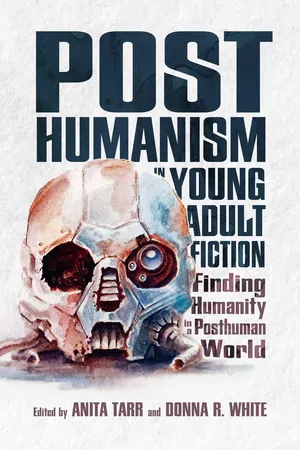
Posthumanism in Young Adult Fiction
Finding Humanity in a Posthuman World
- 304 pages
- English
- ePUB (mobile friendly)
- Available on iOS & Android
eBook - ePub
About this book
Information

PART I
NETWORKED
SUBJECTIVITIES
SUBJECTIVITIES
1
“OPEN TO ME. MAYBE I CAN HELP”
Networked Consciousness and Ethical Subjectivity in Octavia E. Butler’s Mind of My Mind
Mathieu Donner
A few pages into Mind of My Mind (1977), the second novel in Octavia E. Butler’s Patternist series, the narrator informs us that the novel’s antagonist, Doro, is a being whose original body died four thousand years ago as a result of his transition, his coming-of-age and coming-to-power. Jumping from body to body in order to survive ever since, he has been “struggling to build a race around himself” (Mind 16). Wild Seed (1980), Butler’s prequel to Mind of My Mind, is predominantly concerned with this eugenic program. Focused around the conflict that emerges from Doro’s encounter with another powerful being who is able not only to regenerate and transform herself but also to heal others, it explores the problematic ethical dilemma at the heart of Doro’s program. A more or less direct continuation of that novel, Mind of My Mind proposes to expand this exploration of the ethical obligation we bear toward others and to relocate it within a broader argument about the emergence of the political and social subject in an ever-expanding and interconnected world. As in many of her other novels, Butler’s interest lies less in the interaction between humans and technology—here telepathic communication, itself an obvious analogy for the new technologies emerging at the time1—than in technology’s impact on social relations between human beings (Melzer 94). Through her series, she signals the potential for political engagement that these technologies open up, specifically for younger generations of activists, while at the same time interrogating the limitations presented by the networked form of ethical subjectivities they produce.
Butler’s Patternmaster series exposes the benefits presented by the kind of networked model of subjectivity enforced by interconnectivity. Yet as the term itself already suggests, this enforcement is not without problems. Far from introducing a new utopian system of shared humanity, Butler’s narrative operates more directly as a “caution against utopian generalizations” (Melzer 93), a critique of the posthumanist dream and the new power relations established by new technologies.2
Focusing primarily on Mind of My Mind,3 this essay explores the relation Butler weaves between new technologies, adolescence, and ethical responsibility. Reading the novel alongside critical theories on the limits of the mind and their implication for our understanding of the self and its place in the world, I argue that through the coming-of-age story of her protagonist, Butler invites a reconceptualization of subjectivity understood not as an individual quest for uniqueness but as an ethical awakening to the presence, both outside and at the core of the self, of an irreducible and infinite form of alterity. Exploring the individual and collective impact of communication, Butler exposes the vulnerability at the heart of the subject as well as the performative, fluid, and inherently protean dimension of the human, thus challenging the relevance and necessity of its post- incarnation and reframing it instead as yet another source of epistemological violence.
Adolescence, Liminality, and Vulnerability
According to Butler herself, her fiction has tended to be shaped and informed by a vivid interest in the power dynamics at work in people’s relations to others. Her particular predilection for science fiction stems from the opportunity it allows “to imagine new ways of thinking about people and power” (qtd. in Mixon). In her Patternist series, this interest primarily unfolds through the tensions that come to surround the control of the telepathic Pattern implied in the series’s title. Opening in Africa in the midst of the colonial age, Wild Seed introduces readers to Doro, a four-thousand-year-old patriarch intent on creating a new race by bringing “his people” (57) together, that is, by gathering individuals who, like him, present some sort of supernatural powers. In Mind of My Mind, Doro finds himself confronted with one of his own protégées, the young Mary, who, as she awakes to her powers (when she transitions from “latent” to “active”), accidentally triggers the formation of a telepathic pattern of mental connections. Creating precisely the interconnected community of gifted individuals Doro had hoped to achieve through careful and forced interbreeding, Mary quickly becomes a threat to his supremacy.
Mary’s emergence as the new and legitimate leader of her community also slowly awakens her to the responsibility and vulnerability that this position inherently entails. Literally tied to her people, their safety, and well-being, Mary finds herself “neatly positioned within a pattern or web structure” (Hampton 50), forced to evolve, transform, and maybe even die within the dangerous social network she inherited. A fundamental part of both Mary’s experience and Butler’s narrative, this adherence to the network is, however, not a simple fact of life, a product of existence. Instead, transition is shown to occur around puberty and to concern only a select group of people. When Mary unconsciously triggers the transition of the thirty-year-old Clay, Doro’s disbelief highlights the chronologically limited dimension of the process: “Clay lost any chance he had for becoming an active over ten years ago” (Mind 136). Implicitly linked to adolescence, the shift from latent to active reframes the individual’s entrance into adulthood as a dangerous and often fatal, yet necessary, ritual of passage.
Sociological and psychological approaches have both tended to conceptualize adolescence as a period of transition from dependence to independence. Marked by a move away from the child’s reliance on adults and toward a form of individually detached and mature mode of positionality, adolescence has traditionally been understood as the entrance into the cleanly separated and distinct realm of the Symbolic. Introducing distance, becoming adult corresponds to a parallel move toward autonomy. It implies “find[ing] and liv[ing] in accordance with one’s own law,” states Jennifer Nedelsky (10), becoming one’s own master. However, and as Nedelsky herself recognizes, this positioning does not necessarily preclude social inscription. As her use of the word “find” suggests, “we do not make or even exactly choose our own law” (10). Instead, the finding of one’s own law is a process always already “shaped by the society in which one lives and the relationships that are a part of one’s life” (10).
In a similar way, Butler’s reframing of adolescence is not simply a transformative process through which latent people are given access to the complex and fully fleshed subjectivity signified by becoming an active. On the contrary, the transitional period unfolds as a threshold between singularity and plurality, a site of passage from exclusion to inclusion, from enclosure to openness. Doro explains that transition operates primarily through the removal of a latent’s “childhood shield,” the “mental protection that served young actives until they were old enough to stand transition” (Mind 52). It involves opening the egocentric and centripetal self to the centrifugal forces surrounding it. In her conceptualization of adolescence as a mode of passage toward plurality, Butler thus introduces a precursor to Nedelsky’s understanding of autonomy. Indeed, transition here not only implies conceptualizing youth as a space of liminality, a “cultural realm that has few or none of the attributes of the past or coming state” or a space “neither here nor there … betwixt and between the positions assigned and arrayed by law, custom, convention, and ceremonial” (Turner 95); it also entails reframing this passage as a fundamental deterritorialization and reterritorialization whose primary effect is the inscription of the subject within a broad network of relations. In the shift from childhood to adulthood, the subject develops a socially active, majoritarian, and culturally recognized form; she becomes subject, understood here as an autonomous state of existence.4 However, at the same time, this entrance into subjectivity implies a simultaneous recognition of the wider network from which subjectivity itself derives its meaning and power.
Though this conceptualization of adolescence as a move from dependence to autonomy (understood here as a form of being with) may seem rather obvious, its implications are less clear. First, what this approach presupposes is a recapture of adolescence as a necessary and inevitable identity crisis. If we take as foundation of identity theory a certain form of compulsory continuity, a thinking “that holds that ‘selfhood is sameness,’ that there is such a thing as continuity of identity over time and for all time” (Elliott 15), adolescence can but be perceived and received as a rupture. It involves a violent and forceful shattering of the core foundations and possibility of identity. Best explained by Karl, Mary’s husband, transition implies change: “you’re changing. I’ve been watching you change, wondering how far you would go” (Mind 188). However, more than a simple ontological shift, transition is also shaped by the system of power relations within which it is enacted. Having once dominated Mary from his position of authority as subject, Karl recognizes that her access to the Pattern has affected her own position within their relationship, confessing that he “can remember when it was easier to intimidate you” (188). Beyond a simple status change, the disruption signaled by adolescence marks the opening up of the self to a powerful form of ambiguity. It suggests a puncturing of the subject’s ontological core and the opening up of a bi-directional flow responsible for the evanescence of the same and a simultaneous intrusion of difference. Projected and caught up in a temporary limbic space of indeterminacy, the adolescent subject or subject-to-be finds herself “somehow left out in the patterning of society” (Douglas 96), relegated to a space of cultural nonexistence.
As Mary Douglas argues, “To have been in the margin is to have been in contact with danger, to have been at a source of power” (98). Despite being a source of a tremendous amount of power, however, being outside of culture is also marked by vulnerability. Doro’s earlier reference to the lifting up of shields already suggests that adolescence unfolds, for Butler, as a space of violent openness. This potential for harm is highlighted when Mary herself undergoes transition. As Doro explains to Karl, during her transition “she’s going to be reaching for the worst possible stuff…. That’s what’s going to attract her attention. She’ll get an avalanche of it—violence, pain, fear, whatever” (Mind 53). Having been stripped of the social shields conventionally thought to be protecting children, Mary finds herself subjected to an overpowering and overwhelming bombardment of impressions and emotions, utterly vulnerable to a broad network of influences and forces. The Patternist’s transition thus unfolds as a ritual of passage similar to those that have traditionally surrounded the move from childhood to adulthood. Themselves triggered and structured by peer influence, these rituals often imply some very real physical danger to the initiate herself and are part and product of a cultural movement whose objective is to encourage, if not directly force, its new members to conform to social expectations, to enter the dominant framework of society.
Vulnerability and openness to the world come to characterize the liminal period that is adolescence in Butler’s series. It signals a transition which, though painful and often dangerous to the individual (Doro himself died in transition before finding himself able to switch from body to body and thus remaining immortal), remains a necessary step in the emergence of a fully formed subject. In other words, transition operates as what Simon Critchley calls “the original trauma” at the core of being (“The Original Traumatism” 237). As Karl slowly realizes when he attempts to shield Mary mid-transition in order to protect her from the world, “He was preventing her from going through the suffering that was normal for a person in transition. And since the suffering was normal, perhaps it was in some way necessary” (Mind 58). Terrifying and potentially lethal as it may be, the vulnerability implicit in transition is also what constitutes the foundation of subjectivity itself. Creating the conditions for the intrusion of influence into the ontological fabric of the subject, its openness allows the subject to emerge as a relational project. It creates a framework within which the concepts of personal identity and selfhood can be thought of as a continuous state of “dialogue with society, with language, and with other people” (McCallum 3), a collective enterprise engaging both the subject and her world.
Opening up a rethinking of subjectivity not as a solipsistic event produced by the subject’s own action but rather as a collective enterprise through which each and all subjects “develop into responsible moral persons through socialization,” this reading of adolescence also suggests that each individual “rise[s] to meet the expectations [her] caregivers have for [her]” (Cash, “Extended Cognition” 652); that is, each individual emerges as subject within a structure of demands and obligations. By locating in vulnerability the core foundation of the normal adolescent experience, Butler thus echoes traditional sociological approaches that have tended to perceive in it a moment of crisis between individuality and collectivity. As B. Bradford Brown, Jeremy P. Brakken, Suzanne W. Ameringer, and Shelly D. Mahon suggest, “one of the most prominent concerns that American adults express about adolescence as a life stage [is] the power of peer influence” (17). Contingent on an implicit recognition of the vulnerability of all adolescents, this approach reads in this transitional phase the moment of emergence of the idiosyncratic adult. Yet it also suggests that this development is one that requires external input, perceiving therefore in adolescence a period of struggle in which the subject attempts to achieve or construct her own sense of self while continuously being subjected to concurrent and often violent forms of influence. In traditional readings, adolescence thus unfolds as a paradoxical double movement: an inward-looking “quest to find uniqueness, to stand from the crowd,” and a simultaneous outward search for belonging, a “need for a group” or a desire to fit in (Blanton and Burkley 94).
The framing of puberty as the period of emergence of a strong and autonomous self, capable of shielding itself from the bombarding network of forces that strive to remodel while also being part and product of these forces, takes as foundational structure a strict separation between public and private spheres. It reframes the self as a property over which both the collective and the individual simultaneously claim mastery. This conflict between group and individual is at the heart of Butler’s work. Informed by a long-lasting interest in the legacy of slavery, her novels tend to narrate the journey of a protagonist toward self-fulfillment and self-ownership. Wild Seed describes Doro’s strategies to recruit Anyanwu, who has established her own settlement of networked people in colonized Africa. She explains her vision of the world in which “some people [are] masters and some [are] slaves” (9). This initial dichotomic framing sets the tone for the entirety of the Patternist series. Later in the novel, when Doro invites Anyanwu to join his people in a small settlement upriver where, as he tells her, “[o]nly my people live” and “they do not enslave each other,” she simply reminds him how redundant this enslaving would be, his people “[a]ll belonging, as they do, to [him]” (95). Similarly, in Mind of My Mind, when Mary is introduced to her new house, she defines Karl’s relation to his servants as one of absolute ownership: “Karl owned his servants more thoroughly than even Doro usually owned people. Karl owned their minds” (37). As all those examples suggest, within the economy of the series, becoming subject corresponds to a shift in ownership or, as Mary phrases it, to the idea that, by undergoing transition, she would, for once in her life, “be one of the owners instead of one of the owned” (102). As Nedelsky points out, the process of becoming an autonomous adult involves a shift in power relations, a process by way of which one becomes one’s own master.
This impression of mastery, however, ultimately unfolds as little but an illusion or a fantasy. Indeed, the transitional process through which it emerges invariably requires passage through a space of opening in which the amount of “mental garbage” (Mind 62)—a thinly veiled analogy for peer influence—can, if left unchecked, lead one to madness. As the narrator in Wild Seed explains, transition “was the time when the madness of absorbing everyone else’s feelings seemed endless—when in desperation, they would do anything to stop the pain” (186). In many ways, this period of vulnerability is defined throughout the series as a temporary and transitional event in the life of the active subject, the presence of first Doro and later Mary herself both suggesting a more permanent form of dispossession. As Mary herself realizes later in Mind of My Mind, not even her own position as master of the Pattern leaves her untouched by vulnerability. Indeed, Mary makes clear to Doro her own contempt for dependency: “I never liked depending on other people and their cars, anyway. When I rode the bus, I went when I wanted, where I wanted” (103). Yet Mary exposes the paradoxical nature of the subject’s position when, coming back after a long day, she finds herself seeking the bonds she previously rejected: “I didn’t want to be alone. I couldn’t have put into words how much I suddenly didn’t want to be alone, couldn’t stand to be alone, how much it scared me” (103). More important, though, is her next realization, that is, that at that precise moment of need, when “Karl came back to my bed without another word[,] … he could have really hurt me with just a few words” (103). Revealing what Anthony Elliott calls “the illusions of a purely private world, supposedly unaffected or cut off from the wider social world” (4), Butler invites her readers to challenge and question the solipsistic perspective on the self that has come to define Western philosophy at least since Descartes. In its stead, she promotes an understanding of subjectivity born out of “human interaction and interpersonal relationships” (Elliott 28–29), a vision in which t...
Table of contents
- Cover
- Title Page
- Copyright
- Contents
- Acknowledgments
- Introduction
- Part I. Networked Subjectivities
- Part II. The Monstrous Other: Posthuman Bodies
- Part III. Posthumanism in Climate Fiction
- Part IV. Accepting/Rejecting Posthumanist Possibilities
- Notes on Contributors
- Index
Trusted by 375,005 students
Access to over 1.5 million titles for a fair monthly price.
Study more efficiently using our study tools.
Frequently asked questions
Yes, you can cancel anytime from the Subscription tab in your account settings on the Perlego website. Your subscription will stay active until the end of your current billing period. Learn how to cancel your subscription
No, books cannot be downloaded as external files, such as PDFs, for use outside of Perlego. However, you can download books within the Perlego app for offline reading on mobile or tablet. Learn how to download books offline
Perlego offers two plans: Essential and Complete
- Essential is ideal for learners and professionals who enjoy exploring a wide range of subjects. Access the Essential Library with 800,000+ trusted titles and best-sellers across business, personal growth, and the humanities. Includes unlimited reading time and Standard Read Aloud voice.
- Complete: Perfect for advanced learners and researchers needing full, unrestricted access. Unlock 1.5M+ books across hundreds of subjects, including academic and specialized titles. The Complete Plan also includes advanced features like Premium Read Aloud and Research Assistant.
We are an online textbook subscription service, where you can get access to an entire online library for less than the price of a single book per month. With over 1.5 million books across 990+ topics, we’ve got you covered! Learn about our mission
Look out for the read-aloud symbol on your next book to see if you can listen to it. The read-aloud tool reads text aloud for you, highlighting the text as it is being read. You can pause it, speed it up and slow it down. Learn more about Read Aloud
Yes! You can use the Perlego app on both iOS and Android devices to read anytime, anywhere — even offline. Perfect for commutes or when you’re on the go.
Please note we cannot support devices running on iOS 13 and Android 7 or earlier. Learn more about using the app
Please note we cannot support devices running on iOS 13 and Android 7 or earlier. Learn more about using the app
Yes, you can access Posthumanism in Young Adult Fiction by Anita Tarr, Donna R. White in PDF and/or ePUB format, as well as other popular books in Literature & Literary Criticism. We have over 1.5 million books available in our catalogue for you to explore.