- 320 pages
- English
- ePUB (mobile friendly)
- Available on iOS & Android
eBook - ePub
About this book
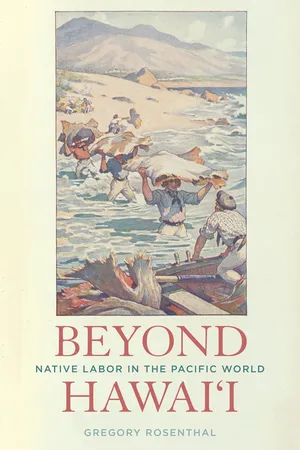
In the century from the death of Captain James Cook in 1779 to the rise of the sugar plantations in the 1870s, thousands of Kanaka Maoli (Native Hawaiian) men left Hawai‘i to work on ships at sea and in na ‘aina ‘e (foreign lands)—on the Arctic Ocean and throughout the Pacific Ocean, and in the equatorial islands and California. Beyond Hawai‘i tells the stories of these forgotten indigenous workers and how their labor shaped the Pacific World, the global economy, and the environment. Whether harvesting sandalwood or bird guano, hunting whales, or mining gold, these migrant workers were essential to the expansion of transnational capitalism and global ecological change. Bridging American, Chinese, and Pacific historiographies, Beyond Hawai‘i is the first book to argue that indigenous labor—more than the movement of ships and spread of diseases—unified the Pacific World.
Information
Publisher
University of California PressYear
2018Print ISBN
9780520295063
Edition
1eBook ISBN
9780520967960
ONE
Boki’s Predicament
SANDALWOOD AND THE CHINA TRADE
FRENCH CAPTAIN AUGUSTE DUHAUT-CILLY could not believe his eyes. He was standing inside Boki’s home in Honolulu. From the outside it was humble, built “of wood and straw,” and “quite the same as all other houses in the town of Honolulu.” But “the interior,” he continued, “carpeted with mats like the others, differed only in its European furniture, standing in every corner and mixed with the native furniture. Nothing could have been more strange than to see a magnificent porcelain vase of French manufacture paired with a calabash, a work of nature,” or to see “two hanging mirrors with gilded frames meant to display beauties in their most elegant toilette but reflecting instead dark skin half covered with dirty tapa cloth.”1 In other words, Boki’s hale (house) was full of stuff—Native stuff, foreign stuff, simple stuff, exotic stuff.
Just one year later, Boki was off on a fantastical adventure. In 1829 he outfitted two ships with nearly five hundred men and set sail from Honolulu to Eromanga, an island in the New Hebrides Islands (today’s Vanuatu), thousands of miles to the south. Boki’s intended goal was to harvest Eromangan sandalwood. Sandalwood paid for all the nice things that Boki had in his home. But Boki never made it back home. Some speculated that his ship was lost at sea; others that he had fled to live out his years in exile.2 Boki faced an awful predicament. He and the other aliʻi (chiefs)—the men and women of Hawaiʻi’s ruling class—had purchased so many goods from foreign ships and foreign merchants that they now owed tremendous debt to American creditors. The U.S. Navy had just recently sailed a gunship into Honolulu Harbor to support American private business, coercing the Hawaiian government to give up their wood. Everybody wanted sandalwood. Throughout the 1820s, Boki and the other aliʻi forced thousands of Hawaiian men to cut wood in the mountains on every Hawaiian Island, and still they were not able to pay off their debts. Only by conquering and colonizing a foreign land, and by taking their wood, he reasoned, could the Kingdom of Hawaiʻi free itself from the grasp of American economic predation and imperialist maneuvering.
This was Boki’s predicament. But more broadly, it is also the story of how capitalism came to Hawaiʻi. This narrative involves thousands of actors spanning the globe. It pairs northern Chinese fur consumers with southern Chinese merchants in the great emporium of Guangzhou (Canton). It matches European and Euro-American ships and their crews to the men and women of Hawaiʻi who willingly and often unwillingly fed appetites for exploitation. The narrative also involves thousands of Hawaiian workers, accustomed to an indigenous political economy based on agricultural and household production, who now sailed away on ships at sea, lived and worked abroad in foreign lands, and climbed into the mountains of their own land to cut down trees so that other people could buy mirrors and porcelain vases.
This is the story of how Hawaiian land and labor became part of the Pacific World, linked to the global economy through ships, salt, sea otters, and sandalwood, and through the labor of thousands of Hawaiians who by the second half of the nineteenth century had become “free,” a landless proletariat set adrift upon the ocean to find work wherever they could.
SHIPS, SALT, AND SEA OTTERS
Some say that Captain Cook discovered Hawaiʻi in 1778. But it was also the other way around. Hawaiians discovered the world. By 1800, Hawaiians had met people and consumed goods from China, North America, Europe, and Latin America, and some had even traveled to these places to see it for themselves. After Hawaiians killed Cook in 1779, his crew continued onward, selling sea otter furs that they had harvested on the northwest coast of North America at the great emporium of Guangzhou (Canton), the main commercial entrepôt of the Qing Empire.3 Within one decade, multiple ships of European and American origin began visiting Hawaiʻi as part of a new trans-Pacific fur-and-tea trade among China, the northwest coast of North America, Hawaiʻi, and points Atlantic.4 These ships called at Hawaiʻi in order to procure “refreshments”: fresh fruits, fresh water, and fresh bodies—women for sexual pleasure and men for manual labor.
Foreigners visiting late eighteenth-century Hawaiʻi encountered a unique land, with a distinctive mode of production. Hawaiians structured relationships of land and labor according to indigenous economic values and longstanding religious and cultural traditions. In eighteenth-century Hawaiʻi there were, broadly speaking, two major socioeconomic classes. Relations of production were divided among makaʻāinana (commoners) and aliʻi (chiefs). The makaʻāinana lived on the common lands of ahupuaʻa, pie-cut-shaped districts, in which commoners had access to the resources of upland forests, lowland valleys (suitable for agriculture), and near-shore fisheries. Hawaiians’ bodily labor was not, however, directed solely toward subsistence, as commoners were also required to periodically give hoʻokupu (tribute) to aliʻi who, on their behalf, maintained proper relations with nā akua (the gods) who, in turn, ensured the fertility of the land. This circular process—what historian Lilikalā Kameʻeleihiwa has called mālama ʻāina (care for the land)—was dependent upon the pono conduct of all parties. Pono, a salient concept in Hawaiian political economy, is often translated as “just” or “proper,” but it also implies a state of balance that can be both ecological as well as bodily. It refers to things being the way they are supposed to be. In summary, the key peoples in Hawaiʻi’s indigenous economy were the two classes, makaʻāinana and aliʻi, and a key moral value was pono, the “right conduct” that governed relations of production between classes as well as relationships among ka ʻohana (the family), ka ʻāina (the land), and ke kino (the body).5
Commoners’ tribute most often took the form of corvée labor. Aliʻi periodically requisitioned labor for building fishponds or heiau (temples) or to serve as foot soldiers in intra-Hawaiian wars. In the nineteenth century, under the rule of the Kingdom of Hawaiʻi (until government reforms in the 1840s), makaʻāinana were required to pay a labor tax that built upon this tradition of hoʻokupu. Penal labor was also a feature of early Kingdom rule. Hawaiian commoners were often forced—either as corvée or as convicts—to labor in state-owned industries such as sandalwood harvesting or at the royal salt works at Āliapaʻakai, Oʻahu.6
By the beginning of the nineteenth century, traditional labor practices and class relations were already changing. Two commodities irrevocably changed Hawaiʻi’s place within the global economy. One was found in abundance in Hawaiʻi: salt. The other was only available thousands of miles away: the fur of the sea otter (Enhydra lutris). In many ways, trade in sea otter pelts is what made the Pacific World go round in the late eighteenth century.7 The players in this grand dance were manifold. There was the Qing Empire. They were at the powerful, strategic epicenter of the fur-and-tea trade. The Qing had what everyone else in the world wanted: tea. In return, there were a few things that they would accept from foreign traders but many that they would not; sea otter furs were a rare desired item. Two other major players, Great Britain and the United States, were compulsively addicted to tea (and to sugar, too, altogether creating a veritable maelstrom of Atlantic and Pacific economic conjunctures: tea, sea otter furs, African slavery, Hawaiian labor—all part of a grand narrative of globalization in the eighteenth and early nineteenth centuries). To get Chinese tea, British and American merchants extracted ginseng from northeastern American forests, sea otter furs from northwestern American bays and coves, sandalwood from Pacific Islands, and so on.8 The Russian empire was also a player in this grand dance: they sold mammalian furs to the Qing as early as the seventeenth century. In the eighteenth century, the Russian empire expanded across the Pacific Ocean into uppermost North America. They extracted sea otter furs from the North Pacific, just as the British and Americans did in the Columbia River region. Russians, Brits, and Americans even variously (and tenuously) worked together at times to get sea otter furs to market.9
All of these world powers—China, Russia, Britain, the United States—were simultaneously dependent on Hawaiʻi. There were no sea otters in Hawaiian waters, but Hawaiʻi had provisions. To get sea otter furs across the great ocean, foreign traders needed a midway rest stop: they needed a place where they could acquire fresh fruits and vegetables, fresh water, and labor. The late eighteenth-century trans-Pacific fur-and-tea trade was intimately dependent on Hawaiian labor and Hawaiian resources. Some Hawaiian migrant workers traveled to the northwest coast of North America to assist with the sea otter hunt, while others simply sought ways to accumulate wealth via the provisioning of biological and mineral resources to passing ships. Toward the end of the eighteenth century, almost every European or Euro-American vessel crossing the ocean between the Americas and China alighted in Hawaiʻi. By one scholar’s reckoning, as many as forty-five ships visited Hawaiʻi in the years between 1786 and 1800.10
Hawaiian workers traveled abroad on some of these ships. For example, while stopped in the Islands in January 1808, John Suter of the ship Pearl reported recruiting six Native men to go with him to the northwest coast of North America to hunt sea otters: “I Ship’d one man, at the Islands, Six of the Natives. I arrived on the Coast the 18th of Feby.” John C. Jones, U.S. consul to the Hawaiian Kingdom, wrote from Honolulu in 1821 that “all vessels on the [northwest] coast now have got double crews,” referring to the equal recruitment of Hawaiians alongside Yankee seamen aboard sea otter hunting ships. “The Brig Frederick, Capt Stetson sailed from here yesterday, who came to these Islands from the Coast, for the purpose only of getting more men for himself & Capt Clark, he has taken away about twenty” Hawaiian men. These Hawaiian workers in the early decades of the nineteenth century were the first significant wave of labor to expand the reaches of the Hawaiian Pacific World.11
In Hawaiʻi, the indigenous political economy was also transformed as Hawaiians began to produce the Islands’ first export commodity. The significance of salt was directly related to the sea otter fur trade. Salt was absent—at least in easily extractable crystalized form—from the coasts inhabited by sea otters. Geography thus inconvenienced those who would seek to preserve sea otter skins and turn them into dollars and cents, but this haphazard geography was a boon for Hawaiians. Traders alighting in Hawaiʻi found tons of salt for the taking. In the coming decades, Hawaiian aliʻi ordered salt extracted and piled up at Kawaihae on Hawaiʻi Island and at Āliapaʻakai near Honolulu on Oʻahu.12
As a commodity, Hawaiian salt was alienated from the ʻāina and from the Hawaiian labor that extracted it. It was buyable, sellable, exchangeable. Its value was determined, in part, by the cost of its production but also by the ups and downs of Hawaiʻi’s unprecedented relationship to a global capitalist economy. In all these ways, the story of salt prefigures the story of sandalwood. Salt provided eighteenth- and early-nineteenth-century Hawaiians with some sense of what it might feel like to link their labor and environment to the supplies and demands of a global marketplace. Indeed, demand for Hawaiian salt was dependent on the success of sea otter harvests along North American shores and on the consumption patterns of Chinese fur wearers in northern China. The triangular nature of this trade prefigured the triangular nature of sandalwood production, distribution, and consumption. Salt, also like sandalwood, was a source of economic power for the Hawaiian ruling class. By 1802, John Turnbull, visiting Hawaiʻi, noted that salt was becoming scarce and expensive. “The natives,” having recognized the advantages of this scarcity, “learned to affix a proper value to the productions of their country.”13
Much of Hawaiʻi’s salt exports came from one site on Oʻahu, a place about four miles west of Honolulu Harbor that the haole called “Salt Lake” and Hawaiians called Āliapaʻakai (literally, “salt encrustation”). In 1824, Euro-American missionary Charles Stewart visited the site, describing “a lake or pond, in which large quantities of salt are continually forming.” The abundant salt crystals sparkling on the lake’s surface seemed like “a frozen pond” to this New Yorker’s eyes. Upon reaching Salt Lake, Stewart was able to reach down and pick up crystals from among the “twigs, grass, and pebbles, over which the water had flowed.” He mused of the minimal labor needed for resource extraction: “From this natural work alone, immense quantities of salt might be exported.”14
But by the 1820s, Hawaiians were not just extracting salt from Āliapaʻakai; they were producing it. “The natives manufacture large quantities from sea water by evaporation,” Stewart wrote. “There are in many places along the shore, a succession of artificial vats of clay for this purpose, into which the salt water is let at high tide, and converted into salt by the power of the sun.” To make so much salt required massive amounts of human labor. Stewart did not report on how many workers produced salt at Āliapaʻakai, but later sources from th...
Table of contents
- Imprint
- Subvention
- Title
- Copyright
- Contents
- Maps
- Acknowledgments
- Introduction
- 1 • Boki’s Predicament: Sandalwood and the China Trade
- 2 • Make’s Dance: Migrant Workers and Migratory Animals
- 3 • Kealoha in the Arctic: Whale Blubber and Human Bodies
- 4 • Kailiopio and the Tropicbird: Life and Labor on a Guano Island
- 5 • Nahoa’s Tears: Gold, Dreams, and Diaspora in California
- 6 • Beckwith’s Pilikia: “Kanakas” and “Coolies” on Haiku Plantation
- Epilogue: Legacies of Capitalism and Colonialism
- Appendix
- Notes
- Glossary
- Bibliography
- Index
Trusted by 375,005 students
Access to over 1.5 million titles for a fair monthly price.
Study more efficiently using our study tools.
Frequently asked questions
Yes, you can cancel anytime from the Subscription tab in your account settings on the Perlego website. Your subscription will stay active until the end of your current billing period. Learn how to cancel your subscription
No, books cannot be downloaded as external files, such as PDFs, for use outside of Perlego. However, you can download books within the Perlego app for offline reading on mobile or tablet. Learn how to download books offline
Perlego offers two plans: Essential and Complete
- Essential is ideal for learners and professionals who enjoy exploring a wide range of subjects. Access the Essential Library with 800,000+ trusted titles and best-sellers across business, personal growth, and the humanities. Includes unlimited reading time and Standard Read Aloud voice.
- Complete: Perfect for advanced learners and researchers needing full, unrestricted access. Unlock 1.5M+ books across hundreds of subjects, including academic and specialized titles. The Complete Plan also includes advanced features like Premium Read Aloud and Research Assistant.
We are an online textbook subscription service, where you can get access to an entire online library for less than the price of a single book per month. With over 1.5 million books across 990+ topics, we’ve got you covered! Learn about our mission
Look out for the read-aloud symbol on your next book to see if you can listen to it. The read-aloud tool reads text aloud for you, highlighting the text as it is being read. You can pause it, speed it up and slow it down. Learn more about Read Aloud
Yes! You can use the Perlego app on both iOS and Android devices to read anytime, anywhere — even offline. Perfect for commutes or when you’re on the go.
Please note we cannot support devices running on iOS 13 and Android 7 or earlier. Learn more about using the app
Please note we cannot support devices running on iOS 13 and Android 7 or earlier. Learn more about using the app
Yes, you can access Beyond Hawai'i by Gregory Rosenthal in PDF and/or ePUB format, as well as other popular books in History & Australian & Oceanian History. We have over 1.5 million books available in our catalogue for you to explore.