eBook - ePub
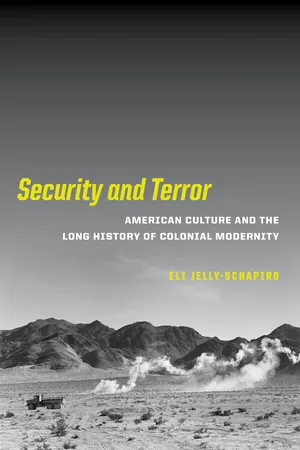
Security and Terror
American Culture and the Long History of Colonial Modernity
- 232 pages
- English
- ePUB (mobile friendly)
- Available on iOS & Android
eBook - ePub
About this book
When in 1492 Christopher Columbus set out for Asia but instead happened upon the Bahamas, Cuba, and Hispaniola, his error inaugurated a specifically colonial modernity. This is, Security and Terror contends, the colonial modernity within which we still live. And its enduring features are especially vivid in the current American century, a moment marked by a permanent War on Terror and pervasive capitalist dispossession. Resisting the assumption that September 11, 2001, constituted a historical rupture, Eli Jelly-Schapiro traces the political and philosophic genealogies of security and terror—from the settler-colonization of the New World to the wars in Afghanistan, Iraq, and beyond. A history of the present crisis, Security and Terror also examines how that history has been registered and reckoned with in significant works of contemporary fiction and theory—in novels by Teju Cole, Mohsin Hamid, Junot Díaz, and Roberto Bolaño, and in the critical interventions of Jean Baudrillard, Giorgio Agamben, Judith Butler, Michael Hardt and Antonio Negri, and others. In this richly interdisciplinary inquiry, Jelly-Schapiro reveals how the erasure of colonial pasts enables the perpetual reproduction of colonial culture.
Information
Publisher
University of California PressYear
2018Print ISBN
9780520295377
Edition
1eBook ISBN
9780520968158
ONE

“All the World Was America”
THE LONG HISTORY OF HOMELAND SECURITY
The dialectic of security and insecurity, like that of security and terror, is central to the philosophy and form of the modern state. For John Locke and Thomas Hobbes, the insecurity—or terror—of the state of nature necessitates the ascent of the sovereign and constitution of the social contract; the state arises to delineate what is secured from what is not, civilization from savagery, inside from outside, citizen from non, the bearer of rights from the rightless. Despite the reciprocal emergence of security thinking and the modern state, the absolute saturation of social and political discourse with security rhetoric is a twentieth-century phenomenon. In the United States, Social Security acquired its rhetorical power and bureaucratic form in the 1930s. The postwar years witnessed the emergence of National Security as an organizing principle of governance. And in the aftermath of September 11, 2001, Homeland Security has attained discursive prominence, giving name to a new state form. In this chapter, I argue for the efficacy of conceptualizing the above-mentioned security paradigms together—shedding light upon the ways in which, for instance, Social and Homeland Security are bound up in one another, sharing both a genealogy and a political rationality. This common genealogy and rationality, I contend, can be traced to the advent of colonial modernity, and to the settler-colonization of the New World in particular. Countering ahistorical accounts of post-9/11 political-economic order, this chapter situates the contemporary manifestation and twentieth-century evolution of security discourse and practice within the long history of modernity at large.
This expansive historical framework, I contend here, as throughout this book, is essential to any critical reckoning with the political forms and narratives of the imperial present. My objective is not to deny the transformations embodied in the Homeland Security state, but to demonstrate the ways in which those transformations are contiguous with—rather than a departure from—the long and recent histories of the modern security project. Essayed in this chapter, to borrow from Fredric Jameson (for his “capitalism” I substitute “security”), “is a dialectical view of [security] . . . in place of the latter’s breaks and discontinuities: for it is the continuity of the deeper structure that imposes the experiential differences generated as that structure convulsively enlarges with each new phase.”1 Newness, in other words, is both a consequence and expression of continuity.
My analysis proceeds through an examination of three elemental relations: security and capital, security and race, and security and emergency. Each of these relations works with and through the others, and all are fundamental to the constitution of a specifically colonial modernity. The security state emerges to guarantee the process and outcome of capitalist accumulation, in the colony as in the metropole. The securing of private property is enabled by and in turn reinforces race thinking and practice, which also functions to structure internally, and mark the external boundaries of, the political community. The capitalist and racial logics of the security state dovetail with the politics of emergency. The enactment of emergency or exception legitimates the preemptive and punitive violence of the security state; sanctions extra-legal forms of accumulation by dispossession; and clarifies the racial distinction between the bearer of rights and the rightless, human and infrahuman.
SECURITY AND CAPITAL
Though the lexiconic proliferation of security thinking is a relatively recent phenomenon, the security project was manifold in its inception. The state was founded to secure the sovereign, “the People,” and the identity, personhood, and liberty of the individual subjects that composed the body politic. All of these principles, meanwhile, were underlain by the security of property. Here Enlightenment philosophers of government and political economy were in agreement. Security was central to the rise of the modern state and, as Mark Neocleous has observed, to the ascendance of the bourgeois property rights enshrined therein.2 The meaning and object of the term “security” is always contested; the vocabulary of security animates movements of resistance as well as processes of dispossession and domination. In its ascendant form, though, the modern security project is constructed and deployed by and in the service of the state and capital—to justify discursively and provide structural mechanisms for the accumulation, uneven distribution, and maintenance of political and economic power.
“In the beginning,” Locke wrote, “all the world was America.” In the beginning, in other words, all the world—untamed and uncultivated—invited the virtuous procedures of primitive accumulation. In the opening paragraphs of “Of Property,” the fifth chapter of his Second Treatise of Government (1689), Locke introduces what is often termed his “labor theory of property.” Because “every man has property in his own person,” he is rightfully entitled to whatever he extracts or derives from nature: “For this labour being the unquestionable property of the labourer, no man but he can have a right to what that is once joined to.”3 Crucially, in claiming land and laboring upon it, thereby increasing the bounty derived from that land, man is in fact increasing, or “improving,” the “common stock” of humanity: “he that encloses land, and has a greater plenty of the conveniences of life from ten acres than he could have had from a hundred left to nature, may truly be said to give ninety acres to mankind.” The dispossession of common lands for the purpose of industrious cultivation is, Locke insisted, in effect a gift to the dispossessed, the Yorkshire peasant and indigenous American alike. “I ask,” Locke wrote, “whether in the wild woods and uncultivated waste of America, left to nature, without any improvement, tillage, or husbandry, a thousand acres yield the needy and wretched inhabitants as many conveniences of life as ten acres of equally fertile land in Devonshire, where they are well cultivated.”4 North American land, lying fallow due to the indolence of its native inhabitants, invites the intervention of the European settler, who through his labor will increase the product of the land and thus the stock of mankind in general.
In a telling passage in “Of Property,” Locke writes that “the grass my horse has bit, the turfs my servant has cut, and the ore I have digged . . . become my property without the assignation or consent of anybody.”5 The phrase “the turfs my servant has cut” intimates that the property owner is entitled to the produce of the labor of anyone he hires or forces to work upon his land. Though “every man has property in his own person,” the product of labor ultimately belongs, in Locke’s formulation, not to the laborer but to the owner of the property upon which the laborer works. “Improvement,” then, might be achieved not just through the enterprising individual whose industry animates the dormant commons, but through the institutions of wage labor and chattel slavery. It is the purpose of government to facilitate, and to secure, this process of expropriation and improvement.
Contrary to Locke, Hobbes argues that property is not intrinsic to the state of nature but is the invention of political authority, of the sovereign who can secure the possession of goods and land and oversee their improvement through industry. Property, in other words, only emerges as a concept when conjoined with security. Hobbes is close to Locke, though, when, in an oft-cited passage from Leviathan, he holds forth on the necessity of labor discipline. While the unable should receive the charity of the sovereign, he writes, “for such as have strong bodies . . . they are to be forced to work; and to avoyd the excuse of not finding employment, there ought to be such Lawes, as may encourage all manner of arts; as Navigation, Agriculture, Fishing, and all manner of Manifacture that requires labor.”6 The duty of the sovereign is to provide security for private property, and to compel through law the labor of those who hold no title to the means of production.
Securing the Social
One lineage of Social Security can be traced to 1834, when the Poor Law Amendment Act was passed in England and Wales. Systems of localized poor relief had existed since at least the mid-sixteenth century in England, but not until the 1834 Act was the administration of poor law centralized and codified at the level of the state. The 1834 Act created a network of workhouses, which absorbed the unemployed into institutions of disciplined and disciplinary labor. The Act sought a solution to the problem of the general insecurity and “superfluous” populations created by early industrial capitalism. Dispossessed of the means of their own subsistence, the proletariat is forced to enter the market to sell their labor for a wage. But there is of course never a guarantee of employment and thus the state must intervene, in a biopolitical manner, to ensure the reproduction of the working classes. In one sense, the poor law provided a measure of security—miserable, horrid security, in the case of the workhouses: “houses of terror,” Marx called them in Capital—to a population defined by its insecure existence, its naked subjection to the basically inhuman laws of the market.7 In another sense, though, poor laws protected the bourgeoisie from the threat of large-scale social unrest and helped ensure the maintenance of capitalist property relations.8 This dual purpose—securing the individual (and the hetero-familial unit to which he belongs) and securing the larger capitalist order—characterized the Social Security provisions inaugurated a century later on the other side of the Atlantic.
Contemporary social insurance programs, though, differ from earlier “poor laws” in important ways. If in eighteenth-century England the poor laws provided a “charity” to the unemployed, Social Security is allocated only to those who contribute to its funding. The Poor Law Act of 1834 demanded labor from its beneficiaries, while Social Security limits its benefits—with few exceptions—to those who labor. The insurance component of Social Security, Jennifer Klein has argued, inspired the rapid proliferation of non-state, for-profit insurance providers9—a moment of entrepreneurial ingenuity in which a capitalist industry arose to protect people against the ravages of capitalism. The market is the solution to the market: a refrain that would echo loudly in the latter part of the century, and indeed one that continues to reverberate in the neoliberal moment, in the context of recurring economic crises.
The securitization of the social went hand in hand with its capitalization. Security became not simply something provided by the government, but something purchased on the market. The biocapitalist industries of life and health insurance emerged in concert with the biopolitical functions of the Social Security state. One object of security for both state and business, in other words, became life itself—an evolution that enabled the broadening and deepening of security governance, the intensification of its effect upon the individual and social body.10 The tripartite pact between state, business, and labor—consolidated to an even greater degree following the Second World War—blunted the class contradictions at the heart of the security/insecurity binary and contributed to the hegemonic reach of the security project. The ultimate effect was the continuation of capitalist social relations, the reproduction of a social order based on the security of private property and accumulation in perpetuity.
Security in the Shadow of War
From its inception, but with a particular intensity following the Second World War, the Social Security project dovetailed with the rhetoric and policy of National Security. During both the Truman and Eisenhower administrations, arguments made for the expansion of Social Security deployed the vocabulary of National Security. Major public infrastructure projects such as the Interstate Highway System—inaugurated by the Federal Aid Highway Act of 1956—and Saint Lawrence Seaway reconstruction—a project undertaken jointly with Canada, which enabled the development of massive hydroelectric power works, and which significantly expanded commercial shipping routes from the Atlantic to the Great Lakes—were likewise justified on National Security terms. Sputnik and the Soviet threat it embodied, meanwhile, occasioned sharp increases in math and science funding, initially allocated for in the National Defense Education Act of 1957—another instance of a major federal investment in domestic public infrastructure made in the name of National Security.11 Generally speaking, the welfare state and the warfare state emerged from the war closely entwined, and would remain conjoined for the next two decades.
Expanding and deepening its social infrastructure at home, during the early stages of the Cold War the United States worked to construct a “Keynesian empire” abroad. This National Security paradigm was founded on a developmentalist logic that cohered with domestic policy, specifically Social Security. In the immediate aftermath of the war, the United States asserted itself as a world power intent on creating and dictating a new international political and economic order—the initial manifestations of which were the European Economic Recovery Program (the Marshall Plan) and the financial framework conceived at Bretton Woods, New Hampshire, in 1944. The intellectual rationale for the Bretton Woods system was capitalist security—the belief that peace amongst nations depended upon a liberal system of international trade, one that would be regulated by select governments and supported by international financial institutions (created at Bretton Woods) such as the International Monetary Fund (IMF) and World Bank (known in 1945 as the International Bank for Reconstruction and Development, or IBRD). Though a departure from the explicitly territorialized logic of the modern colonial system, the international economic order devised at Bretton Woods and instituted in the decades to come maintained the stark divide between the overdeveloped global North and underdeveloped global South. It maintained, moreover, a commitment to the ethos of “free enterprise.” The architects and authors of U.S. policy during the Cold War imagined the freedom of enterprise as that freedom which conditions the possibility of all others. Here we find a more modern version of the Enlightenment axiom that there can be no liberty and security prior to the liberty and security of private property.
Neoliberal Security
In the late 1960s and 1970s, the particular economic expression of U.S. foreign policy underwent a dramatic change. Before the close of the 1960s, “embedded liberalism”—the economic order, based on a market sphere subject to extensive social constraints, that facilitated high levels of economic growth in the advanced capitalist world throughout the 1950s and 1960s—had begun to show signs of distress. In the early 1970s, a conjunction of factors—notably energy crises, high unemployment, and inflation—resulted in fiscal crises across the global North, and the Bretton Woods system of international financial regulation broke down. Embedded liberalism no longer seemed capable of guaranteeing the conditions for capital accumulation. The alternative that established itself in the early 1970s, and that has remade the capitalist world in the years and decades since, is neoliberalism.
Broadly defined, neoliberalism signifies an economic order wherein markets are deregulat...
Table of contents
- Subvention
- Title Page
- Copyright
- Dedication
- Contents
- Acknowledgments
- Introduction: History, Narrative, and the War on Terror
- 1 • “All the World Was America”: The Long History of Homeland Security
- 2 • “A General Principle of Democracy”: Terror and Colonial Modernity
- 3 • “Choc en Retour”: Security, Terror, Theory
- 4 • “Vanishing Points”: Postcolonial America
- 5 • “This Is Our Threnody”: Writing History as Catastrophe
- Epilogue: Rupture and Colonial Modernity
- Notes
- Bibliography
- Index
Trusted by 375,005 students
Access to over 1.5 million titles for a fair monthly price.
Study more efficiently using our study tools.
Frequently asked questions
Yes, you can cancel anytime from the Subscription tab in your account settings on the Perlego website. Your subscription will stay active until the end of your current billing period. Learn how to cancel your subscription
No, books cannot be downloaded as external files, such as PDFs, for use outside of Perlego. However, you can download books within the Perlego app for offline reading on mobile or tablet. Learn how to download books offline
Perlego offers two plans: Essential and Complete
- Essential is ideal for learners and professionals who enjoy exploring a wide range of subjects. Access the Essential Library with 800,000+ trusted titles and best-sellers across business, personal growth, and the humanities. Includes unlimited reading time and Standard Read Aloud voice.
- Complete: Perfect for advanced learners and researchers needing full, unrestricted access. Unlock 1.5M+ books across hundreds of subjects, including academic and specialized titles. The Complete Plan also includes advanced features like Premium Read Aloud and Research Assistant.
We are an online textbook subscription service, where you can get access to an entire online library for less than the price of a single book per month. With over 1.5 million books across 990+ topics, we’ve got you covered! Learn about our mission
Look out for the read-aloud symbol on your next book to see if you can listen to it. The read-aloud tool reads text aloud for you, highlighting the text as it is being read. You can pause it, speed it up and slow it down. Learn more about Read Aloud
Yes! You can use the Perlego app on both iOS and Android devices to read anytime, anywhere — even offline. Perfect for commutes or when you’re on the go.
Please note we cannot support devices running on iOS 13 and Android 7 or earlier. Learn more about using the app
Please note we cannot support devices running on iOS 13 and Android 7 or earlier. Learn more about using the app
Yes, you can access Security and Terror by Eli Jelly-Schapiro in PDF and/or ePUB format, as well as other popular books in History & North American History. We have over 1.5 million books available in our catalogue for you to explore.