eBook - ePub
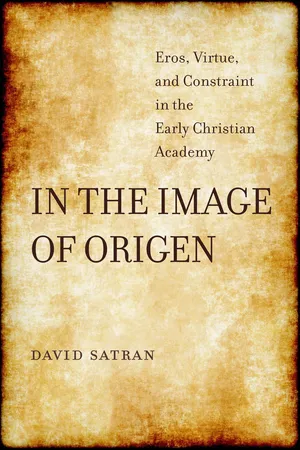
In the Image of Origen
Eros, Virtue, and Constraint in the Early Christian Academy
- 248 pages
- English
- ePUB (mobile friendly)
- Available on iOS & Android
eBook - ePub
About this book
The most prominent Christian theologian and exegete of the third century, Origen was also an influential teacher. In the famed Thanksgiving Address, one of his students—traditionally thought to be Gregory Thaumaturgus, later bishop of Cappadocia—delivered an emotionally charged account of his tutelage under Origen in Roman Palestine. Although it is one of the few personal narratives by a Christian author to have survived from the period, the Address is more often cited than read closely. But as David Satran demonstrates, this short work has much to teach us today. At its center stands the question of moral formation, anchored by the image of Origen himself, and Satran’s careful analysis of the text sheds new light on higher education in the early church as well as the intimate relationship between master and disciple.
Information
ONE
Providence, Eros, and Constraint
Tu m’hai di servo tratto a libertate
per tutte quelle vie, per tutt’ i modi
che di ciò fare avei la potestate.
You drew me out from slavery to freedom,
by all those paths, by all those means,
that were within your power.1
The opening pages of the Address are so highly stylized, so unmistakably the product of an author trained in the mechanics of the Greco-Roman rhetorical tradition, that the reader might despair of any possible encounter with the living relationship between teacher and student. This conclusion would be natural and yet mistaken. Gregory’s text, while deeply inflected by the training he had received and so successfully assimilated, is at the same time one of our very rare, documented points of entry to the intimacy of ancient educational practice. Nowhere is this more tangible or poignant than in his evocation of the earliest stages of the relationship with Origen: the unpredictable path that led him from his home in northern Asia Minor to the coast of Palestine, the unlikely nature of their initial encounters, the unforeseen emotional depth of Gregory’s attachment. Indeed, there is an opportunity to turn what might be perceived as a textual cul-de-sac, the highly rhetorical framing of his initial encounter with Origen, into a privileged means of access. Behind Gregory’s language, traditional and formulaic in its basic features, lies invaluable testimony to intimacy and its cultural expression.
PROVIDENCE
Having weighed the constraints of silence (1.1–2.20) against the offense of ingratitude (3.21–30), Gregory reluctantly embarks on his “thanksgiving address” (logos charistērios [3.31]), and from the outset issues of agency and freedom come to the fore. Deeply conscious of the need to offer hymns and praises of gratitude toward the Deity, yet overwhelmed by the concomitant impossibility of doing so in a fitting manner, Gregory describes God as the “leader and cause of all things” (3.32). Turning to a more accessible and appropriate object of thanksgiving, the Savior and the “first-begotten Word,” Gregory assigns the corresponding title of “creator and pilot of all things” (4.35). These functions and concomitant titles would appear to be neither accidentally nor loosely attributed; rather they have been chosen to emphasize the guidance and control that the Deity, in its different aspects, exercises over both the natural world and human affairs.2
Descending the scale of divine hierarchy, Gregory ultimately focuses on his very own angelic escort. Here, the theme of divine oversight is both strengthened and personalized: “appointed by some great judgment to manage and to raise and to guide me from childhood” (4.40), this guardian figure served as Gregory’s own “personal pedagogue” (4.43). In a proleptic summary of the circumstances that were to bring him ultimately to Caesarea Maritima and to Origen, Gregory acknowledges the unfailing intervention of this angelic guide:
Aside from his being good in every respect altogether, he was my tutor and guardian. . . . Both then and still today he rears and trains and leads [me] by the hand; and above all else he arranged to introduce me to this man [Origen]. . . . With truly divine and wise foresight he [the angelic guide] brought us together and contrived this meeting as my salvation. I can only suppose that he foresaw this earlier, from my first birth and upbringing. (4.44–46)
Gregory’s experience is, of course, deeply rooted in a broader cultural ambience: the acute sense of the presence of an invisible guide, the confidence in an unseen but no less real companion, were staples of widely variant forms of late ancient spirituality.3 Gregory’s angel is repeatedly described in terms drawn from the realm of training and education: “personal pedagogue,” “nourisher and protector,” “divine pedagogue and true guardian,” “good guide and protector.”
No less significant, however, is the emphasis on the elements of “foresight” and “management” (oikonomia), which lend a providential atmosphere to the passage. This theme represents in many respects the infrastructure of the entire opening movement of Gregory’s narrative. As his personal story unfolds (5.48–72), relating the unlikely chain of events that brought him into the sphere of Origen in Caesarea, Gregory also deepens his reflection on the guiding hand of divine providence. This alone could make sense of the series of personal circumstances that were to lead him from birth and childhood in a distant land plagued by “misguided ancestral customs” (5.48) to an unforeseen and unintended destination, bathed in the light of the “true sun” (6.73). Following a prolonged description (5.50–54) of his youthful awakening to the power of reason (logos), human and divine—which scholars continue to find perplexingly ambiguous4—Gregory offers a very few, but enticing details of his early education. Following the elementary stages of study, and through the concerns and efforts of his mother, he had been sent to study rhetoric in order that eventually he might too acquire that profession. In this manner, the chain of events had been set in progress. At this stage, Gregory’s “divine pedagogue and true protector, ever wakeful” (5.57), takes matters under control: the rhetorician (and teacher of the Latin language) to whom Gregory has been entrusted suddenly finds himself moved, “by a more divine inspiration” (5.61), to employ his estimable powers of persuasion in order to encourage his charge to study Roman law (5.58–61). In this manner, Gregory’s teacher too had become an unwitting agent of the divine plan concerning the student’s ultimate destination.
A tone of forcefulness and purpose pulses throughout this account of divinely inspired progression from rhetoric to the study of Roman law: “When I became a student of these very laws, whether of my own will or not, somehow bonds already had been forged” (5.62). While the ultimate consequence couldn’t have been appreciated by Gregory or those around him, the geographical effect was immediate: transfer to the city of Berytus, present-day Beirut, on the eastern coast of the Mediterranean—“most Roman in character and with a highly regarded school for the study of the law.”5 This was quickly to prove a further and essential component of the divine scheme. For only several years earlier (233/4?) a very differently motivated journey had transpired further south along the Mediterranean coast: under circumstances not completely transparent to the modern historian, though certainly far from irenic, Origen had departed his native city of Alexandria in order to take up duties as teacher and presbyter in the city of Caesarea on the coast of Roman Palestine.6 While these relocations, to Berytus and Caesarea respectively, had closed the distance between the unknowing student and his divinely appointed teacher, the two men would have remained, nevertheless, at a significant remove from each other. One further strategem was required, or in Gregory’s words, “How then was this too contrived?” (5.65).
If concern regarding Gregory’s education and professional career, on the one hand, and the bitter ecclesiastical strife surrounding Origen over questions of episcopal authority, on the other, had sufficed to this point, providence now had set the wheels of the imperial administration in motion: the governor of Roman Palestine abruptly summoned Gregory’s brother-in-law, an expert in legal affairs himself, to report to his service in Caesarea. As soon as he had settled there, he sent for his wife, Gregory’s sister, and the military consort who escorted her to the administrative capital in order to rejoin her husband also served as a traveling companion for her brother (5.65–67). To the vicarious agencies of Gregory’s legal career and the ecclesiastical politics of Alexandria had been added the designs of the Roman governor of Palestine. (Historians might have wished that Gregory had been just a bit more generous at this stage of his narrative in sharing the names of the actors involved and a few other precious details—yet here too, as previously observed, we encounter a characteristic reticence, ordained perhaps by the restraints of the literary genre or by the influence of the man who was to become Gregory’s spiritual master.)
However unknowing Gregory may have been at the time, none of this occurred accidentally or by chance; indeed, the purposiveness of all these events and the necessity of all those involved would become starkly apparent in retrospect: “Everything, then, was moving us: good will toward our sister, our studies, and even the soldier, since he too should be mentioned” (5.69). And while the actual events may have been “manifest,” the underlying mechanism and its salvific implications remained “hidden” (5.70) to Gregory. Ultimately, however, Gregory was to recognize both the higher purpose and the true agent behind this remarkable concatenation of decisions and determinations:
It was not the soldier, then, but some divine fellow-traveler, a good guide and guardian. . . . He was the maker and mover of all things until by every contrivance he would bind [us] with this cause of so many good things for us. . . . And when, having come through so much, he entrusted the management to this man, the divine messenger perhaps rested here as well, not from weariness or fatigue, for the race of divine servants is untiring, but because he had entrusted [this] to a person who would satisfy as far as possible all providence and care. (5.71–72)
“This man,” the unnamed Origen, is more than simply the destination to which the angelic consort safely had delivered his charge—he was to become the next (and final) stage of stewardship. The “divine fellow-traveler” and “good guide and guardian” now transferred to “this man” the very management (oikonomia) with which he had been charged, entrusting him with the providence (pronoia) and care (epimeleia) for his charge. Gregory had, at long last and by means of every possible divine mechanism, been united with Origen. For Gregory, the outcome was to be as beneficent as it had been unforeseen and yet inevitable: “truly the first, the most precious of all days for me, if it need be said, when the true sun first began to rise on me” (6.73)—the beginning of his new life.
Within this extended narrative of angelic guidance and providential care, questions arise concerning the element of choice and Gregory’s own measure of freedom: his expressions of unlimited gratitude to the Deity and his attendant angel have necessary implications for our understanding of the degree of autonomy exercised by the human agent himself. Gregory’s account heightens this concern through the use of decidedly determinative language: the protective spirit “rears and trains and leads [me] by the hand” (4.44); his own acts followed “more under constraint than willingly” (5.50); the decision to study in Berytus was truly “willing and unwilling” (hekōn kai akōn) and the result of “bonds [that] had already been forged” (5.62); by means of the closely coordinated train of events “everything was moving us” (5.69), though we remained “blind and unknowing” (5.70); finally, under the guidance of that angelic consort who had been the “the maker and mover of all things” (5.71), Gregory was “entrusted” (5.72) to Origen.
We might well expect the preeminent motif of divine providence to recede, once Gregory has arrived in Caesarea and entered the gravitational field of Origen. (Having heard him preach? Actively recruited by another student or, perhaps, by Origen himself? Once again, our composition is frustratingly taciturn.) And so it does, as Origen takes center stage, and the presence of both divine and angelic actors is reduced and modulated in the central portion of Gregory’s text. Yet the closely attendant concern over the limitations of human agency and the underlying question of Gregory’s exercise of free will had not been resolved by his arrival in Caesarea and entrance into the circle of Origen. Quite the opposite, in fact: it could be argued that it was there, under the influence and tutelage of Origen, that Gregory was to experience the most acute and significant curtailment of his freedom. To appreciate this is to enter into the very special nature of the relationship between the student and his master.
PRESENCE
The initial encounter with Origen—the first real day of Gregory’s life—was far from idyllic. Though retrospectively enshrined as “the most precious of all days . . . when the true sun first began to rise,” Gregory records the beginning of the relationship as both emotionally charged and filled with misgiving. Indeed, his tersely vivid description of those early days with Origen suggest extreme uneasiness: “At first, like wild animals or fish or birds that have fallen into the nets of hunters or fishermen, we attempted to slip away and to escape, desiring to withdraw from him either to Berytus or to our fatherland” (6.73). While this may have been the aftereffect of the long journey to Palestine or simply the shock of ...
Table of contents
- Imprint
- Subvention
- Title
- Copyright
- Dedication
- Contents
- Acknowledgments
- Introduction
- 1. Providence, Eros, and Constraint
- 2. Dialectic and the Training of the Mind
- 3. Moral Formation and the Path to Scripture
- 4. Paradise and the Cave
- 5. Paideia, Loss, and Prospect
- Notes
- Bibliography
- Index
Trusted by 375,005 students
Access to over 1.5 million titles for a fair monthly price.
Study more efficiently using our study tools.
Frequently asked questions
Yes, you can cancel anytime from the Subscription tab in your account settings on the Perlego website. Your subscription will stay active until the end of your current billing period. Learn how to cancel your subscription
No, books cannot be downloaded as external files, such as PDFs, for use outside of Perlego. However, you can download books within the Perlego app for offline reading on mobile or tablet. Learn how to download books offline
Perlego offers two plans: Essential and Complete
- Essential is ideal for learners and professionals who enjoy exploring a wide range of subjects. Access the Essential Library with 800,000+ trusted titles and best-sellers across business, personal growth, and the humanities. Includes unlimited reading time and Standard Read Aloud voice.
- Complete: Perfect for advanced learners and researchers needing full, unrestricted access. Unlock 1.5M+ books across hundreds of subjects, including academic and specialized titles. The Complete Plan also includes advanced features like Premium Read Aloud and Research Assistant.
We are an online textbook subscription service, where you can get access to an entire online library for less than the price of a single book per month. With over 1.5 million books across 990+ topics, we’ve got you covered! Learn about our mission
Look out for the read-aloud symbol on your next book to see if you can listen to it. The read-aloud tool reads text aloud for you, highlighting the text as it is being read. You can pause it, speed it up and slow it down. Learn more about Read Aloud
Yes! You can use the Perlego app on both iOS and Android devices to read anytime, anywhere — even offline. Perfect for commutes or when you’re on the go.
Please note we cannot support devices running on iOS 13 and Android 7 or earlier. Learn more about using the app
Please note we cannot support devices running on iOS 13 and Android 7 or earlier. Learn more about using the app
Yes, you can access In the Image of Origen by David Satran in PDF and/or ePUB format, as well as other popular books in Theology & Religion & Philosophers. We have over 1.5 million books available in our catalogue for you to explore.