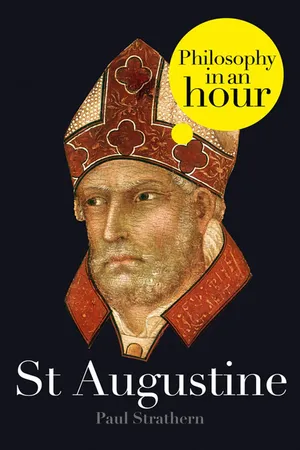
St Augustine: Philosophy in an Hour
eBook - ePub

St Augustine: Philosophy in an Hour

  1. English
  2. ePUB (mobile friendly)
  3. Available on iOS & Android
eBook - ePub

St Augustine: Philosophy in an Hour

About this book

Philosophy for busy people. Read a succinct account of the philosophy of St Augustine in just one hour.

Frequently asked questions

Yes, you can cancel anytime from the Subscription tab in your account settings on the Perlego website. Your subscription will stay active until the end of your current billing period. Learn how to cancel your subscription.
No, books cannot be downloaded as external files, such as PDFs, for use outside of Perlego. However, you can download books within the Perlego app for offline reading on mobile or tablet. Learn more here.
Perlego offers two plans: Essential and Complete
  • Essential is ideal for learners and professionals who enjoy exploring a wide range of subjects. Access the Essential Library with 800,000+ trusted titles and best-sellers across business, personal growth, and the humanities. Includes unlimited reading time and Standard Read Aloud voice.
  • Complete: Perfect for advanced learners and researchers needing full, unrestricted access. Unlock 1.4M+ books across hundreds of subjects, including academic and specialized titles. The Complete Plan also includes advanced features like Premium Read Aloud and Research Assistant.
Both plans are available with monthly, semester, or annual billing cycles.
We are an online textbook subscription service, where you can get access to an entire online library for less than the price of a single book per month. With over 1 million books across 1000+ topics, we’ve got you covered! Learn more here.
Look out for the read-aloud symbol on your next book to see if you can listen to it. The read-aloud tool reads text aloud for you, highlighting the text as it is being read. You can pause it, speed it up and slow it down. Learn more here.
Yes! You can use the Perlego app on both iOS or Android devices to read anytime, anywhere — even offline. Perfect for commutes or when you’re on the go.
Please note we cannot support devices running on iOS 13 and Android 7 or earlier. Learn more about using the app.
Yes, you can access St Augustine: Philosophy in an Hour by Paul Strathern in PDF and/or ePUB format, as well as other popular books in Philosophy & Philosophy History & Theory. We have over one million books available in our catalogue for you to explore.

Information

Further Information

From St Augustine’s Writings

Give me chastity – but not yet!
– Confessions, Book VIII, Chap. 7
For many, total abstinence is easier than perfect moderation.
– On the Good of Marriage, Chap. 21
Therefore it is true to say that when you had not created anything, time did not exist, because you created time. And there is no time which exists eternally with you, because you never change; for if time never changed, it would not be time.
What, then, is time? There is no quick and easy answer to this, for it is no simple matter to understand what time is, let alone find words to explain it. Yet in our conversation, no word is more familiar to us, or more easily recognised, than the word ‘time’. We definitely understand what this word means, both when we use it ourselves and when we hear it used by others.
What, then, is time? I know perfectly well what it is – so long as no one asks me; but as soon as I am asked what it is and try to explain it, I am nonplussed. However, I can say with confidence that if nothing passed, there would be no past time; if nothing were going to happen, there would be no future time; and if nothing were, there would be no present time.
So with these three divisions of time, how can two of them – the past and the future – be, when the past no longer is, and the future is not yet? As for the present, if it were always present and never moved on to become the past, it would not be time but eternity. Therefore, if the present is time only because of the fact that it moves on to become the past, how can we say that even the present is, when the reason why it is is that it is not to be? In other words, we cannot properly say that time exists, except because of its impending state of nonexistence.
– Confessions, Book XI, Chap. 14
Love the sinner, but hate the sin.
– Letter 211 in Patrologiae Latinae (1845), Vol. 33
So I muddied the stream of friendship with the filth of lewdness and clouded its clear waters with hell’s black river of lust. And yet, despite such putrid depravity, I was vain enough to harbour an ambition to succeed in the world. I also fell in love, which was a trap of my own making. My God, God of mercy, how good you were to me, for you mixed much bitterness in that cup of pleasure. My love was returned, and I became chained in the shackles of its consummation. Even in the midst of my joys I was embroiled in tribulation, lashed by the cruel rods of jealousy, suspicion, fear, anger, and bitter argument.
– Confessions, Book III, Chap. 1
I was attracted to the theatre, because the plays reflected my own sad plight and were sparks which set my feelings ablaze. Why do men enjoy feeling sad at the sight of tragedy and sufferings on stage, although they would be pitifully unhappy if they had to endure such things themselves? Yet they watch plays because they hope to be made sad, and the feeling of sadness is what they enjoy. What pitiful madness this is! The more a man suffers such sorrows himself, the more he is moved by the sight of them on stage. Yet when he suffers himself, we call it misery; when he suffers out of sympathy for others, we call it pity.
– Confessions, Book III, Chap. 2
There was no extreme of heat or cold in paradise, and its inhabitants experienced no desire or fear which might obstruct their goodwill.… A man and his wife maintained a faithful partnership based on love and mutual respect, and faultless observance of the commandment.… When humanity was blessed with such ease and plenty, it would have been possible for the seed of children to be sown unaccompanied by foul lust. The sexual organs would have been stimulated into necessary activity by willpower alone, just as the will controls other organs. Then, without being goaded on by the allurement of passion, the husband could have relaxed upon his wife’s bosom in complete peace of mind and bodily tranquillity… that part of his body not activated by tumultuous passion, but brought into service by the deliberate use of power when the need arose, the seed dispatched into the womb with no loss of his wife’s virginity.… So the two sexes could have come together for impregnation and conception by an act of will, rather than by lustful cravings.
– City of God, Book XIV, Chap. 26

AUGUSTINE: You who wish to know, do you know that you exist?
REASON: I do.
A: How do you know this?
R: I do not know.
A: Do you feel yourself to be simple or complex?
R: I do not know.
A: Do you feel that you are self-moved?
R: I do not know.
A: Do you know that you think?
R: I do.
– Soliloquies, Book II, Chap. I
The certainty that I exist, that I know this, and that I am glad of it, is known independently of any imaginary fantasy or contradiction.
With regard to these truths, I am not afraid of any arguments put forward by the Academics. If they say, ‘What if you are mistaken?’ I reply, ‘Even if I am mistaken, I still exist.’ A nonexistent being cannot be mistaken. Therefore I must exist if I am mistaken. Since my being mistaken proves that I exist, how can I be mistaken when I think that I exist, if my mistake confirms my existence? Therefore I must exist in order to be mistaken, then, even if I am mistaken, there is no denying that I am not mistaken in my knowledge that I exist. Therefore I am also not mistaken in knowing that I know. For in the same way that I know I exist, I also know that I know. And when I am glad about these two facts, I can add with equal certainty the fact of that gladness to the things that I know. For I am not mistaken about the fact of my gladness, because I am not mistaken about the things which I love. Even if these things are illusory, it would still be a fact that I love the illusions.
– City of God, Book XI, Chap. 26
You certainly will not deny there is an immutable truth, containing all things that are immutably true, which you cannot claim is yours or mine or any other man’s. In some wonderful way, an ineffable and universal light is, so to speak, present and made manifest equally to all. But who can say that what is present to all who reason and understand belongs in any real sense to the nature of any individual? For remember what we said just now about the bodily senses. Namely, that what we all perceive with our eyes or our ears, such as colours and sounds, do not belong to our individual eyes or ears, but are there for all. In the same way, you cannot say that those things which we all apprehend, with our own individual minds, are anything to do with these individual minds. For what the eyes of two people see at the same...

Table of contents

  1. Cover
  2. Title Page
  3. Contents
  4. Introduction
  5. St Augustine’s Life and Works
  6. After St Augustine
  7. Further Information
  8. About the Author
  9. Copyright
  10. About the Publisher