![]()
Schopenhauer’s Life and Works
With Schopenhauer we return to planet earth – with a vengeance. As a man, Schopenhauer was a nasty piece of work, but his writings are immensely endearing. Of the great philosophers he was the finest stylist since Plato. His philosophy too is very appealing. It is the first since Socrates to be imbued with the entire personality of the man who propounds it. From Schopenhauer’s writings you gain a very clear picture of what he was like as a person – with one proviso that is worth remembering at all times when reading him: what appears as witty, insightful, and destructive of humbug on the page may often be sarcastic, egotistical, and aggressive when encountered in real life. Offstage, comedians are seldom renowned for their human qualities – and just because witty philosophers are so rare doesn’t make them an exception to this rule. (Socrates is extremely fortunate that we have no testimony from his wife, Xanthippe.)
But Schopenhauer was original in another, more fundamental way. Not for nothing is he known as the ‘philosopher of pessimism’. With most other major philosophers you can’t escape feeling that the writer is on his best behaviour, and you’re expected to be so too. Everything is all very serious and moral. (Even Hume takes philosophy seriously while doing his demolition job.) Schopenhauer, on the other hand, makes it very plain that he regards the world and our life in it as a bad joke. In this he is undeniably closer to describing the actual state of affairs than those who view the world from an optimistic or purposive standpoint. This pessimism was immensely refreshing in its day, after centuries of Christianity and latter-day rationalism. But Schopenhauer was a pessimist only in so far as he claimed that the world is indifferent to our fate – it doesn’t thwart us on purpose.
This was an attitude that had not received full expression since the Stoics, who advocated a mealymouthed withdrawal from the evils of the horrible world. Schopenhauer advocated the same, but he did so in a distinctly combative and worldly manner. And he was far too egotistical to achieve such self-denial in his own life (though in his view he endured an existence of exemplary asceticism). These paradoxes account for much of Schopenhauer’s popularity. They stem from a contradiction that lay deep in his character and remained unresolved throughout his life.
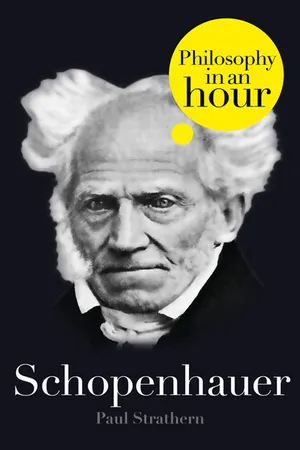
Arthur Schopenhauer was born on February 22, 1788, in the Baltic city of Danzig (now the Polish city of Gdansk), just across the gulf from where his lifelong hero Immanuel Kant was living in Königsberg. Schopenhauer’s father was a merchant from a patrician family, and his mother was a lively woman with an unfulfilled artistic nature. The family was cosmopolitan in outlook – Arthur was given his name because it was also the same in French and English. When the Prussians, who did not share this zenophile outlook, marched into Danzig in 1793, Schopenhauer’s father immediately removed his home and business to the free port of Hamburg. Here the Schopenhauers eventually took up residence in a fine old house in the Altstadt (Old City).
The Schopenhauers’ new home was sufficiently grand to contain a panelled ballroom with a stuccoed ceiling, and in the customary manner it backed onto the large warehouses containing the family business which overlooked the Fleet (canal) for unloading barges. The house was one of many where the wealthy merchants of the city lived and entertained each other in stolid bourgeois fashion. It was not homely in any way, and young Arthur grew up a sophisticated little prig receiving (and eventually requiring) little love.
At the age of ten he was sent away for two years to France to learn French, staying with the family of a business friend of his father’s in Le Havre. Here he became like a brother to the son of the house, Anthime. When he was fifteen Arthur’s parents took him on a two-year grand tour of Europe. In London he was dazzled by Piccadilly and the theatres, but he was then forced to spend several months in ‘Egyptian darkness’ learning English at a school in Wimbledon while his parents toured Scotland. This English private-school education helped make up for all he had missed by not going to a Prussian school – being chased into the pool before breakfast, regular floggings from the masters, English ‘cuisine’, and endless church services. It also helped prepare him for the tourist sights to follow. These included a two-month stay in Bordeaux, in the very house that Hölderlin had fled in a fit of insanity two years earlier, and a visit to Toulon, where six thousand galley slaves were chained up in ‘the dirtiest, most revolting sojourn imaginable’. (Years later Schopenhauer was to draw on this horrific image to describe the misery of humanity fettered to the evil of the will to live.) In Bohemia Schopenhauer climbed Mount Schneekoppe, where his reaction has since been found in the chalet visitors’ book:
‘Who can climb
And remain silent?
Arthur Schopenhauer from Hamburg.’
But on the whole this was an immensely depressing time for young Arthur. Wherever the family travelled in Europe, evidence of the misery caused by the recent Napoleonic Wars was all too plain to see. Maimed beggars lined the streets of the cities, many villages were semiderelict, and still Napoleon’s megalomania remained unsatisfied. The age that had begun with such hopes at the French Revolution had degenerated into a despair felt all over Europe. This was the period that produced the sophisticated insouciance of Byron, the melancholy lyrics of the great Italian poet Leopardi, ‘a thoroughly finished world’ in the words of Goethe, where Beethoven tore the dedication to Napoleon from his Eroica (Heroic) Symphony.
Schopenhauer was deeply aware of such things and wished to play his own part in the world of culture. But this was not to be. His father browbeat him into becoming a businessman. At the end of his grand tour of Europe, Schopenhauer was forced to abandon his education and become apprenticed to a local business in Hamburg. This was a time of deep – and deeply repressed – personal distress for Schopenhauer. (At the same age, a very similar conflict caused the equally tough-minded Hume to suffer a nervous breakdown.)
Then suddenly Schopenhauer’s entire situation changed. In the early hours of April 20, 1805, Schopenhauer’s father climbed to the top of the warehouse at the back of the family mansion and flung himself into the Fleet. The precise nexus of reasons for his suicide remains uncertain. His marriage had become something of a painful charade; the European scene was immensely depressing; and business prospects didn’t look good. Yet perhaps more pertinent was his deep streak of melancholy (which his son was to inherit) and a family history of mental instability (Arthur’s paternal grandmother went insane). But Schopenhauer’s mind does not appear to have been affected by madness – there was to be no saner philosopher than Schopenhauer.
The suicide was hushed up, as such unusually profound decisions in high society often are (presumably in case they prove inspirational). The Schopenhauer business was wound up, leaving the family with a comfortable private income for life; and Arthur’s mother and his younger sister left Hamburg to live a new artistic existence in cultural Weimar. Meanwhile the eighteen-year-old Schopenhauer was left alone in the city, working at a job he didn’t like but felt obliged to continue with. Shortly before his death, Schopenhauer’s father had given him an essay by the poet Matt...